Every night, a woman lights a lamp in a room where no child has ever slept. For twenty years she has asked heaven for one thing, and heaven seems silent. No one imagines what that silence is preparing.
The House With No Voice of a Child
In the hills of Galilee, in the days of King Herod, life smelled of olive trees, of wool, of fresh bread. The roads went down toward Jerusalem loaded with pilgrims, toward the rebuilt Temple, that mountain of golden stone where the smoke of sacrifice rose from dawn. A whole people was waiting for something. They waited for the consolation of Israel, the fulfillment of ancient promises. And in the meantime they measured God's blessing in things they could touch: rain in its season, the harvest, the flock. And, above all, children.
A table full of children was the visible seal of heaven's favor. A womb that stayed empty, instead, was read as a rebuke. It wasn't always said aloud; there was no need. A glance by the well was enough, a silence as someone passed, a question that one day simply stopped being asked. In that world, a childless woman carried a double sorrow: her own, and the one others handed back to her in their eyes.
In one of those villages of cube-shaped stone-and-mud houses lived a couple whom everyone respected. His name was Joachim: a prosperous shepherd and owner of flocks, hands weathered by the sun, known for a custom that astonished his neighbors. Each year he divided his wealth into three parts: one for the Temple, one for the poor, and only the third for his own household. Her name was Anne. She had come to that home as a young bride, brown hair braided beneath the linen veil of newlyweds, spindle in hand and her heart full of simple plans.
The Gospels never wrote down their names. It was the earliest Christian communities who, generations later, refused to let their memory die. An early Christian writing from the second century, the Protoevangelium of James, preserved for us what those communities told of them: their names, their home, their long wait. The Church never counted it among her Scriptures. Even the dates are only approximations that devotion fixed centuries later. What no one had to invent was the waiting itself — any heart that has pleaded for something year after year already knows it.
The first years of marriage were like those of any couple in Galilee: work, Sabbaths of prayer, a house slowly filling with things. It filled with wool and oil, with jars and the laughter of relatives, with lambs in the pen and bread on the table. Everything, except the one thing the two of them asked for. One year passed. Five passed. Twenty passed. And the room Anne had dreamed of for a cradle remained the quietest room in the house.
The people had a name for that grief, and it was not kind. Barren: the word fell on a woman like a verdict, as though the silence of her womb were heaven's punishment. Anne heard it for years on the lips of others, and something inside her could have turned to stone. It did not. She kept the old stories of her people close: Sarah, who laughed in her old age with a son in her arms; Rachel, who waited in tears. If the Lord had opened those closed wombs before, he could open hers too. And she kept asking, night after night, with the lamp burning.
Joachim, for his part, answered the waiting in the way that was most his own: by giving more. His offering at the Temple was doubled — one portion for himself, another for the people — as if generosity could make up for what life withheld from him. No one ever heard him complain. But the years crept into his body: his hair turned gray, then white; his beard filled with winter. And in the village, the looks that had once been pity began to turn into suspicion. If God gave them no children, some murmured, there had to be a reason.
So the two of them grew old, held up by a faith that asked for no deadlines. Anne spun wool by the door, gathering her first gray hairs beneath the veil; Joachim counted his flocks at dusk and walked home by the same road as always. A wait like that seems to have no way out; and yet everything still to come will be born from precisely this sorrow. It remained to be seen how much longer a faith like theirs could hold. The answer came one feast morning, when Joachim prepared his double offering, loaded the lambs, and went up to Jerusalem. That day, the grief the two of them had kept behind closed doors became public. And it burned like a humiliation.
The Offering Turned Away
It was one of the great feast days in Jerusalem. The Temple courts churned with pilgrims: lambs bleating, baskets of doves, the smoke of the altar rising straight in the morning air. Joachim moved through the crowd with his double offering, as he did every year. He knew those steps by heart: he had climbed them as a young man, dark-haired and steady, and he climbed them now white-haired, carrying the lambs of his offering and a hope still whole.
Then a man stepped into his path. His name was Reuben, and his voice rang out loud enough for everyone to hear: "It is not lawful for you to present your offering first, for you have fathered no child in Israel." That was all. A handful of words, spoken before the whole assembly. Joachim stood frozen, the animals still in his hands. No one spoke in his defense. The man who gave the Temple double what others gave. The man who shared his grain with the poor. He stood marked before his people as one whom God had set aside. And that shame burned worse than any blow.
He did not argue. He asked for no explanation. He went down the steps in silence, crossed a crowd that pretended not to look at him, and did not take the road home. What face could he show Anne now? He went instead to the Judean Desert, where his shepherds kept the flocks, and pitched his tent among them, like a man who no longer expects anything from other men.
There he chose to stay forty days and nights, fasting. "Prayer will be my food and my drink," he said. By day the sun bore down on the ochre hills sloping toward the Dead Sea; by night the cold bit under a vast field of stars. An old man alone before his God, with no offering but his hunger. If the Temple would not accept his lambs, he would give the one thing no one could refuse him: his own plea, held up hour after hour on the bare rock.
In Galilee, meanwhile, Anne waited. The days went by and her husband did not return; no one could tell her whether he was alive or dead. To her old grief was added a new one, and she wept twice over: for the child who never came, and for the husband who did not come back. The house, so full of everything, suddenly felt vast and mute.
And one more wound was still to come. A great feast of the Lord was drawing near. Her servant Judith tried to lift her spirits: she offered her a headdress, an ornament fit to appear before God, and urged her to set aside her mourning clothes at last. Anne refused; to dress for a feast with grief still in her heart felt like a lie. Then the girl, stung by her own good intention, struck back where it hurt most: if the Lord had closed her womb, she said, it must be because he meant to punish her. The reproach of a servant echoed inside her own home. That is how far the world's judgment can reach: into the kitchen of a woman who had done nothing wrong. Anne said nothing. She washed her face, put on her feast-day clothes at last, and went down to the garden, at the hour when the light begins to fall.
She sat beneath a laurel tree and lifted her eyes. Among the branches was a nest, and in the nest, chicks chirping beside their mother. It was as though all creation were whispering it to her: everything bears fruit before the Lord. The birds of the air, the beasts of the field, the earth with its harvests. Everything, except her. The weeping rose from deep within her, one long lament, twenty years long. And yet on her lips the grief did not turn to a curse: it turned to prayer. That other Anne of Scripture, the mother of Samuel, wept before the Lord in the sanctuary until she wrung a son out of the silence. So this Anne wept beneath her laurel. Asking. Still asking.
That evening, two old people prayed the same plea in two separate deserts: he among the rocks of Judea, she in a garden that grief had turned into a desert of its own. Neither knew of the other; neither received an answer. All Israel was waiting then for the Messiah, the Christ of God, and no one suspected that this vast waiting and the small waiting of a childless house were about to touch. Was anyone listening to those two voices?
In the depths of those two solitudes, something began to break open. And a light set out, toward the garden and toward the desert, at once.
The Announcement and the Golden Gate
She was still beneath the laurel, her tears not yet dry, when the air of the garden changed. There was no thunder, no wind: only a brightness that did not come from the setting sun, and within it, a figure standing among the trees. A messenger from heaven, who called her by name twice, the way one calls someone in need of comfort: "Anne, Anne, the Lord has heard your plea: you shall conceive and bear a child, and your offspring will be spoken of throughout the world."
Your offspring will be spoken of throughout the world. Twenty years of silence, undone in a single sentence. The Lord had listened; he had not forgotten, he had not punished. He had been listening from the very beginning: every lamp lit in the night, every plea repeated, that evening's weeping beneath the branches. And Anne's answer rose up whole, without calculation, greater still than the promise she had received: "As the Lord my God lives, whatever is born to me, boy or girl, I will offer as a gift to the Lord, to serve him all the days of its life."
Something immense had just been decided, almost without a sound. A woman who had begged for a child for half her life now gives him away before having him. She asks to keep nothing; she sets no conditions. She promises to give back to the Lord what the Lord has not yet given her. In that vow, spoken kneeling in a garden, everything to come is already decided: the waiting has become an offering, and there is no turning back.
Many days' journey away, among the ochre hills of Judea, that same light found Joachim. He was worn thin by the fast, his skin drawn tight over his bones, the plea still on his lips, when the messenger came down to him as well: the Lord had heard his prayer; his wife would conceive; he was to rise and return home. And to Anne, too, a messenger came, telling her to go out and wait for him at the city gate.
The old man gathered his flocks and set out for home, his step lighter than it had been in years. She, hearing the news, set out as well. And by the great eastern gate of Jerusalem's wall — the one Christian memory would later call the Golden Gate, facing the Mount of Olives — Anne saw him coming from far off, among shepherds and animals, still small against the dust of the road.
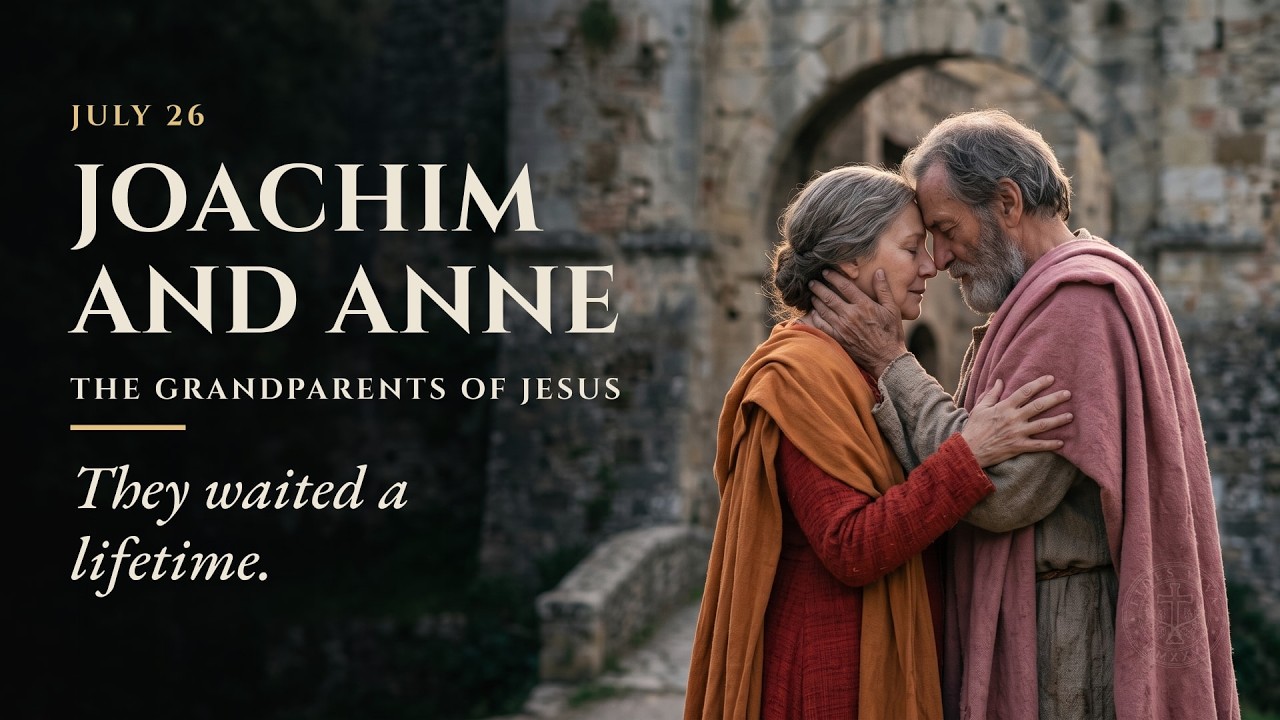
She ran. A woman past forty, running down the road to Jerusalem with her mantle streaming behind her, careless of who might see. And he quickened his pace when he recognized her. They met beneath the stone arch, and Anne threw her arms around his neck like a young girl: "Now I know the Lord has blessed me." Two old people locked in an embrace at the city gate, weeping for joy before the travelers passing by. All the shame of the Temple, all the years of reproach, dissolving in that one embrace.
Over the centuries, Christian devotion saw in that embrace more than a reunion: the very beginning of the promised daughter, conceived in the faithful love of two elderly spouses. This is a devotional reading, a way of contemplating the mystery. It differs from the dogma of the Immaculate Conception, defined by the Church much later, which speaks not of the parents' embrace but of the daughter's soul, preserved from all sin from her first instant. Here, at the gate, what the eyes see is enough: two people who waited together, and to whom hope was given back in each other's face.
No one in Jerusalem paid much attention to those two old people embracing. And yet, hidden in that threshold, the history of salvation was beginning: the Christ Israel had awaited for centuries was, without anyone knowing it, beginning to have a family. Heaven was preparing his coming not with armies or signs in the clouds, but with the worn, faithful love of an elderly marriage.
The promise had changed everything; but no one had yet been born. And Anne walked home carrying, alongside her joy, the sweet and terrible weight of her vow: she had promised to give back what she did not yet have. Receive first. Let go after. That was how the faith of this house would be measured, to the very end.
The Purest Fruit
The following months passed the way spring follows a long winter: quietly, changing everything. And then the day came. In the house where no infant's cry had sounded for twenty years, a baby girl broke into her first cry. Anne asked what she had given birth to, and when they told her it was a daughter, her gratitude poured out in praise. As Hannah of old had once sung on receiving her son Samuel, this aging woman of Galilee sang now to the God who lifts the lowly from the dust. She named her Mary.
The fruit so long asked for now slept in arms creased by age. And from the first day, those aging parents treated her for what she was: a gift on loan. The early Christians told how Anne turned the child's room into a small sanctuary, where nothing unclean was allowed to enter. When Mary took her first steps, her mother lifted her up so her feet would not touch unholy ground, all the way until the day the vow was kept. That is how that ancient memory chose to say something very deep: in that house, the ordinary had become sacred. Before the child ever knew the Temple, her home was already a temple.
When the little girl turned one, Joachim prepared a great banquet and invited the priests and neighbors, the very same who had once measured his disgrace. Now they blessed the daughter of the couple they had called barren. The man once turned away from the altar now presided at the table; the woman from beneath the laurel served the bread, laughing.
Where was that house? Christian memory never fully agreed. One cherished tradition places it in Jerusalem, beside the pool of Bethesda, where centuries later a basilica would rise over the cave venerated as Mary's cradle. Others carry it to Galilee, to Nazareth or to Sepphoris. There is no need to settle it. What all of them say with one voice is what matters: there was a faithful home. In its cradle slept, though no one yet knew it, the future Mother of Jesus Christ.
The gift awaited for half a lifetime was, at last, in their arms. But over that joy weighed a promise given, sweet and immense. Three years passed. And the day came to keep it.
The Stairway
They went up to Jerusalem on a clear morning. Joachim walked ahead, his stride slowed by the weight of his years. Anne held Mary by the hand — the girl was three now, and she did not know, or perhaps in her own quiet way she already did, that this journey had no return. So that the child would not turn her heart back, the parents had called on the young daughters of the neighborhood, and each of them carried a lamp already lit. That is how the old memory kept it: a procession of small flames climbing toward the Temple, and at its center, the little girl, her eyes fixed on the light.
At the top of the stairway waited the high priest, vested according to the rite of the Second Temple. He wore the tunic, the ephod — the priestly sash — and the breastplate set with the twelve stones of the twelve tribes. Tradition names him Zechariah. He took the child in his arms, kissed her, and blessed her with these words: "The Lord has magnified your name through all generations." No one standing on that esplanade could measure the weight of such a blessing: the small girl before them would one day be the mother of Jesus Christ.
Then they left her on the first step. And Mary climbed alone.
Step by step, on legs only three years old, with no one there to carry her. At the top, she did not look back. Not once. That detail, so small and yet so immense, is the one Christian memory never let itself forget: the child did not look back, and her parents did not call out to her.
There was the price of the vow. Twenty years spent pleading for a daughter, and now their hands were empty again — but empty in a different way this time: not through punishment, but through offering. The two elders went down the very same steps, slowly, astonished that God had accepted something so great from their hands. They were grateful simply to have had something so great to give. They had given back the gift they had received. That was all. That was all heaven had ever asked of them, and they had carried it out in full.
With that farewell on the stairway, what we know of their life beside Mary comes to a close. But the story of these two elders does not end there: they had prepared the Redemption without ever living to see it. Their name, left unspoken by the Gospels, began its quiet journey through the centuries that followed.
The Name That Was Never Lost
Little trace remains of their final years. Joachim died first, the story goes — old and at peace, in the house that had known both the waiting and the joy. Anne followed him some time later, without living to see what her daughter would bring into the world. The Churches of the East keep for her a feast with a beautiful name, the Dormition of Saint Anne, every July 25: not a death, but a falling asleep. Neither of them ever rocked the Child of Nazareth in their arms. They sowed in darkness, and in darkness they departed, trusting the fruit would flower without them.
And yet that name did not fade. The first Christians kept telling the story of Mary's parents, house to house, community to community. Around the year 150, someone set it down in writing: the Protoevangelium of James. The Church examined it and never received it as Scripture; she left it outside the Gospels. But she embraced its substance, recognizing in it something true: the love of the faithful for the origins of the Mother of the Lord. From that substance were born feasts, hymns, and works of art.
The devotion grew the way rivers grow. By the sixth century, Constantinople already had a church dedicated to Saint Anne. Around 1138, the Crusaders built in Jerusalem, beside the pool of Bethesda, a basilica of pale stone over the grotto pilgrims venerated as Mary's birthplace. People still pray in its crypt today. And in the eighth century, Saint John Damascene cried out before the faithful words the Church still reads every July 26: "O blessed couple, Joachim and Anne! All creation is indebted to you, for through you creation offered the Creator its most excellent gift: that most exalted mother, the only one worthy of the Creator."
Afterward, the name crossed into Europe. In Provence, the town of Apt has kept since the Middle Ages relics venerated as Saint Anne's; another reached Chartres in 1204, brought from Constantinople, and is honored there still, among its blue stained glass. In Brittany, the accounts of the shrine tell how, in 1623, the saint appeared to a farmer named Yves Nicolazic. From an ancient image found buried in the earth was born Sainte-Anne-d'Auray, the heart of Breton faith. And in 1658, on the far side of the ocean, settlers raised beside the Saint Lawrence River, in Quebec, the first chapel of Sainte-Anne-de-Beaupré. Today it is an immense basilica. Crutches and canes hang from its columns, left by pilgrims like Louis Guimont, a laborer cured of a back pain while raising the sanctuary's first stones — grateful to walk home again through the grandmother of Jesus Christ's intercession.
Rome, too, made that love her own. In 1382, Pope Urban VI extended the feast of Saint Anne; in 1584, Gregory XIII made it universal, while Joachim was celebrated separately, on a different date. It took until 1969 for the Church to do the simplest and most fitting thing: join the two spouses in a single memorial, on July 26. The East has celebrated them together for centuries, under a title that says everything: the holy and righteous ancestors of God.
From a house left unnamed in the Gospels, to shrines on three continents. And that thread of faith reaches all the way to one particular Sunday in our own time, carrying a new name for an ancient story: the grandparents of Jesus.
The Grandparents of Jesus, Today
In 2021, Pope Francis wanted to give the whole Church a date to look toward its elders. He instituted the World Day for Grandparents and the Elderly, setting it on the fourth Sunday of July, alongside the feast of Joachim and Anne. It was no accident: if Jesus had grandparents, the Church has grandparents. And those who today have gray hair and teach a grandchild their first prayers have had, ever since, patrons with faces of their own.
In 2026, the calendar did the rest. The sixth World Day falls exactly on Sunday, July 26 — the very day the liturgy honors Saints Joachim and Anne. The grandparents of the world and the grandparents of Jesus share, that day, a single feast. For that World Day, Pope Leo XIV chose a theme drawn from the prophet Isaiah: "I will never forget you." And in his message he asked for something very concrete: to restore the custom of visiting the elderly, to celebrate a Mass for them in every cathedral, and to tell the elderly not to fear their frailty.
I will never forget you. It is hard to find three words that better sum up what those two spouses from Galilee lived through. God did not forget the barren woman when everyone had given up on her; he did not forget the old man turned away from the altar. And he does not forget, today, the grandmother who eats alone, or the man who no longer remembers names but still remembers a prayer.
Because the calling of Joachim and Anne did not end with them. It continues, quietly, in every home where a grandparent joins a grandchild's small hands together and teaches them to say the name of Jesus. That scene — so small that almost no one notices it — is the very same one from two thousand years ago: one generation handing the faith to the next, the way bread is passed on.
The echo of that house in Galilee still sounds, every time someone older blesses someone small. And whoever hears that echo carries within a final question — the one that long wait once lit, now returning to the heart of each one.
What Is Born in Silence
What does one do with a prayer that, for twenty years, seems to fall into silence? Joachim and Anne did not answer it with words. They answered with their lives: they kept praying. They kept climbing to the Temple, lighting the lamp, setting the table for two. And when the answer came — late, and in a way neither of them could have imagined — it turned out that silence had never been empty. It was a cradle. Inside it, unseen by anyone, God was preparing the mother of his Son.
No one remembers a single word spoken by Joachim and Anne. Not a saying, not a letter, not a famous gesture. We remember their fruit: and their fruit was the Mother of God; and the fruit of their fruit, Jesus Christ. They waited without seeing, they gave without holding back, and their quiet house turned out to be the threshold through which salvation entered the world.
We too carry prayers like theirs. The one repeated for years for a child who never comes; for health that never returns; for someone who drifted away and no longer calls. The one whispered while switching off the kitchen light, not knowing if anyone hears on the other side.
A stone house in Galilee has held, for two thousand years, that none of those prayers falls into emptiness. That God's silence can be a hidden workshop. That the greatest thing in history was born in the quietest house.
The question raised by that long wait has not grown old. They gave their answer. Ours — what we wait for after all these years, and how we wait for it — remains ours, tonight, in silence.
Saints Joachim and Anne, custodians of the promise, grandparents of the Redeemer, patrons of grandparents and the elderly, pray for us.