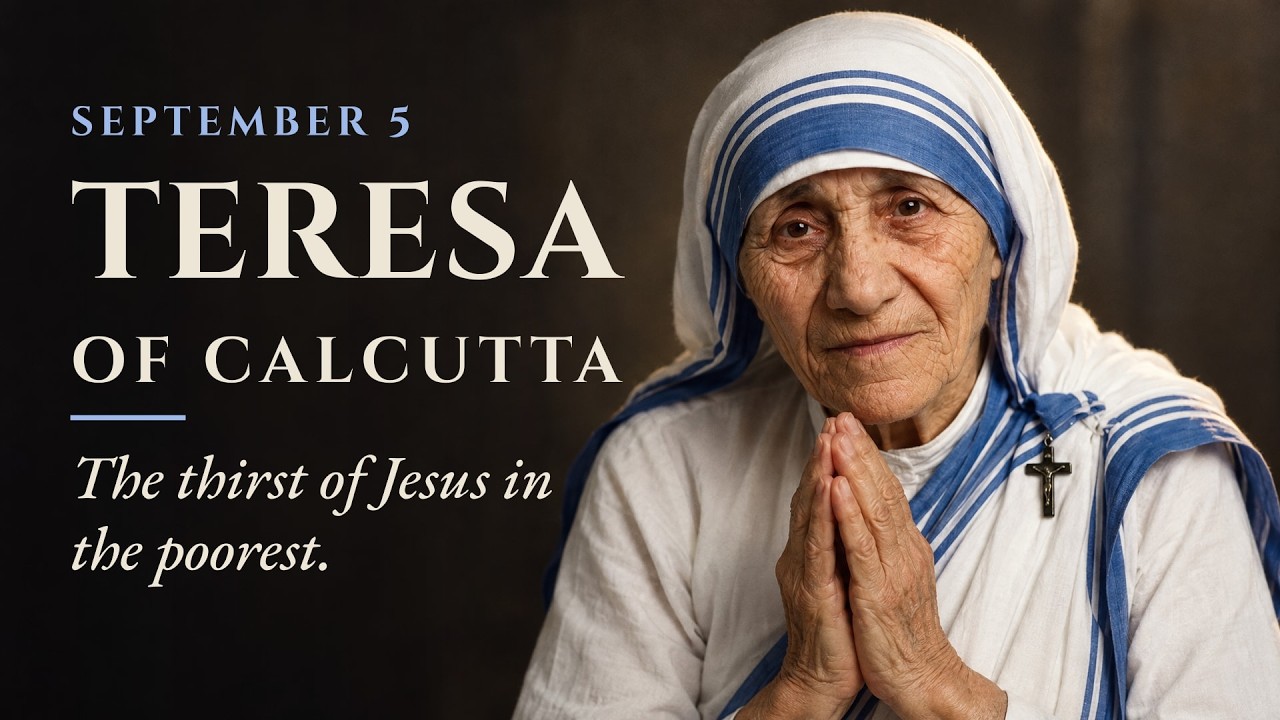
It is early, and the street still smells of charcoal smoke. A tiny woman, bent with age, kneels beside a man who is dying. She lifts his head with both hands, slowly, as if holding something of great value. She wipes his face. She speaks to him softly, in a language she learned far from home.
Inside, she feels nothing.
For years she has prayed and the heavens have been silent. For years she has smiled before the cameras of the entire world, and at night she confesses in letters a void she tells no one else about. She even asked that those letters be burned.
Because the world already calls her a saint. Journalists cross oceans to photograph her. Presidents and kings want to shake her hand. And she remains here, on a sidewalk in Calcutta, holding a dying man who can give her nothing in return.
Nearly fifty years like this. Thousands of photographs smiling. Inside, the night.
The young women in white saris who follow her everywhere call her simply, Mother.
How does one keep giving everything when there is nothing left inside? She never explained it in words. She answered it this way: kneeling down, every morning, again.
Roots at an Open Table
In a city of minarets and red tile roofs, along the banks of the Vardar River, there is a house where there is always one extra plate at the table. It is Üsküb, in the Ottoman Empire; today it is called Skopje, in North Macedonia. There, on August 26, 1910, a girl is born into the home of the Bojaxhiu family, an Albanian and Catholic household. The next day they carry her to the parish of the Sacred Heart of Jesus and baptize her with two names: Anjezë Gonxhe. Gonxhe, in Albanian, means flower bud. Many years later, she would say that her true birthday was that second day: the day water touched her forehead.
Her father's name is Nikola: a merchant, a traveler, a man of several languages and a city councilman. His business prospers and his house is among the happiest in the neighborhood, with music, guests, and long meals. Her mother's name is Dranafile—Drana—and she governs the kitchen by a rule that is written nowhere: at that table also sit the neighbors who have nothing to eat. Elderly people, alone. The sick. A widow and her children. Drana visits an old woman whom her own family has abandoned, and she brings the children with her, so they will see. Charity, in that house, is not preached: it is served hot, and learned by watching.
Little Gonxhe grows up in that world: she sings in the parish choir, plays the mandolin, asks about the guests at the table. She is joyful, fragile in health, and observant. She is about eight years old when everything breaks. Around 1919, Nikola dies suddenly, in the prime of his life. What the family always said, in a low voice, is that he was poisoned: he was a man committed to the cause of his Albanian people, and those were dangerous years to take such a stand. The business is lost. The happy house fills with silence, and Drana ties the black headscarf of widows under her chin.
A widow with three children, in a city where being Albanian and Catholic means being twice a minority. Drana could have closed the door and guarded what little remained. She does the opposite. She opens a workshop for embroidery and textiles, works until late, keeps the house standing with her own hands. And the table—this is what the girl will never forget—stays open. With fewer plates, with smaller portions, but open.
What can be born from a wound like that, in a house where charity is learned before you know what to call it? The years pass. The girl becomes a young woman, and in the parish of the Sacred Heart they begin to read aloud some letters that arrive from very far away. They are written by priests who serve in Bengal, on the other side of the world, among peoples she cannot imagine. The young woman listens with a different kind of attention. Something inside has begun to look toward the east.
The First Renunciation
In that same parish there was a congregation of young women devoted to the Virgin, guided by a Croatian Jesuit, Father Franjo Jambreković. They prayed there, they studied, they spoke of those who served Jesus Christ in distant lands. And there, among mission bulletins and afternoons of prayer, the young woman began to ask herself a question that would not let her go. She herself, many years later, would remember it with this precision: the certainty came to her around age twelve, and by eighteen there was no longer room for doubt. She wanted to be a missionary. She wanted to go to India, to Bengal, where those priests whose letters were read aloud were serving.
Deciding is one thing. Paying for it is another. Going with the Sisters of Loreto, the religious women who worked in Bengal, meant traveling first to Ireland, learning English, and not coming back. There were no vacations for a missionary in those years. Leaving that house meant leaving forever.
On September 25, 1928, at the railway station in Skopje, a mother and daughter embrace on the platform. Drana, the widow who never closed her table, lets go of the daughter she had formed at that table. Both of them know what that train means. The young woman climbs aboard, the carriage pulls away, and the figure in the black headscarf grows smaller and smaller, until it disappears. They never saw each other again. Years later, the borders of an Albania sealed off from the world would stand between them until the end.
The journey carried her through Zagreb to Rathfarnham, near Dublin: a gray stone house among green meadows and fine rain, the house of the Sisters of Loreto. Everything was new and everything was foreign. The language, the climate, the food, the silence of the polished corridors. The young Albanian woman studied English word by word, with the same stubborn will with which her mother had kept the workshop running. And upon entering religious life she chose a new name: Teresa, spelled in the Spanish way, so as not to be confused with another sister who already bore it. She took it from Saint Thérèse of Lisieux, that French Carmelite who never left her convent and is, nonetheless, patroness of the missions. The one who taught that what is small, done with love, reaches far.
A few weeks later, another ship. On January 6, 1929, she disembarked in India. Calcutta received her first: the humid heat, the noise of the port, the colors, the crowd like a river. From there she climbed to Darjeeling, at the foot of the Himalayas, among terraced tea plantations and mist that opens, on some early mornings, onto the white mass of the mountains. In that high mountain silence she made her novitiate. In 1931 she pronounced her first vows, kneeling before the altar; in 1937, the perpetual vows, the ones that cannot be returned. And according to the custom of Loreto, from then on they called her differently: Mother Teresa.
Her assignment was a classroom. In the walled grounds of Entally, a neighborhood of Calcutta, the Sisters of Loreto had Saint Mary's School, and there the young religious taught geography and history to Bengali and Anglo-Indian girls. She did it well, and she did it with joy: nearly twenty years among blackboards, notebooks, and bells, until she came to direct the school. She wrote in those years that she was the happiest woman in the world, the spouse of Christ, teacher to her girls. Life, in her thirties, seemed settled.
But the grounds of Entally had a wall. And on the other side of the wall was another world: shacks, mud, children who went to no school at all. From a window of the school one could glimpse it. The teacher looked, on some afternoons, toward that side. She did not yet know that world had her name waiting.
The Call Within the Call
On August 16, 1946, the world on the other side of the wall broke into the life of the school in blood. Calcutta had been accumulating wounds for years: the world war, and the famine that in 1943 had strewn the ditches of Bengal with the dead. And a tension growing ever sharper between Hindus and Muslims, as the partition of the country drew near. That day the tension became massacre. For hours, armed bands moved through the neighborhoods with knife and fire; the dead were counted in thousands. Shops closed, markets stood empty, and within the grounds of Entally the students were locked in, with nothing left to feed them.
The principal then did what she would do for the rest of her life: the practical thing. She went out alone into the street, in her black habit, to find rice for her girls. She crossed empty streets and streets with bodies, found food, and came back with it. From that day she left no speeches; she left behind the gesture. In the face of horror she could not remedy, she remedied the hunger she could.
A few weeks later she was exhausted. The cough would not leave her, and the weariness of those years weighed more than ever. Her superiors sent her to rest and to make her annual spiritual exercises in Darjeeling, the mountain station where she had been a novice. On September 10, 1946, as evening fell, she boarded the night train. An ordinary carriage, a sick religious woman beside the window, and the plains of Bengal sinking slowly into darkness.
There, without radiance and without witnesses, the decisive thing occurred. In the prayer of that journey she perceived, with a clarity that would never leave her, what she herself would later call "the call within the call." God was asking for more. He was asking her to leave Loreto — not religious life itself, but its safe form — to go out from the walls, to go and live among the poorest of the poor and serve Christ in them. Not from a distance, not through others: in them, one by one. It was the most bewildering request imaginable: to leave a real happiness not for something better, but for something poorer. She knew it was an order and she knew from whom it came; and that she could not refuse without failing that voice. The Missionaries of Charity still keep that date and call it the Day of Inspiration.
The train arrived in Darjeeling. The exercises ended. The voice did not. During the months that followed, the teacher kept giving her lessons, correcting notebooks, ringing the bell — and within, listening. It was not the voice of fatigue or a fever dream: it came again and again, always with the same request, spoken in the words of Jesus on the cross: "I thirst." Thirst for love, thirst for those whom no one loved. And alongside that thirst, a call that asked her to set out: "Come be my light." Bring the light of Christ to the darkest corners of the city, there where no one wanted to enter.
She kept nothing to herself. She confided it in writing to her confessor, Father Celeste Van Exem, a prudent and discreet Belgian Jesuit. Through him the matter reached the man who had to examine that request before anyone else: the Archbishop of Calcutta, Ferdinand Périer. In 1947 she described to him in a letter three inner visions: a multitude of poor — children, the sick, the dying — who called to her; the Virgin in their midst; and Christ on the cross. Three images and one direction only: downward, toward the least.
The Archbishop was a cautious and methodical man. Before him stood a religious woman of exemplary life, with nearly twenty years of unblemished service, beloved by her students. And that woman was asking his permission to leave everything and go live alone in the most wretched neighborhoods of a city in the midst of the agony of independence and partition. Any prudence seemed insufficient. Périer did not say no. He said something harder: wait. Two years of trial and silence. Without speaking of the matter to anyone, without writing to Rome, without taking a single step. If this came from God, it would withstand the waiting.
And she waited. It is easy to admire boldness; it is hard to measure waiting. Each morning, the bell, the blackboard, the girls in uniform; each night, the certainty burning within and the command to be silent. Her letters from those months, written from Entally and from Asansol, where she was sent for a time, insist, ask, ask again — but they never disobey once. She had learned in the kitchen of Üsküb that charity is made with what there is; she was learning now that vocation is proven by what is denied. Two years like that weigh like a stone one cannot set down or show to anyone.
Because everything invited her to stay. The school was running well, the community respected her; now past thirty-six she had exactly the life the young woman at the platform in Skopje had set out to find. No one would have blamed her for keeping it. The voice, on the other hand, offered her nothing: no house, no money, no companions, no guarantee whatsoever. Only the thirst of Christ and a nameless multitude waiting in the mud. To stay was reasonable. To obey was to let go of everything won and begin again, halfway through life, with empty hands.
The waiting was completed in full, just as the Archbishop had imposed it, and at the end of the two years the certainty remained untouched: the same order, the same thirst, the same multitude. Then Périer authorized the request to travel to Rome. The answer would take months more to arrive. But when it came, it would bring with it an August day when a black habit, worn for twenty years, would be folded away for good. In its place would wait a cloth of coarse white cotton, the dress of the poorest women of Bengal, with three blue stripes at the edge.
The White Sari: Beginning in Nothing
The answer from Rome came in August of 1948: an indult of exclaustration, permission to live outside the convent without ceasing to be a religious woman, keeping her vows intact. Behind the dry language of the document a door opened that she had been watching for two years. She did not let the moment cool.
On the afternoon of August 16, she folded for the last time the black habit that had been with her for twenty years. Father Van Exem blessed the sari before she put it on: it was the dress of the poorest women of Bengal, chosen precisely for that reason, so that among the poor no one could tell her apart from the poor. On her left shoulder she pinned a small black crucifix: Christ carried on the same shoulder where a burden is carried. There was no public ceremony and no witnesses outside the house. A religious woman of thirty-eight years crossed a doorway and found herself alone in the street, without a house, without money, and without a community, in a city of millions. That same year she asked for and received Indian citizenship: the street she had just stepped into would be her country forever.
Before she served, she learned. She traveled to Patna, to the north, and with the missionary medical sisters she trained in the basics of nursing: how to clean a wound, how to bandage, how to care for the sick, how to recognize a fever that kills. Whoever was going to touch broken bodies needed hands that knew how to touch them. A few weeks later she returned to Calcutta with that new skill and a borrowed roof, and in December of 1948 she walked into Motijhil, the neighborhood of shacks she had seen from the school windows for years.
Now she was inside. Shacks of bamboo and tin, still pools of water, mud, smoke from charcoal fires. She gathered a few children in an open space, smoothed the earth with her hand, and wrote the letters of the Bengali alphabet with a stick, because there was no blackboard, no classroom, no notebooks. That was the first day of the work: a teacher crouched on the ground and barefoot children watching the letters. The next day they came back, and brought others. Someone gave soap and a basin, and the soap became school too, because it taught washing to those no one had taught. After classes she visited the sick in the neighborhood, family by family, shack by shack. Out of that nothing, something slowly began to grow.
None of this looked like a glorious beginning. She begged for food and medicine door to door — she who for twenty years had always had a table set for her — and she ate what the poor ate and walked until her feet bled. She told it herself in her own letters: in those first months of hunger and solitude she felt the temptation to return, even if only in thought, to the safe walls of Loreto. One word would have been enough to go back to comfort. And in those same letters her choice was also written: to stay, freely, for love of God. Fidelity was not a passing impulse of a single day; it was a choice repeated each morning.
Then one day in 1949, a young Bengali woman of nineteen knocked at the door. Her name was Subashini Das and she had been one of her students at Entally; she had seen her principal leave everything, and she came to do the same. When she entered religious life she took the name Agnes — the baptismal name of her teacher, Anjezë — and she was the first. After her came other young women, many of them former students, trading the school uniform for the white sari. Each one would have three saris in total: one being worn, one being washed, one as spare. Nothing more. Where months before there had been one woman alone, now there was a shared table, the rosary said on the street on the way to work, a small beginning of family.
It has always been remembered this way among the sisters: one afternoon, on a Calcutta sidewalk, she found a dying man lying among the people passing by. She took him to a hospital, and the hospital would not admit him: he was poor, he had no cure, he was not worth a bed. And she stayed with him, with no one else to ask for help. From that rejected body, a certainty remained with her, one that never left her: no one should die like an animal in the street; even the one who is dying deserves a hand that holds him and a roof where he is seen. The city was full of the dying, with no one beside them. Someone would have to open a house for them.
On October 7, 1950, the feast of Our Lady of the Rosary, Archbishop Périer — the same man who had imposed the two years of silence — erected the new congregation canonically: the Missionaries of Charity. To the three customary vows — poverty, chastity, and obedience — was added a fourth, so as never to forget whom they served. Free and wholehearted service to the poorest of the poor, without distinction of class, creed, or color. It was not a social work with a uniform: it was a way of serving Jesus Christ himself, touched and cared for in each abandoned body, one by one. The voice of the train now had, four years later, a family with a name.
What did all this live on? On uncertain alms, on young hands, and on a faith that asked for no guarantees. There was no growth plan and no backing of any kind: there was a rule, a sari, and a city full of wounds. And yet the work grew, because each day some young woman knocked on the door and each day some fallen body was lifted from the ground. Those hands that had learned to bandage in Patna had their deepest task still ahead of them: to wash, to hold, and to accompany those who were dying with no one beside them. That house was about to open.
A Family for the Discarded
The city gave her a place no one would have imagined for a Catholic nun: an old pilgrims' hostel next to the Hindu temple of Kali, in the neighborhood of Kalighat. On August 22, 1952, that long, low building opened its doors with two rows of cement cots, pale green walls, high barred windows, and enamel buckets. She called it Nirmal Hriday: Home of the Pure Heart. And it began to fill with those no one wanted. Men and women picked up from the streets, wasted by hunger, tuberculosis, or wounds, with days or hours of life ahead. They washed them, they bandaged them, they fed them with a spoon, they laid them on a clean cot. And they stayed at their side until the end.
Not everyone understood it at first. From the temple next door came bells, incense, pilgrims; and now, just on the other side of the wall, a foreigner dressed in white was collecting the dying. There were protests from neighbors and from priests of the temple, complaints, suspicion. Then some came in and looked. They saw those women clean wounds that no one else wanted to touch, charging nothing, asking nothing. The protests died away on their own, because against that sight there was no argument.
Each one died, moreover, according to his own faith. Hindus were given water from the Ganges on their lips and taken to be cremated at the ghat; Muslims were read the Qur'an and given burial; Christians received the anointing and the prayers of the Church. The sisters washed and shrouded each body with the same care. No one was required to convert to be admitted: the fourth vow said without distinction of creed, and it was kept even in the way of dying. What was given to all, without exception, was what the street had denied them: going from this world with a hand holding their head.
In February 1953 the community, which no longer fit under any borrowed roof, moved into a gray, simple building on A. J. C. Bose Road, almost invisible from the avenue. It would be the Mother House forever. Inside, a courtyard with flower pots and a bare chapel, with woven mats on the floor instead of benches. And next to the crucifix of that chapel, written on the wall, two words: "I thirst." The words of Jesus on the cross, the same ones that had come in the nights after that train. Each morning the sisters prayed before them, and each morning they went out to answer that thirst where it waited for them: in the bodies lying in the streets of Calcutta.
The home for the dying was not the end of the work. In 1955 the Shishu Bhavan opened, a home for abandoned children: newborns left on a doorstep or brought in from the street, malnourished infants, arriving in the sisters' arms. Sometimes they lived only a few hours — but they lived those hours in someone's arms. Then came the mobile clinics for those with leprosy, the untouchables among the untouchables, and in Titagarh grew Shanti Nagar, a village of low buildings beside the railway line, with workshops and wooden looms. In those workshops the white saris with three blue stripes of the congregation were woven. In that same place built for those with leprosy the habit of the sisters was made. Hard to say more clearly who held whom up.
The family kept growing where no one expected: in 1963 came the male branch, the Missionaries of Charity Brothers, and on February 1, 1965, there arrived from Rome the Decretum Laudis, the decree that raised the congregation to pontifical right and opened it to the whole world. That same year the white sari crossed the ocean for the first time, to a village in Venezuela called Cocorote. After it came more countries, more continents, and in each new house the same as always: three saris per sister, a bare chapel, and the two words next to the crucifix.
Fifteen years before, she was a woman alone writing letters in the dirt. Now she was a mother with daughters in two hemispheres, eighteen-hour days, and a back that had begun to curve under the sari. Journalists were beginning to seek her out; cameras were learning her furrowed face and her brief smile. The whole world was about to look at her very soon. No one suspected yet what she carried inside.
White Sari Before the World
The world's gaze had a date: December 10, 1979. That day, in the great hall of Oslo City Hall, beneath monumental murals and the electric light of a Nordic winter, gathered the most formal Europe: tailcoats, evening gowns, royal protocol. Outside, snow. And into the middle of it all came a woman of sixty-nine, bent with age, barely five feet tall. She wore a sari of coarse cotton, a dark cardigan, and open sandals in the depths of a Norwegian December. She had come to receive the Nobel Peace Prize. She had not bought clothes for the occasion. She owned no others.
Her first words made clear whom she spoke for: "I accept the prize in the name of the hungry, the naked, the homeless, the crippled, the blind, the lepers, of all the people who feel unwanted, unloved, uncared for." The call of 1946 — to serve Christ in the poorest of the poor — rang out now, intact, before kings and the cameras of the world. She invited the assembly afterward to pray with her the prayer of peace that had become custom among her sisters: Lord, make me an instrument of your peace. And she asked something unheard of: that the official banquet in her honor be canceled and its cost given to the poor of Calcutta. She asked it just like that, in Oslo, in front of everyone.
The prize did not change her step or her hours. She returned to Calcutta, to the bucket and the cot, to eighteen-hour days. But fame, which imprisons so many, served her as a key. Doors opened that had been shut for decades; donations arrived; presidents and prime ministers received the woman in the white sari, and she seized every audience to speak for the poor. She spoke with the powerful as she spoke with a dying man in Kalighat: looking them straight in the eye, asking nothing for herself. By then her sisters already worked in dozens of countries, and in each new house, the same poverty and the same thirst written on the chapel wall.
The body, meanwhile, began to exact its price for thirty years without rest. In 1983, during a visit to John Paul II in Rome, she suffered her first heart attack. With that Polish pope she shared a deep and public bond: two lives spent without reserve, two ways of saying the same thing. In those same years the religious family kept growing: in 1984 came a priestly branch, the Missionaries of Charity Fathers. And that friendship with the pope was preserved in photographs forever: on February 3, 1986, John Paul II traveled to Calcutta and entered with her into Nirmal Hriday. The man dressed in white walked slowly down the two rows of cement cots, beside the woman dressed in white who barely reached his shoulder. The pope of Rome and the nun of the streets, bent together over the same dying men and women.
Two years later, that closeness bore fruit that would have seemed impossible: in 1988 a house of the Missionaries of Charity opened within the very walls of the Vatican, the Dono di Maria — the Gift of Mary — a shelter for the poor in the shadow of the Basilica of Saint Peter. The white sari with three blue stripes had reached the very heart of the Church, and continued to do there what it always did: serve tables.
Health, meanwhile, kept declining. In 1989 she had to have a pacemaker implanted beneath her collarbone. In 1991, a severe pneumonia struck her down in the midst of a journey through Mexico. The photographs from those years show her ever smaller: the back bent forward, the face become a map of deep lines, the gnarled, deformed hands gripping the rosary. And they show her, too, always on the move. Neither the damaged heart nor the doctors could keep her seated: she continued opening houses, visiting her sisters, carrying, in arms that could barely manage it, the children that no one else would carry.
From the outside, all was recognition: medals, magazine covers, crowds who wanted to touch her. The world had decided that this tiny old woman was a living saint, and told her so every day. No one asked what remained within all that giving; it was taken for granted that a light burned within, equal to so much work. When the lights faded at night, that same bent figure crossed alone through the gray door of the Mother House and knelt in the chapel of woven mats, before the two words on the wall. What happened then between her and Christ, no one suspected.
The Interior Night
From shortly after she put on the white sari, around 1949, and for nearly fifty years, the woman who taught the world to love God ceased to feel Him. So she wrote, again and again, to her confessors and her spiritual directors: she prayed and it was like speaking into a void. She sought Jesus and found silence. She felt, she said, unloved by the One to whom she had given everything. The voice that after that train had asked her "Come Be My Light" did not speak to her again. And she kept serving as if God spoke to her every morning.
There was one respite. In 1958, during the funeral rites for Pope Pius XII, she suddenly felt the light return: a brief interval of consolation, of presence, of that sweetness she had known as a young woman. Then the night came back. And it did not leave.
What is astonishing is not the darkness. It is what she did with it. Guided by her directors, she came to understand it not as a punishment or a loss of faith. She understood it as the deepest part of her calling: to share in the thirst of Christ on the cross, in His cry of abandonment, and in the darkness of the poor she served. The dying of Kalighat felt loved by no one; she lived feeling unloved by God. She was, without the world knowing, exactly where they were. The two words she had inscribed beside the crucifix in every chapel — "I thirst" — were also the description of her own soul.
All those years she smiled in thousands of photographs. She gave hope by the handful while none reached her within. Only her closest sisters sensed, at times, what that smile cost. The difference is the span: half a century, telling no one but her spiritual directors, and asking them to destroy the letters.
They did not destroy them. When she died, those papers passed to the cause for canonization, and in 2007 they were published in a book that took its title from the voice on the train: Come Be My Light. The world, which believed her radiant within, discovered then another woman: darker and, to many, greater. Because it is one thing to serve sustained by consolation, and quite another to serve fifty years in darkness, by pure fidelity to a call received only once.
The question her letters left open still hovers: whether holiness is not the absence of doubt, but perseverance when the light does not return. She remained. With that night upon her shoulders, she entered her final years, when the body, worn to the end, began to demand of her one last act of obedience.
The Last Service
That obedience had a date. On March 13, 1997, in the Mother House, the sisters gathered in chapter and elected a successor: Sister Nirmala Joshi, an Indian of Nepalese origin, born into a Brahmin family and converted from Hinduism, trained in law, who had directed the contemplative branch of the congregation. The foundress, who for nearly half a century had signed every letter, opened every house, and decided every destiny, handed over the office without ceremony. Having given everything else, she gave up command too. Six months of life remained to her.
She spent them where she had lived: in the gray house on A. J. C. Bose Road, among the sisters, near the chapel of mats. The heart, worn down by heart attacks and held together by a pacemaker, could barely pump anymore. On the afternoon of September 5, 1997, breathing became difficult; that night, at eighty-seven, she died in her own house, as so many had died in theirs thanks to her: accompanied. Those who saw her afterward spoke of a relaxed and serene face, hands crossed over her chest, the rosary between her fingers. The interior night had lasted to the end. The white sari, too.
Calcutta answered as a city answers the death of a mother. Her body was taken to St. Thomas' Church and laid in state for days in a glass-topped coffin, dressed in a clean white sari, surrounded by flowers. Thousands and thousands passed before her: Hindus, Muslims, Christians, beggars and ministers, women lifting their children so they could see her once. Many of those who stood in line had been washed, fed, or picked up from the street by a woman in a white sari.
On September 13, India gave her what she never asked for. A state funeral at Netaji Indoor Stadium: the coffin crossed the city on a gun carriage, drawn by the Armed Forces — the same that had carried the bodies of Gandhi and Nehru. A nation of Hindu majority paid the honors of a head of state to a Catholic nun born in the Balkans, who had arrived sixty-eight years before with nothing and died with nothing: three saris, a pair of sandals, a dented bowl. Delegations came from every continent. Sister Nirmala spoke before the assembly. And in the streets, pressed and silent, the crowd no protocol had invited: the poor of Calcutta, bidding farewell to one who was theirs.
That same afternoon, without cameras, they buried her where she had lived: on the ground floor of the Mother House. No mausoleum, no crypt. A low block of white concrete, flush with the floor, and over it a plain white marble slab. In the stone, words of Jesus, the ones she had tried to fulfill letter by letter: "Love one another as I have loved you."
Over that slab the sisters placed fresh flowers and a wooden box for petitions from anyone who wished to leave them. The question hung in the air of the house: whether a work like this could stand without the woman who had built it. The answer began to arrive sooner than anyone expected, and from where no one was looking.
Miracles, Signs, and Controversies
It came from a village in West Bengal, a year after her death. Monica Besra, a Santal woman from a farming family, had carried for months a tumor in her abdomen that grew unchecked before her family's eyes. At the house where the sisters cared for her, someone placed a medal with the image of Mother Teresa over her belly, and they prayed asking for her intercession. What the Church recognized afterward as a miracle was what followed: the tumor disappeared, and the woman stood up healed. Some doctors who had treated her offered a different explanation later — a cyst, they said, cured by months of medication. The ecclesiastical recognition, now firm, was not changed. The debate stayed in the newspapers; the woman, healed, in her village.
John Paul II would not wait. He dispensed with the five-year waiting period the Church requires before opening a cause. On October 19, 2003, already elderly and ill himself, he declared her blessed before a St. Peter's Square overflowing to the colonnade. The pope who had walked with her among the cots of Kalighat now placed her name on the altars. Only six years had passed since the white marble slab.
The second sign came from the other side of the world. In December 2008, in Brazil, an engineer named Marcilio Andrino lay dying in a coma. A brain infection had seeded abscesses, and fluid was building up inside his skull. The doctors were taking him to the operating room as a last resort. Meanwhile, his wife Fernanda prayed with her parish priest, asking for one thing only: the intercession of Mother Teresa. Thirty minutes later came the outcome: Marcilio woke. Without pain. Without aftereffects. The medical commission of the Vatican, after studying the case, voted unanimously that the healing had no explanation; in December 2015, Pope Francis signed the decree.
On September 4, 2016, in the midst of the Jubilee of Mercy, St. Peter's Square overflowed: the hundred thousand tickets, gone. Pilgrims from every continent under the September sun, and among them, like flecks of white chalk, hundreds of white saris with three blue stripes. On the façade, the official tapestry did not show her young or airbrushed: it showed the bent elderly woman of the photographs, faithful even in that. Francis spoke the formula, and the whole Church called her saint.
The miracles came at the end, like a seal on an already-written letter. The Church does not canonize prodigies: it recognizes a life conformed to Christ, and the signs only confirm what fifty years of buckets, bandages, and early mornings had already said. Holiness was not decided in a square in Rome; it was decided each morning, on a street in Calcutta, one by one. And while Rome raised her to the altars, the work she had left behind kept walking on its own, with the same step of worn sandals.
When Only the Work Remains
That step leads today to a gray façade at 54/A A. J. C. Bose Road, so discreet that almost no one notices it from the avenue. Inside, in a whitewashed room on the ground floor, there is a low block of concrete covered by a smooth white marble slab. On the slab, fresh flowers—sometimes petals arranged to form a word—and candles. Next to them, a wooden box where pilgrims leave folded papers, petitions that the sisters offer each Friday at Mass. Carved on the marble, as an epitaph, are the words of Jesus to his own: "Love one another as I have loved you." Visitors sit on the floor, in silence. They come from everywhere, every day.
And the family she founded still stands. In 2025 it turned seventy-five: more than five thousand sisters, some seven hundred fifty houses, nearly a hundred forty countries, under a third successor, Sister Mary Joseph. The same white cotton sari with three blue stripes, not a single change: when giving it up might have opened doors in some country, the answer was still no. That cloth was part of the promise made to the poor.
The question remains with which it all began: how can someone keep giving everything when they feel nothing inside. Her whole life is the answer. For nearly fifty years she rose before dawn, prayed in darkness before the tabernacle, and went out to the street with bucket and bandages to find the first one. She did not wait to feel before she served.
We too know those mornings: the job that no longer says anything to us, the sick family member we must return to once more, the message we have left unanswered for weeks. What do we do when we feel nothing, but someone is waiting for us?
She chose to go anyway. She put her hands where her heart could not reach, day after day, one by one, until the end. That is why her tomb needs no tall marble and no letters of gold: a white slab is enough, some flowers, and a box full of petitions that the sisters keep opening every Friday. The small work, done with great love, remains standing.
Saint Teresa of Calcutta, mother of the poorest of the poor, pray for us.