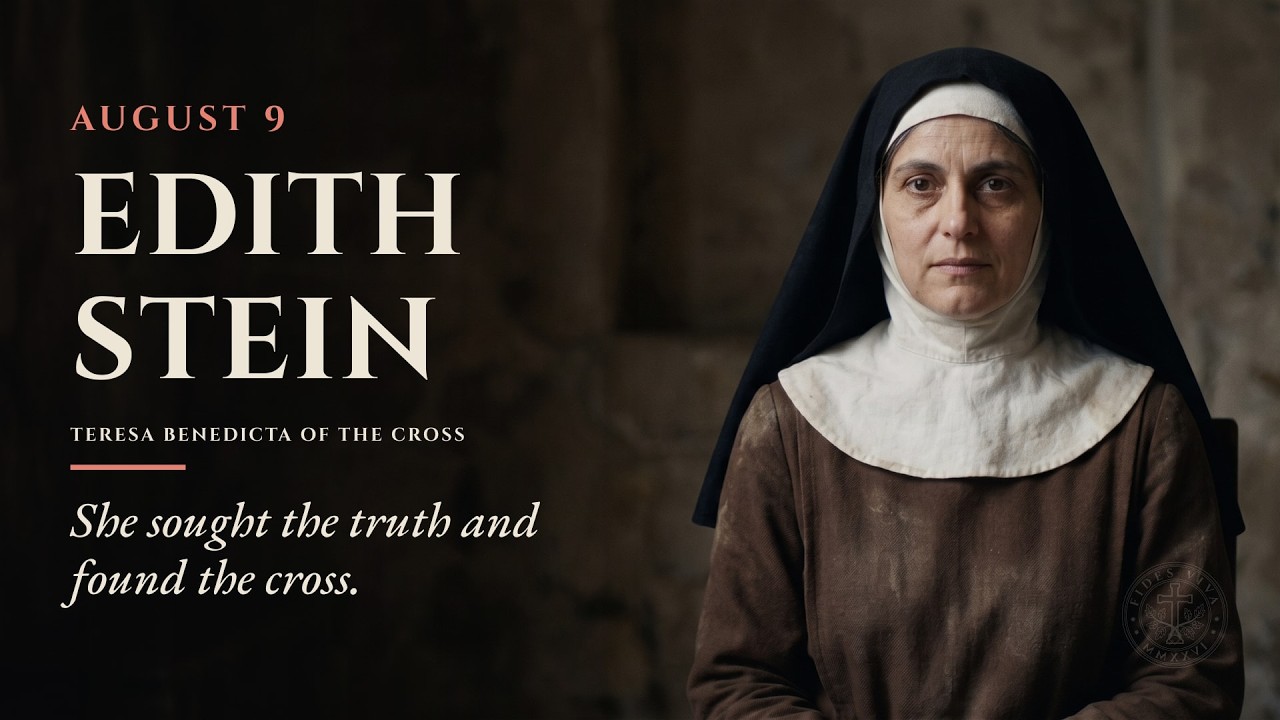
In a synagogue in Silesia, a girl accompanies her mother. Everyone prays; she is silent. She has decided not to pretend at a faith she no longer feels. No one suspects how far that honesty will take her.
Breslau: The First Decision
Late in the nineteenth century. Breslau, in Prussian Silesia, is a city of brick and stucco: streetcars that screech beside the Oder, warehouses that smell of fresh-cut wood, gas lamps being lit at dusk. Its Jewish community speaks German, reads German poets, feels at home. No one imagines that the century ahead will call into question something so basic as the worth of a single life. In this city, a life will be born that will answer that question before the world dares to ask it.
On the twelfth of October, 1891, in the home of Siegfried and Auguste Stein, their eleventh daughter was born. That year, the Hebrew calendar had made the date coincide with Yom Kippur—the day of great atonement, the holiest day of Israel. Auguste would keep that detail all her life, the way one keeps a sign. The girl was named Edith.
The joy in that house did not last long. Before Edith was two years old, her father died, and Auguste was left alone—with the children, with grief, and with a timber business that almost no one believed a woman could sustain. She sustained it. Every morning she crossed the warehouse among the logs and ledgers. Every Friday she lit the Sabbath candles and presided at table with a Jewish faith as firm as her hands. From her, her children learned to work without complaint, to study seriously, and to bend before nothing.
The youngest grew up under that discipline and that fierce tenderness. She was a child of early brilliance and iron will. At school in Breslau she devoured books, asked questions that unsettled her elders, and demanded reasons where others accepted custom. She studied until exhaustion. In her room, the lamp went out last.
And around the age of fourteen, she made a decision she announced to no one: she stopped praying. It was not a slammed door or the rebellion of a young girl. It was a demand for honesty. If she could not hold prayer with the same seriousness she held her studies, she preferred to let it fall. She declared herself an atheist. She said it with the quiet of someone who does not wish to scandalize, only not to lie.
And yet she continued to accompany her mother to the synagogue and to sit beside her. She kept silence while the others prayed, the psalms open before her and her lips still. She did not want to wound Auguste; nor could she lend to God words that rang hollow. Between those two loyalties—the one of the heart and the one of conscience—she chose both, and bore alone the weight of holding them together.
What does a young woman seek who renounces even prayer? What remains of faith when the ritual stops and the heart stays awake? She did not yet have a name for it. She only knew that truth—whatever it was, wherever it lay—deserved a whole life. Her eyes, dark and fixed, began to turn toward books, toward classrooms, toward the questions her era scarcely dared to ask. The search had begun. And it would carry her far beyond Breslau, far beyond what anyone at that family table could have imagined.
Göttingen and the Search for Truth
The first classrooms were in her own city. At the University of Breslau she studied German literature, history, psychology, and philosophy, with that intensity of hers that admitted no half measures. And among so many books, one stopped her: Edmund Husserl's *Logical Investigations*. It proposed something almost scandalous for its time: return to the things themselves, describe reality as it shows itself, without prejudice or prior theory. For a young woman who had stopped praying rather than lie to herself, that method sounded like a promise. In 1913 she packed her things and left for Göttingen, where Husserl taught.
Göttingen was then a small university town where philosophy happened on foot. Around the master had gathered a circle of young minds: Adolf Reinach, who received her with a cordiality that disarmed her; Max Scheler, whose lectures spoke of faith with a freedom she had never witnessed; Hedwig Conrad-Martius, who would become her closest friend. They debated for hours, in classrooms and under the trees, with the seriousness of those who believe truth exists and can be reached. And the young woman from Breslau, trained to look without prejudice, began to notice something unexpected: among the phenomena that deserved to be examined honestly was also the faith of people she admired.
Then the war came. In 1915 she interrupted her studies and volunteered as a Red Cross nurse in a military hospital for infectious disease in Mährisch-Weisskirchen, in Moravia. Here there were no phenomena to describe: there were men with typhus, fever, and fear. She washed, she kept vigil, she held the hands of soldiers who spoke languages she did not understand. Suffering ceased to be a philosophical problem and became a concrete face, repeated bed after bed.
Back to philosophy, in 1916 she defended her doctoral thesis at Freiburg: *On the Problem of Empathy*—how we come to understand the experience of another, how their pain and joy become present to us. The grade was summa cum laude, the highest possible, and Husserl took her on as his assistant. She was twenty-four and stood at the summit of what reason could give her.
A year later, reason encountered something it could not classify. In the autumn of 1917, Adolf Reinach fell in Flanders. His widow, Anne, asked Edith to sort through her husband's philosophical papers, and she traveled, fearing she would find a shattered house and a broken woman she would not know how to console. She found the opposite. Anne, who with her husband had embraced faith in Christ not long before, received her with grief that was whole and a peace that did not come from resignation: it came from the cross, held as a real hope. Years later, Edith herself would mark that visit as the moment her disbelief broke.
She did not convert that day. But the question lay open like a clean wound: Can reason alone lead to something that surpasses it? She went on working, writing, searching. And some summers later, in the country house of her friend Hedwig, among fruit trees and tall shelves, the search would cease to be a matter of thesis and become, in a single night, a matter of life itself.
The Night of Truth: Conversion and Fidelity
That summer found her there, in Bergzabern, a village in the Palatinate, visiting the home of Hedwig Conrad-Martius. Her friends had to leave for a few days, and she remained alone in the house. One afternoon, looking for something to read for the evening, she approached the library and took down a volume almost by chance. It was the life of Teresa of Ávila, told by herself: a sixteenth-century Castilian nun who described, with disarming frankness, her own experience of God.
She began to read and could not put it down. Page after page, that woman from another time did not argue: she described. She told what had happened within her with the precision of one who had seen, without ornament and without systems. And the reader, trained for years to accept nothing without evidence, recognized the ground: this was exactly what phenomenology had taught her to respect—an experience narrated with absolute honesty. Only the object of that experience was God. The lamp stayed lit hour after hour, while outside the valley slept.
She finished as dawn was breaking. She had not slept, and it did not matter. When she closed the book, she said: "This is the truth."
What she had been seeking since the girl who stopped praying finally had a face and a name: Jesus Christ. Reason had not been a detour. It had been the way.
She asked for baptism with the same resolve she had brought to everything in her life. On January 1, 1922, in Bergzabern, Edith Stein was baptized. Standing at the font was Hedwig Conrad-Martius, her godmother: a convinced Protestant standing by a Jewish woman as she entered the Catholic Church. Friendship proved wider than borders. Weeks later, on February 2, she received confirmation in Speyer. She was thirty years old.
What remained was the hardest step, and it would not happen before any altar. She traveled to Breslau to tell her mother in person. Auguste Stein had buried her husband young, had raised eleven children and a timber business alone, had endured everything without breaking. When her youngest daughter spoke the word "Catholic," she wept. Edith saw her mother cry for the first time in her life. There were no shouts or slamming doors: there was that weeping, which weighed more than any reproach. For that faithful mother, baptism sounded like abandonment of the people of Israel.
But the daughter did not leave. She stayed beside her those days and went on as before: she accompanied her mother to the synagogue and prayed the psalms beside her. The same words served them both. The psalms her mother prayed as a Jew, her daughter now prayed as well, without betraying them. Her entry into the Church did not tear her from her roots: it restored them to her in fullness. She had not ceased to be a daughter of Israel; she had found, at the heart of that inheritance, the Messiah whom Israel awaited. Two loyalties fit in a single heart, and the heart did not break.
Her conversion did not withdraw her from the world: it sent her into it. Her newly found faith demanded hands and words, and she would soon find them in a classroom, among young women, in an ancient city on the banks of the Rhine.
Teaching and Calling: The Science of the Cross
That city was Speyer, and the classroom was in the school of Saint Mary Magdalene, run by Dominican sisters. There she spent eight years teaching in the halls of future teachers, a woman in a dark dress and white collar among religious in white habit and black cape. She was not a nun, but she lived almost as one: she slept little, ate less, spent hours before the tabernacle before the school woke. The students noticed something difficult to name in that demanding and serene teacher. She taught grammar, and at the same time she taught how to see: each girl who sat in her class was, for her, an irreplaceable person, not just another desk.
The nights belonged to the desk. She translated pages of Cardinal Newman into German, another convert who had come to faith by the path of conscience. Then she undertook something larger: translating the Disputed Questions on Truth of Saint Thomas Aquinas. To render it in her language, she had to think it through entirely, and in that work the phenomenologist and the medieval master joined hands: two ways of seeking truth that she united in her own person, without sacrificing either.
Soon the voice from the classroom reached beyond it. Between 1928 and 1932 she traveled across Germany, Austria, and Switzerland as a lecturer. She spoke about the vocation of women and education, before packed halls, in a time that debated passionately the place of women in the world. Her thesis was serene and firm: a woman's worth lies neither in imitating man nor in fitting herself into a mold. Her worth lies in unfolding what she is—a capacity of her own to receive, to sustain, to see the concrete person. Every human being, she said, is unique and cannot be replaced. Europe was beginning to flirt with ideologies that affirmed the very opposite.
In 1932 came academic recognition: a teaching position at the German Institute for Scientific Pedagogy in Münster. It lasted one academic year. In January 1933 the National Socialists took power, and within weeks the first boycotts and the first laws of exclusion fell upon the Jews of Germany. For the new regime, that Catholic thinker remained, above all, a Jew. Teaching was closed to her.
Her first response was not to hide. It was to write. In April 1933 she addressed a letter to Pope Pius XI. She asked him for a public word from the Church about the persecution of the Jews, and she warned that what was beginning with boycotts would not stop there. Very few in that spring saw so far. The letter remained filed in the Vatican archives, and the world would take seventy years to read it.
She was forty-one, with a growing body of work and a voice heard across half of Europe. In a few months she lost everything: the classroom, the lectern, the academic future. And then what had been ripening in secret for years came to the surface. And then what had been maturing in silence for years found its way forward: the desire for Carmel, postponed while teaching still claimed her. Now teaching no longer existed for her. Every door had closed from the outside, except one that could only open from within: the door to silence, where Christ had long been waiting. That autumn, with a small suitcase, she traveled to Cologne and stood before the gate of a convent of Discalced Carmelites.
The Silence Chosen: Carmel and the Offering
The door opened on October 14, 1933, the eve of the feast of Saint Teresa of Ávila, the woman whose book had reached her one summer night. Inside waited a whitewashed cell, a bare wooden cross, and a life of silence, work, and prayer. Outside lay a Germany of parades and slogans, each day more hostile to her people. When the world began to shout, she chose to be silent. She did not hide from history: she entered its center by another path.
Six months later, in April 1934, she received the brown habit of the Discalced Carmelites and, with it, a new name: Teresa Benedicta of the Cross. An entire program in three words: blessed by the cross. The doctor who had filled lecture halls across half of Europe now shared the common work of the house, the silence of the choir, and the schedule of a small community. She accepted that change without complaint and with peace. In 1935 she made her first vows, the temporary promise of poverty, chastity, and obedience that precedes the final gift of self.
Her superiors soon understood that such a mind should not lie idle, and they returned the pen to her. In her cell, between the prayer of dawn and the prayer of evening, she wrote *Finite and Eternal Being*, her great work of maturity: the attempt to think, with all the tools of philosophy, how the fragile being of man rests upon the eternal being of God. Ink stained her hands again. Once again the lamp burned late into the night.
On September 14, 1936, her mother died in Breslau. The enclosure did not allow her to travel; the grief had to be lived within those walls, with the same psalms that the two of them had prayed together so many times. That same year, following the path that Edith had opened, her sister Rosa asked for baptism.
On April 21, 1938, came perpetual profession: the black veil and white cape of the professed, the gift now without time limit or turning back. Months later, in the night of November 9 to 10, the synagogues of Germany burned. Shattered glass, looted shops, men arrested by the thousands. From her cell she understood that her very presence put the community in danger: for the regime, beneath the habit there remained a Jew. On the last night of that year she crossed the border toward the Netherlands, to the Carmel of Echt.
In Echt she once again found a cell, a walled garden, a schedule of silence. And there, on June 9, 1939, she wrote a few lines that are the key to all that would follow. She offered her life to the Heart of Jesus as a sacrifice of atonement for true peace and for her people. She knew exactly what she was asking. And she asked it nonetheless. She gave the paper to her prioress and returned to her routine, as if nothing had changed. But something had changed: the death that others were already preparing ceased to be only something they would do to her. It became, in advance, a free gift.
In 1940 Rosa also arrived at Echt and settled as the portress of the convent: the two sisters, together again under the same roof. That same year war reached the Netherlands, and the border that Edith had crossed no longer protected anyone.
She was then commissioned to write a study on Saint John of the Cross, for the fourth centenary of his birth. She titled it *The Science of the Cross*: page by page she explored the dark night of the soul, that knowledge which is not learned in books but suffered with Christ. From May 1942 she wrote with a yellow six-pointed star sewn over her habit, the one the occupation imposed on all Jews. She wrote of the night while her own drew near.
Somewhere in the convent lay the paper signed in June 1939. She had given it to her prioress and never spoke of it again. Can a life offered in secret change the meaning of what has not yet come to pass? She believed it could. And what had not yet come to pass was already on its way, that summer, drawing near to the door of the Carmel of Echt.
The Arrest and the Final Threshold
The answer came one Sunday, from every pulpit at once. On July 26, 1942, in each Catholic church in the Netherlands, the same pastoral letter was read. The bishops, with the Archbishop of Utrecht at their head, publicly protested the deportations of the Jews. It was one of the clearest voices raised across all of occupied Europe. In the chapel of the Carmel of Echt it too was read, and among those who heard it was a nun with a yellow star sewn over her habit. It was, at last, the public word she herself had asked of Rome nine years before. Now that word existed. And she would pay for it.
The occupier decided that this protest would have a price. If the Church spoke, reprisal would fall upon the baptized Jews throughout the country. The order was carried out a week later.
On Sunday, August 2, in the mid-afternoon, two men came to the door of the convent. They carried an order of arrest against Edith Stein and against her sister Rosa. There was barely time: a few things in a suitcase, a coat over the habit, the community standing in the hallway, disbelieving. That same afternoon, throughout the country, other Catholics of Jewish origin—religious men, religious women, laypeople—were arrested in the same sweep. On the desk of her cell lay the manuscript of *The Science of the Cross*, unfinished. The work about the night had stopped because the night had come.
In the eyes of the regime, neither the veil nor baptism protected her. They reached her, together, the two things she was and never wanted to separate: a Jew by birth, a disciple of Jesus Christ by choice. For the first, they had sought her; for the second, for the public word of the Church, they had found her.
Rosa, who kept the convent gate and did not live in enclosure, stood bewildered at the threshold, not fully understanding what was happening. The memory of the sisters of Echt held that moment: Edith drew near, took her by the hand, and said: "Come, let us go for our people." A brief phrase, with no explanation. It held a whole life.
They were taken first to Amersfoort and from there to the transit camp of Westerbork, in the north of the country. Low wooden barracks on the sand of Drenthe, barbed wire, a low gray sky. It was the anteroom to the transports toward the east. No one knew with certainty what lay at the end of those trains; almost everyone sensed it was something from which no one returned.
Those who were with her in those days told of it afterward. Among the disorder and fear moved a nun at peace who paid no attention to herself. There were mothers so sunk in despair that they no longer tended their own children; she washed those children, combed their hair, and sat beside the women who could no longer weep. Her calm was not indifference: it was the peace of one who had signed, three years before, what was now beginning to be fulfilled. The hands that had written treatises of philosophy undid the tangles in the hair of a lost child. It was her last visible work. Perhaps the greatest.
On August 7 the transport was formed. A freight train, sliding doors, a platform of sand. Edith and Rosa boarded together, with hundreds of deportees, and the door rolled shut. The rails pointed eastward, toward Silesia: the land where she had been born fifty years before, on a day of Yom Kippur.
What remains when a whole life is reduced to a platform, an outstretched hand, and a phrase remembered? What remains is what she had kept safe long before: an offering signed, kept in a convent, waiting for its hour.
The train rolled for two days through a Europe at war. At the end of those rails was a brick door. Before it, the account of these days falls silent.
Auschwitz: The Offering Consumed
The train came to a stop at the end of the journey. The rails entered beneath an arch and ended there, inside the camp. Auschwitz-Birkenau. The doors of the boxcars rolled open, and a multitude descended onto the platform: men, women, children, suitcases, names. Among them all, two sisters from Breslau. Those who saw them leave remembered that one of them still wore the habit of Carmel, with the yellow star on her chest.
No one recorded their last words; no witness told of that ending. They stepped down, walked with the others, and disappeared into the anonymous crowd. The hour is not recorded; only the day. That same day, Edith and Rosa Stein died in Auschwitz-Birkenau, with their people.
There is no grave. There was no body to bury, no stone to bear two names. Their tomb is the air; their memory, the open sky above the rails. The offering signed in Echt three years before had reached its end. The life given freely to the Heart of Jesus, for peace and for her people, was consumed there, where that people died. It was not simply taken from her: she had already given it. Sister Teresa Benedicta of the Cross: the name she chose in Cologne was fulfilled in Silesia, to the last letter. Like her Master, she died stripped of all, her hands open.
A life can disappear leaving no grave and not be extinguished. Because what Edith Stein left behind could not fit in a sepulcher: a search, a fidelity, some pages, a gesture at the door of a convent. All of that remained outside the camp, untouched. Multitudes died there with no one to write their names; she chose, to the end, to be one of them, and with them she remains. And the silence of that August 9 began, very slowly, to become memory.
A New Name for Europe: The Legacy
Forty-five years later, that memory filled a stadium. On May 1, 1987, in the Müngersdorfer in Cologne, tens of thousands of people surrounded an altar in the open air, with the towers of the cathedral in the distance. Above the altar, a portrait: the photograph taken in Carmel around 1938 — the brown habit, the white cape, the black veil, the dark and serene gaze. And before the portrait, a pope from Poland, born in the same land where she had died: John Paul II, a philosopher by training in the phenomenological tradition, a reader of the same masters she had studied. That day he declared her blessed and a martyr. The Church gave her death the name she herself had prepared in silence: the life offered to Christ years before anyone came to take it from her.
To inscribe her name among the saints, the Church asks for a sign. And the one that came seemed written for her. On the other side of the ocean, a girl from a Catholic American family of Jewish descent, Benedicta McCarthy, fell gravely ill from poisoning. According to what her family testified in the canonization process, the damage was deemed irreversible. And she survived. Her family attributed the healing to the intercession of the Carmelite of Auschwitz. In 1997, after examining the case, the Holy See accepted it as the miracle of the cause.
One year later, on October 11, 1998, her face hung on the façade of Saint Peter's Basilica, woven into the great tapestry of canonizations. Before a square filled with people, John Paul II inscribed her in the catalog of the saints. And he defined her with words that embrace her whole life: "an eminent daughter of Israel and a faithful daughter of the Church." Neither of the two identities dissolved the other. Both, held together, were fulfilled to the end.
And there was still a title to come. On October 1, 1999, the same pope proclaimed her co-patroness of Europe, alongside Saint Bridget of Sweden and Saint Catherine of Siena. The continent that had watched her die in an extermination camp was, in part, entrusted to her care. He himself explained the gesture: "To declare Edith Stein co-patroness of Europe today means to place on the horizon of the old continent a banner of respect, of tolerance, and of welcome." And in the same document he set down the key to her martyrdom. The Church recognized in her witness as an innocent victim "the imitation of the Lamb who was slain and a protest against all violations of the fundamental rights of the person." A Jewish woman, a philosopher and a Carmelite, murdered for her origin and reached by her faith, has kept watch over the heart of the continent that could not keep watch over her.
From those years on, the devotion of the faithful gave her an image of her own. In stained glass and statues she is shown with two signs united: the Star of David and the cross. So she is seen in Cologne, in Echt, in Speyer, in Wrocław — the city she knew as Breslau. No one separates them in those images, because she never separated them in her life.
Each August 9, the day of her death, the whole Church remembers her in its liturgy. In Germany, in the Netherlands, and in the Discalced Carmelite order, her feast day has its own liturgical rank. But whoever wishes to visit her will find no sepulcher. One can enter her cell in Echt; pause before the memorials in Cologne, in Speyer, in Auschwitz; read her handwriting in the manuscripts she left behind. What one cannot do is bring flowers to a tomb, because it does not exist. To remember her requires something else: to speak her two names — Edith Stein, Teresa Benedicta of the Cross — and let them go on saying, together, what they said in life. A memory like that does not rest in stone. It lives in those who speak her name.
The tapestries, the titles, and the stained glass tell the end. But the beginning remains untouched: a Silesian girl who one day, out of pure honesty, stopped praying. Between that day and the platform at Auschwitz runs a single straight line. And that line still has something to say.
Contemplate the Search
There remains, at the end, the question with which everything began. What does someone seek in giving up prayer for honesty's sake, and how far can that search lead? The girl who fell silent in the synagogue of Breslau answered with her whole life. She sought the truth. And the truth, one night, came to meet her with a face and a name. She closed a book at dawn and recognized there, without reservation, the truth she had been seeking for years.
From then on, each step she took was another answer. To pray the psalms beside her mother without renouncing anything. To sign in silence the gift of her own life. To take her sister's hand at the door of the convent. To comb the hair of children in a transit camp, as those who saw her remembered, when there was nothing left to give.
We too know that search, though it may be on a different scale. It resembles the lamp we leave burning one ordinary night, when a question keeps us from sleep. We do not yet know what we hope to find. She walked that path to the end. The answer she gave was hers; ours remains open, this night, on the table.
She left no tomb. She left a light burning, and more than eighty years later it still burns in every person who seeks the truth without fear of where it leads.
Saint Teresa Benedicta of the Cross, seeker of truth and martyr of your people, pray for us.