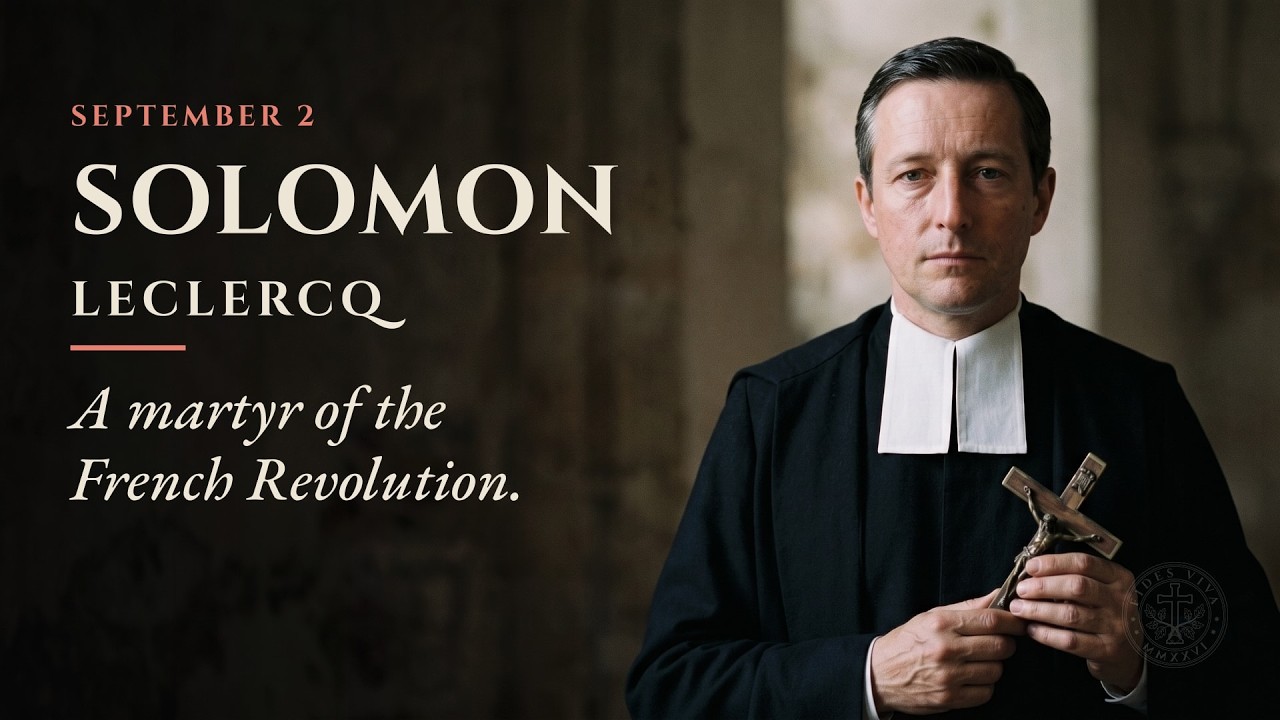
A man in black looks at the paper waiting on the table. It is an official document: an oath, with its blank line at the bottom. He has spent his life writing — accounts, records, letters, registers of an entire congregation. His hand has signed thousands of pages without trembling.
Today the pen does not move.
It is 1790. The new power of France demands that every religious take an oath in writing: whoever signs keeps his house, his school, his name. Whoever refuses loses everything. The penalty could be exile. It could be prison. It could be death.
He pulls his hand back.
He does not argue. He does not flee the country, as so many others do. A few months later, he will put away his black habit and dress in a worn coat, disappearing into the streets of Paris like any other man. Two summers after that, the unsigned paper will come looking for him at his door.
There is nothing in his past that announces a martyr. He taught mathematics to poor children. He kept the storeroom of a large house. He sealed letters, organized files, balanced columns of numbers. Forty-five years without a single gesture the world would call heroic. No one in 1790 would have placed his name on an altar.
And yet in that quiet hand lies an entire life.
What must be inside a man to risk his life for a signature he will not give?
The World Before the Oath
At the far north of France, the wind off the English Channel drives seagulls over the walls of Boulogne-sur-Mer. It is the autumn of 1745. Louis XV reigns in Versailles, and the world of the Ancien Régime seems built to last forever: bells that mark the hours, guilds that order the trades, merchant ships that unload cloth and salt at the docks. No one imagines that this entire world will burn before the child about to be born grows old.
On November 15, in the house of a well-to-do merchant family in the city, a boy is born. The next day they carry him to be baptized, and he receives three names, as befits a family of position: Guillaume-Nicolas-Louis Leclercq.
The Leclercqs want the best for the boy. In Boulogne, the best are certain teachers dressed in black, with a white collar of two points on the chest — the rabat, the mark of the Brothers of the Christian Schools. They had been founded, some seventy years before, by John Baptist de La Salle, a priest who gave up everything to teach the children of the poor for free. In their long benches, Guillaume learns to read, to count, and to pray. He learns too something that no manual teaches: that a man can spend his entire life, without fanfare, serving Jesus Christ in front of a blackboard.
When his studies end, the boy moves to the back room of the family business. Bundles, a scale, the grey light of the harbor in the window. He has a good hand with numbers: the quill pen, the inkwell, columns that balance on the first try. His parents see that talent and envision a settled future: the son will run the enterprise, and the enterprise will carry the family name forward.
He sees something else. Nothing was written down about what happened inside that young man: there is no account of a vision, no record of a decisive conversation, no sleepless night. Only the result survives. At twenty-one, against his parents' wishes, against the inheritance assured to him, he decides to become a religious. Not a priest: a Brother. A lay consecrated man, one of those who do not step up to the altar or preach, whose only visible greatness is a classroom full of children without resources.
On March 25, 1767, the Feast of the Annunciation, he crosses the threshold of a novitiate of the Institute. There he surrenders the cloth suit, the hair tied back with a black ribbon, the hat: everything that colored his former life. In exchange he receives a black woolen tunic, the white collar worn by his teachers, and a new name. From that day forward he is Brother Solomon.
No bell rang out for that decision. No chronicler recorded it as news; in Boulogne, perhaps, someone lamented it as one laments a good business lost. Why does a man give up everything certain for a calling that no one applauds?
The answer did not stay in words. It stayed in what came after: twenty-five years so hidden that almost no one looked twice — classrooms, storerooms, and account books.
Years of Classrooms and Account Books
A brass bell rings in a whitewashed classroom, and an entire row of children stands beside their long benches. They are the sons of day laborers, fishermen, widows who cannot afford a schoolmaster. Before them stands a young Brother in black tunic and white collar, pointing at the slate board with a ruler. He teaches them to read, to write in clear letters, to add without error: the tools that might change a poor child's life. And he speaks to them of Jesus Christ, because in La Salle's schools faith is taught with the same seriousness as reading and writing: a child whom no one counts discovers there that the Lord counts him.
The chronicles of the Institute remember him in those early posts, around 1770, in Rennes and in Rouen — a teacher among many — and place his religious profession in those years: the vows that sealed for life what began that day of the Annunciation. Then the trail becomes firm. At some point in those years, Brother Solomon arrives at Maréville, near Nancy, in Lorraine: one of the largest houses of the Institute, pale stone, a square courtyard, whitewashed corridors, an orchard, classrooms full.
There he spends long years doing everything such a house requires. He teaches mathematics — this is what will remain of him in memory: a patient teacher before the figures. He directs the studies. He forms the novices, young men who arrive as he arrived, with their street clothes still under their arm and their entire life still to decide; he teaches them to pray, to be silent, to endure. And he runs the storehouse, the stewardship: the material governance of one of the Institute's largest houses.
It is work without luster. Barrels that come in, sacks that go out, candles bought by the dozen, bread counted by the loaf. Every expense noted, every column squared. By night, when the house sleeps, he remains bent over bound ledgers of parchment, by the light of an oil lamp that strains his eyes. No one applauds a steward. No one writes the history of a well-kept storehouse. He keeps it anyway, year after year, with the same care he brings to prayer.
The black habit and white collar have become a second skin. He rises with the community, prays with the community, works until the bell says enough. He lives as the Rule demands: possessing nothing of his own, not the pen with which he writes, not the bed on which he sleeps. His family name is scarcely used; his signature serves only to vouch for the accounts of others.
Anyone who has spent years in work that no one watches — papers, classes, tasks that repeat — knows this landscape. Twenty years like this, without a single event that merited a line in any chronicle. The first grey hairs show at his temples. And yet something is taking shape in that methodical man, gesture by gesture, number by number: a way of being faithful in small things so deep that he will not know how to be otherwise. Can a life of bells and account books prepare someone for a greater trial? At Maréville no one asks that question. There is no need yet.
But beyond those walls, France is changing temperature. In the markets people speak of bread prices; in the salons, of new ideas that no longer ask permission; in Paris, other pens write words that will soon fill everything: nation, law, suspicion. The storm remains distant still from the square courtyard in Lorraine, where a bell continues to mark the hours of God.
But it is coming.
The Oath on the Table
The General Chapter of 1787 tears him from Lorraine. The superiors of the Institute gather to review the course of the work, and they need a trusted pen to record every word. The appointment falls to the steward of Maréville. Session after session, Brother Solomon takes down the minutes of the Chapter with the same precision he brought to squaring columns. When the Chapter closes, the man who expected to return to his storehouses does not return. The Superior General, Brother Agathon, wants him at his side. He will be his secretary general.
Now he works at the heart of the Institute: a Parisian house with a sober façade, tall windows, tables covered in files, seals and wax, correspondence tied with cord. Through his hands passes the written life of communities across all of France: appointments, obediences, schools for poor children that ask for teachers. At forty-two, with grey now plainly showing at his temples, this quiet man holds the memory of an entire work. He does not know it yet: he has been given the post of watchman, and from that desk he will see the wave arrive.
The wave breaks in 1789, and at first it does not even seem aimed at them. Paris tears down in months what seemed eternal; the new words — nation, law, citizen — run through the streets like a wind that still smells of promise. But in 1790 the National Assembly passes a law with a grey title: the Civil Constitution of the Clergy. Under that bureaucratic heading, the Church of France is placed under the State. Bishops and priests will be elected by local assemblies, as one elects a functionary. And men of God are required to swear allegiance "to the nation, to the law and to the king." Whoever swears keeps his post. Whoever refuses exposes himself to exile, to prison, even to death.
The words of the oath sound almost innocent. Solomon is French and loves his land; obeying the law has been the air of his entire life. But to swear to it is to accept something else: that civil power governs the house of God, that the Church of Jesus Christ is governed by an assembly the way one governs a bridge or a tax. It is only a signature. One line of ink at the foot of a paper. And it is exactly the line his conscience cannot cross.
There is no tribunal or square. The requirement arrives as everything official arrives: on paper, across a table. And the man who has signed his whole life — minutes, receipts, inventories, thousands of lines given as good — this time leaves the pen where it rests. He does not argue. He does not draft protests. Simply, he does not swear. And with him, the vast majority of his Brothers say no too, from one end of France to the other: teachers of poor children turned, overnight, into rebels against the law.
The price does not wait. The Institute loses its legal standing: for the law, it ceases to exist. The schools close one after another; the classrooms where generations of poor children learned to read are left with empty benches and the slate half-erased. And the communities dissolve. Men who have lived twenty and thirty years under the same roof say goodbye in the courtyards and separate without knowing if they will see each other again. Communities scatter across all of France, and many have no path but to hide.
The black habit and white rabat, which for more than a century had marked a teacher of the poor in the streets, now mark a suspect. They must be folded, stored in the bottom of a chest, and one must learn to walk dressed like anyone else. For men who had given everything, that garment was all they had. That too is asked of them.
What happens when fidelity demands disappearance? In the Paris house, the secretary general remains at his post while the world he served dissolves around him. He arranges papers that perhaps no one will ever reclaim, seals letters that find fewer and fewer recipients. One by one, the others leave. The corridors grow emptier; the voices, more distant. And in that growing silence, without proclamations and without turning back, begins for him the loneliest stage of his life.
Hiding: Letters and Solitude
Someone has to stay. The papers of the Institute — records of foundations, of names, of appointments — cannot be left abandoned, and the house on the rue Neuve, empty, would be easy prey for any search. Brother Agathon sends him to Paris, and there he himself decides to remain and guard the house. Solomon accepts without condition: he will stay in Paris, in the very heart of danger, with only the hope of passing unnoticed.
For that, first, he must stop looking like what he is. For that, one supposes, he puts away his habit and dresses like any neighbor: a dark, worn coat and waistcoat, grey stockings, a plain round hat. No religious sign on him. To the street's eye, a modest bourgeois who enters and leaves a house too large. Inside, nothing has changed: the vows still stand, though the law declares them abolished.
Because the law tightens more each day. In the spring of 1792 the Assembly forbids religious vows and dissolves the congregations: it is no longer only that the Institute does not exist for the State; it is that being what he is has become a crime. He lives then the numbered days of a hunted man. Shutters half-closed, a candle that goes out early, the outside world reduced to street noise: carts, vendors' calls, sometimes the tread of a patrol with a tricolor cockade. He eats little. He sleeps poorly. Any curious neighbor, any question too close, could be the end.
The fear of those months is not a single moment: it is a climate that does not lift. And in that climate, each gesture of calm costs.
Solomon's calm has one channel: writing. To his family in Boulogne, and above all to his sister, a religious like himself, many letters flow — the most intimate voice he left of himself. In them there are no complaints, no bitterness toward anyone. There are measured reports, affection untouched, and a faith that does not shrink: fidelity to Christ and to His Church, spoken with the plainness of one who knows no other way to speak, and a desire that returns again and again — to offer one's own life, if it should come to be asked.
What can sustain a man in fear and waiting? In his case, no new heroism. What sustains him is what it has always been: the prayer of each day, the order learned in twenty-five years of classrooms and accounts, the quiet certainty that his life belongs to Jesus Christ from that morning of the Annunciation. His hidden life does not make him another man. It reveals the one he already was.
Outside, the summer of 1792 becomes unbearable. On the tenth of August the monarchy falls; the prisons of Paris begin to fill with priests and religious, and in the neighborhoods lists are drawn up. He knows it, and he stays at his post, and he keeps writing home with an even hand.
One of those letters will be the last.
The Arrest and the Last Letter
It is the fifteenth of August, 1792, the feast of the Assumption. Paris lives with its heart clenched: the monarchy has fallen five days before, the Prussians advance toward the frontier, and in every neighborhood lists of suspects are drawn up. In his room, in the same steady hand as always, Solomon writes to his sister in Boulogne. Among the greetings and the customary affection, one sentence rises above all the rest:
"The tribulations we suffer here below are passing, and the reward we await will be eternal."
He folds the paper. He melts the sealing wax. He leaves the letter ready on the table.
That same afternoon, knocks on the door.
They are armed men of the Revolution, with tricolor cockade. They come for him. Perhaps someone has spoken; perhaps it is simply his turn on the lists. There is no struggle, no shouting: the man who obeyed bells for nearly twenty-five years knows how to obey this hour as well. He gathers what little he is allowed and descends the stairs between his captors, without the street taking notice.
They take him to the rue de Vaugirard, to the former convent of the Carmelites turned into a prison. As he crosses the threshold he finds not criminals, but bishops, priests, and religious, locked away there as he is in those August weeks. And he, a school brother, a lay religious, enters that captivity of shepherds as one among them.
What he wrote in the morning begins to come true in the afternoon. The tribulation has just arrived; the reward, he wrote, will be eternal. With that hope — the one his letters of those months repeat without emphasis — he hears the door of the Carmes close behind him.
The Wait in the Carmes
Inside, the days have a different measure. The convent that was a house of prayer becomes one again, now behind locks: through the whitewashed corridors, through the church and the linden garden, more than a hundred bishops, priests, and religious are scattered, detained for the same reason as him — for refusing to swear. They sleep on straw, eat what is passed to them, wait without knowing what. Among so many black cassocks, a man in worn civilian clothes: the school brother, one of the few religious in that captivity who was not a priest, but a consecrated lay brother.
There is Archbishop du Lau of Arles, white-haired, fifty-four years old, the first of that group. There are the La Rochefoucauld brothers, bishops of Beauvais and of Saintes, two brothers by blood who wait together, in the same prison, for the same end. And the prison does what honors never did: it levels. The prelate and the teacher of poor children share the same straw, the same scant bread, the same uncertainty. No one asks about rank. They help each other however little they can: a place by the wall, a blanket, a word.
The days take shape as best they can, around prayer. The office is recited in low voices, rosaries run through fingers, they seek a moment in the garden when the guards allow it. That is how the memory of those days has come down to us: priests who hear one another's confessions, preparing for what they sense. Because the news that filters in from outside leaves no room for illusions. The Prussians advance, Paris seethes, and in the sections of the city there is talk of the prisoners as traitors who will have to answer for it.
What is said, and what is left unsaid, when each evening may be the last? Of Solomon nothing is preserved from those eighteen days — not a line. But whoever had read him until the fifteenth of August can guess where his heart lay: with Christ, to whom he had given his life at twenty-one. And with that reward he had called eternal, with the ink still fresh. His way was never to speak. It was to remain, to serve, to hold up those beside him. In the Carmes prison too there are accounts to keep: the accounts of hope for each day.
Thus August passes. Thus September begins.
On the second, from beyond the walls, a murmur begins to arrive. Footsteps. Voices drawing near along the rue de Vaugirard. More and more voices.
The Martyrdom in the Garden
That day, the doors give way. Armed men with pikes and swords pour into the convent. With them comes the fever of the entire city: shouts, lists of names, the certainty that the prisoners are traitors and that the nation in peril demands their blood. There is no trial. There is, at most, a question repeated in the tumult: did you swear or did you not? And for those who did not swear, the corridor, the staircase, the garden.
The prisoners are chased through the buildings and pushed toward the garden. Archbishop du Lau, of Arles, falls among the first, near the altar of the convent's oratory. Others descend the stone staircase toward the lindens, and below the swords await them. Cassock after cassock, the September afternoon fills with bodies.
At some point that afternoon, Brother Solomon dies. No one recorded where he fell — if on the staircase, if on the gravel of the garden, if inside the building: that day left no scribes. He was forty-six years old. He wore the dark, worn clothes of a man in hiding. He was neither bishop nor priest; none of the assailants knew his name. He died for the same thing he had been living quietly, in small ways, for twenty-five years: for belonging to Jesus Christ without reserve, to the end, even when belonging to him cost his life.
Among the bodies lay a wounded priest, the abbot of La Pannonie, who survived the massacre. Thus has been passed down what he told afterward, and of all that horror what stayed etched in his memory was a single thing: "I heard no complaint from any of those I saw slaughtered."
Not a cry of hatred. Not a curse. Not a desperate plea. The men who died that afternoon had spent eighteen days waiting together, praying and holding one another up in that waiting. Their silence was not shock: it was the same silence with which they had prayed, taught, and served all their lives. To die thus is not improvised. It is learned in years of fidelity without witnesses, in classrooms, in pantries, in account books that balance. That day, the teacher of poor children gave his last lesson without saying a word.
When the assailants depart, the garden falls silent. The sun of late summer lengthens the shadows of the lindens across the gravel. Within hours, nearly all who lay enclosed there have died within those walls, and in the prisons of Paris the massacre will continue for several days more. The bodies are removed quickly, without names, without marked graves. The Institute of the Brothers of the Christian Schools has its first martyr, and no one knows it.
The Republic has urgent matters enough to remember them by: the war, the hunger, the Terror that draws near. The name of the brother secretary is lost among thousands of lost names. Everything seems finished. But there are lives that do not end where the body ends, and his was only beginning to speak.
From Hidden Martyr to Universal Saint
The silence lasted more than a century. Then, on October 17, 1926, in Rome, Pope Pius XI raised to the altars the martyrs of that September: nearly two hundred names rescued from oblivion. Among them, one who was neither bishop nor priest: Brother Solomon, first Blessed and first martyr of the Institute that Saint John Baptist de La Salle had founded for poor children. That beatification left behind his official image: the black habit, the white rabat, the palm of martyrdom in his hand. And with it the Lasallian family heard again the echo of his letters: the serene voice of those pages from hiding was now the voice of a blessed of the Church.
But the story kept moving where no one expected it, and what came next is still told in Venezuela with wonder. In 1970, when the old Brothers' novitiate was sold to the Central University of Venezuela, a portrait of Brother Solomon went to La Salle school in Caracas. Years later, a priest devoted to the French martyr carried it to a small chapel in El Hatillo, in the hills above Caracas, where young people without resources gathered. An old canvas, in a simple chapel, an ocean and two centuries away from the garden of the Carmes.
There, in 2007, a venomous snake bit María Alejandra Hernández, a five-year-old girl in the home's care. The venom advanced; the doctors feared for her leg and for her life. The community did the only thing in its power: it gathered before the portrait of the brother from Boulogne and asked Jesus Christ, through his intercession, for the healing of the little girl. The symptoms eased. The signs of poisoning receded, and medicine could not account for why. The teacher of poor children had turned his attention to a poor child once more.
The Church examined the case with the patience of centuries. The diocese opened the case in 2011; in Rome, doctors and theologians agreed, one after another, that the healing had no explanation, and Pope Francis signed the decree. The path lay open.
On October 16, 2016, an enormous tapestry hung from the facade of Saint Peter's Basilica: a man in black habit and white collar, with the palm in his hand. Below, a multitude filled the square — Brothers, teachers, students, flags from the eighty countries where Lasallian schools work today — and among them, the entire Lasallian network, the same one that had prayed before that portrait across the ocean. Francis pronounced the formula, and the accountant of Boulogne, the steward of Maréville, the secretary who did not sign, was inscribed forever in the catalogue of the saints.
The superior of his Brothers — a distant successor of Brother Agathon — wrote in those days that mercy is love, and that "for love one is willing to do anything, even to give one's own life." That is what Solomon had done one September afternoon. That is what he continued to teach, two hundred twenty-four years later, without saying a word.
In El Hatillo they kept praying before the portrait. The schools kept opening each morning. And in Paris, in the crypt of the church of that same convent of the Carmes, the bones of the martyrs rest in the dimness of a crypt that can still be visited.
Silence and Fidelity: A Question for Today
Low vaults, whitewashed stone, the dimness of burning candles. Behind the grilles and glass, the bones rest in order: skulls aligned, plaques with names, a flower here and there that an anonymous hand renews. Among them, without a separate urn, without any distinction at all, lie the remains of the brother who kept the accounts of Maréville. He rests as he lived: one among his companions, lined up with the others, beneath the church built upon his prison. The visitor finds silence — the same silence he kept all his life: the silence of a calling never told, of hiding, of those who died without complaint.
Above, in the garden, the stone staircase remains where it was, its steps worn smooth, descending toward the lindens. A simple plaque marks it.
"Hic ceciderunt" — here they fell. Two words in Latin for more than a hundred men. Today the garden belongs to a seminary; students cross it with their books, the blackbirds peck the gravel, and each September a community returns to gather at the foot of those steps, with candles, to pray where they prayed for the last time.
What leads a man to risk everything for a signature he will not give? The answer does not lie in that refusal before the paper: it lies in the forty-six years that led to it. It lies in the boy who left his father's business almost without a word. In the teacher who showed the sons of poor families how to read and count. In the brother who for twenty years kept classrooms, storerooms, and the accounts of an entire house in order. In the man in hiding who wrote to his sister, night after night, that the sufferings of this world pass away. Someone like that could not swear against his conscience, because his conscience was not a piece of paper: it was a fidelity to Jesus Christ woven day by day, account by account, class by class. The great hour did not change him. It only showed him.
The serenity of that September afternoon was not improvised: it had been rehearsed, without knowing it, through twenty-five years of fidelity with no one watching.
We too live among small papers. A report it would be convenient to doctor, a comfortable silence in a meeting, a message we prefer not to answer, a truth that gets in the way at work. No one is watching us; nothing seems to hang in the balance. What do we do with those hours no one sees, when giving way is easy and being faithful matters to no one?
Solomon faced that same question, with his life as the price. He had the pen in his hand — the pen with which he had written thousands of pages — and he set it on the table.
That is why his Brothers remember him not as a hero of a single day, but as the saint of the small hours: the brother to whom many entrust, with no official title, those who teach, administer, care for, and persevere without anyone's applause. His memory returns each September 2nd to Lasallian schools scattered across some eighty countries, among children who do not yet know that an accountant can reach the altars. What that man decided in silence gave him, more than two centuries later, a place among the saints.
Saint Solomon Leclercq, first Lasallian martyr, faithful educator, witness to freedom of conscience, pray for us.