In the dim light of a gallery carved beneath the earth, lit only by oil lamps, an assembly prays in silence. The gray-haired man who presides hears footsteps that should not be there. No one rises. No one flees.
Rome Under Threat
Rome, the middle of the third century. The Empire is fracturing: the borders give way to peoples from the north and east, the currency loses its silver, plague empties entire streets. In the temples, smoke from sacrifices rises thick toward a sky that does not answer. The Emperor Valerian has decided that the salvation of the Empire lies in returning to the gods of old. Whoever will not burn incense before them becomes suspect. And in a city hungry and afraid, suspicion has ears on every corner.
The Christians of Rome live on that edge. They have no temples in sight: they gather in private homes and celebrate the Eucharist in borrowed rooms. They bury their dead outside the walls, in galleries carved beneath the countryside of the Appian Way. They confess that Jesus Christ is Lord, not the emperor; for this reason they cannot offer that incense. A first imperial edict strikes them where it hurts most: mandatory worship of the gods, and a ban on gathering in their cemeteries, under penalty of exile or death. Even the place of their dead is forbidden to them.
And yet they descend. At night, in small groups, with oil lamps they shield from the wind with their hands, they go down narrow stairs into the city of their dead. There, among niches sealed with stone, they pray beside the tombs of the martyrs. The earth hides them; faith unites them.
But the danger does not come from outside alone. Within the Church a dispute burns that threatens to tear it apart. The question seems technical and it is a matter of life and death: when someone was baptized by heretics, outside the Church, does that baptism hold, or must it be repeated? Stephen, bishop of Rome, holds that such a baptism is valid; Cyprian of Carthage and Firmilian of Caesarea in Cappadocia hold that it is not, and they do not yield. Letters cross the sea laden with reproach; some of them wound. Africa and Asia Minor distance themselves from Rome, and communion—that bond that makes many communities one Church—begins to crack just as the Empire sharpens its sword.
Among the Roman clergy living through those years is a presbyter of gray hair and measured words. His name is Sixtus. His origin left no certain record; some believed him Greek, perhaps from confusion with a philosopher of the same name. He is about fifty-five years old, and those who know him recognize his way of listening: his head slightly inclined, his dark eyes attentive, in no hurry to answer. He reads the letters that arrive from Carthage and from the East, and what everyone reads pains him: brothers who speak to one another as adversaries while the whole world is hostile to them.
On August 2 of the year 257, Stephen, the bishop of Rome, dies. The dispute remains unresolved; the edict remains in force. And the chair—the seat from which the bishop teaches and presides—stands empty at the worst possible moment. Everyone in the community knows what it means to occupy it now: whoever accepts will be the first person the edict's enforcers come looking for. To lead is to sign a sentence with an open date. For weeks, the question hangs in the houses where people pray and in the galleries where they bury their dead: who will take that risk?
In the shadows of the assemblies, eyes begin to search for one another. Someone will have to sit in that chair. And the air of that late summer grows heavy with waiting.
The Shepherd Chosen in the Storm
Twenty-nine days after Stephen's death, the waiting ends. On August 31 of the year 257, the Christian community of Rome gathers to give the city a bishop. There are no crowds, no proclamations: there is a room in shadow, presbyters and deacons standing, and a choice that all understand without need of explanation. The choice falls on Sixtus, a man of the Roman clergy remembered for his measured words.
He could refuse. No one would fault him: the edict remains in force, and the name of the bishop of Rome heads every list of suspects. To accept the chair is to accept that, sooner or later, someone will come looking for him. He accepts.
He sits in the chair that Stephen left empty. The dignity of the moment is not found in ornament—there is no ring, no insignia, only a linen tunic and a woolen pallium across his shoulder. It lies in the circle of men around him and in the weight of what he assumes: the flock of Jesus Christ in the most watched city of the Empire.
No one acclaims him. The community enfolds him more in silence than in joy, because all know what kind of crown they have just placed on him. Someone prays in a low voice; others touch his shoulder as he passes, the way one touches someone setting off on a journey.
When he leaves the assembly into Rome's night, his stride is the same as always: straight, unhurried. But from this hour forward, each step he takes will answer to a single question—whether the shepherd will spare himself, or spend himself to the end.
The Peace Most Difficult
The answer begins to write itself that same season, and it is not the answer one would expect from a man under threat. He inherits a Church still wounded, and he decides his first battle will not be to win the dispute, but to heal communion. With the Empire sharpening its sword outside, he chooses to turn inward—not to vanquish the controversy, but to mend what had been torn.
Night after night, by the light of a single lamp, he composes letters to Africa and to Asia Minor. He does not yield on what Rome believes: baptism given in the name of Christ is not repeated. But he changes the tone. Where his predecessor had raised his voice, Sixtus extends his hand. And the hand is received. Cyprian, the bishop of Carthage, begins again to treat Rome as a sister. The churches of Asia Minor, with Firmilian of Caesarea in Cappadocia, return also to communion. The rupture that seemed inevitable does not come to pass.
In Africa, a contemporary would later capture him in three words.
Bonus et pacificus sacerdos: a good and peaceable priest. That is how one who knew him saw Sixtus, and that is what the peace he sought in those months declares.
Meanwhile, he shepherds his people almost in hiding. Wrapped in a dark cloak with hood, he crosses the damp streets by night to visit the faithful in their homes. He listens more than he speaks; his presence alone says what matters: the shepherd has not gone. And something unexpected happens—for months, no one troubles him. The community breathes, feels itself whole again.
But a messenger departs toward the sea with his final letter, and along the same road, from the opposite direction, another piece of news draws near. The peace is made. What remains to be seen is whether it will hold when the sword of power falls once more.
The Sentence Without Appeal
The other news reaches the community in the first days of August in the year 258. Valerian has issued a second edict, and this time it does not speak of exile or forbidden cemeteries. It speaks of death.
The imperial order fits in a single line.
Episcopi et presbyteri et diacones incontinenti animadvertantur: bishops, presbyters, and deacons are to be executed at once. Without trial, without defense. The power no longer demands incense: it strikes at the shepherds so that the flock will scatter on its own.
Beside the lamp by which he wrote the peace, the bishop reads the sentence that names him without naming him. The flame flickers; his face tightens. There is no surprise in his eyes—he has known since his election that the chair meant this—only the certainty that there is nowhere left to appeal.
The news spreads in whispers from house to house. Faces searching each other in the half-light; mothers drawing their children close; deacons meeting each other's gaze and saying nothing. All understand the same thing: to gather around the bishop is, from this moment, to share his fate.
And yet no one proposes suspending the worship. He least of all. He has spent his only year gathering what lay broken; he will not scatter now what Christ has entrusted to him. When the day of the liturgy comes, he will descend with his people under the earth, as always. Death is no longer a threat: it is an order. What remains to be seen is what a shepherd does when it comes for him at the altar.
The Altar Become Martyrdom
The sixth of August arrives with the white heat of a Roman summer. From early morning, in small groups so as not to draw attention, the faithful leave behind the city walls and walk along the Appian Way, between dust-covered mausoleums and cypress trees. A narrow staircase swallows them one by one. Below, the air changes: cool, damp, carrying the smell of earth and burned oil. In the niches along the galleries, terracotta lamps open small islands of golden light.
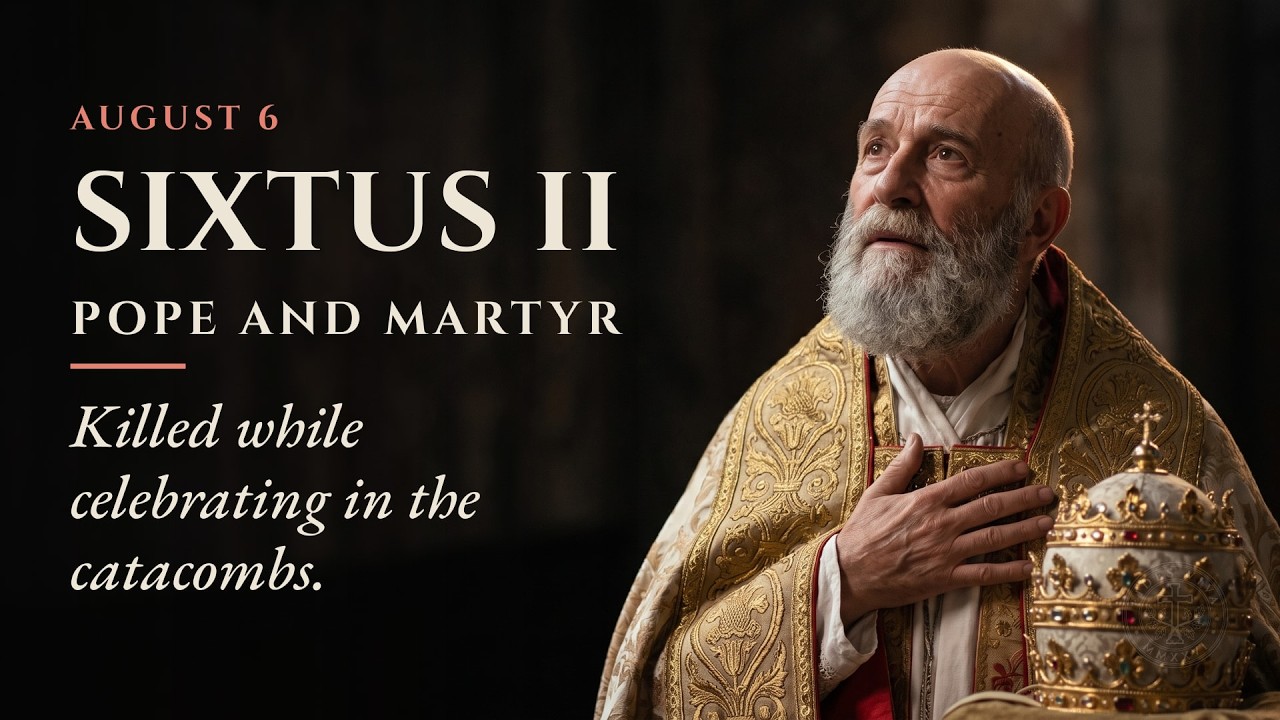
In a vaulted chamber, the assembly presses together among the tombs of their dead. The bishop presides, seated on a wooden chair, above the grave of a martyr: a white linen tunic, a raw wool pallium across his shoulder, his feet still dusty from the descent. Before him, a clay paten and a blown-glass chalice; at his side, his deacons. He celebrates the Eucharist: he proclaims the death and resurrection of the Lord Jesus surrounded by those who had already fallen asleep awaiting him.
The voices blend into a single low prayer. And in the midst of that prayer comes the other sound. Footsteps, numerous and heavy; metal against stone; sharp orders echoing down the gallery. One by one, the words fade, until only the breathing of the assembly and the crackling of the wicks remain.
The soldiers enter, stooped in the narrow corridor: helmets, armor, the long sword at the side, red cloaks brushing against the niches. They search for exactly what the edict commands: the bishop. And they find him where a shepherd must be. No one needs to point him out. He does not rise to flee; there is no flight possible, and even if there were, he would not take it. He has spent an entire year gathering the scattered; he will not leave them, as a final lesson, with the image of a shepherd who flees. He remains in the chair, still, his gaze serene upon his people.
Everything is swift. That same day, the sixth of August in the year 258, he is executed with four of his deacons. Roman memory would remember him beheaded without rising from the chair; others said he was taken outside. He dies beside the altar he presided over. Blood runs across the stone where the bread had just been broken. The pallium slips to the floor; the chalice lies overturned. A fallen lamp beside his body keeps burning, determined in its small light.
When the boots fade away, the faithful emerge from the darkness. Trembling hands lift the body of the shepherd, close his eyes, compose the blood-soaked tunic. There are no cries: beneath the earth, even grief learns to be silent. That same day they bury him beneath the Appian Way, among the martyrs he had come to honor. His pontificate, begun on the last day of August the year before, had lasted only that: one year.
What remains of a life cut short like this? A community on its knees, an empty chair, a lamp that no one dares to extinguish. And something more, not yet visible: the news is already on its way. While Rome buries her bishop, a ship prepares to set sail for Africa. Soon a letter will cross the sea.
The Memory That Crosses the Sea
Days later, the news reaches port in Carthage.
There waits Cyprian, the bishop with whom Sixtus had sealed the peace barely a year before. The man who had disputed with Rome and returned to embrace her now receives, by sea, the weight of grief. Toward the tenth of August he takes up his stylus and writes to Successus, another bishop in Africa, to warn him of what draws near. Among the urgent lines of the letter, the news runs: "Know also that Sixtus was executed in a cemetery on the sixth of August, and with him four deacons."
A sober line, almost spare, written four days after the blow by someone who loved him. Cyprian writes to alert: the same edict will come for the shepherds of Africa, and he knows it. But the letter does more than it intends. It holds the date, the place, the number, with the exactness of one who does not want anything to be lost. The letter travels from bishop to bishop as a warning and, without seeking it, as a testimony. Cyprian himself will walk toward his own sentence only weeks later, in September of that same year.
In Rome, meanwhile, there remains a deacon. Lawrence, the archdeacon, the man who guarded the Church's goods and knew her poor one by one. The memory of the Church later added an encounter between the two. Lawrence came to meet the elder as the soldiers led him away, grieving that he could not die at his side. And the pope consoled him: he would follow in three days; his, meanwhile, was the charge of distributing the Church's treasures among the poor. With the passing years, that same memory gave names to other deacons who fell that day, until the count reached six.
The rest came as promised. On the tenth of August, four days after the pope, Lawrence too gave his life for Christ. The torch had passed from hand to hand without going out: the shepherd first, the deacon behind, and between them a fidelity that the sword could not cut.
Beneath the Appian Way, the body of Sixtus rests in a chamber carved from the tufa, beside other bishops of Rome of that same century. Pilgrims would call that place the Crypt of the Popes. In that crypt the names were scratched with a point into the stone, without titles: only a name in the rock. It is little. And it is a beginning. So a death begins to become a seed: a letter that crosses the sea, a charge placed in the hands of the poor, a name entrusted to stone. To that darkness, soon, those who wished to pray where he fell would descend; and the stone that today is silent would learn, in time, to speak.
A Name That Does Not Fade
A century later, the stone spoke.
It was through the hands of a poet-pope. Damasus, bishop of Rome between the years 366 and 384, descended into the crypt where the shepherds of the age of persecution slept and wanted no one to forget. He had the chamber excavated, enlarged, lit. Over the tomb of Sixtus he ordered an epitaph carved in verse, in the elegant hand of his calligrapher Filocalus: fine strokes, squared serifs. In those verses the scene was fixed: the chair, the shepherd seated, the soldiers who broke in. Someone remembered when no one lived who had seen it.
From then on pilgrims descended to pray where he fell, and scratched their names into the plaster of the galleries. Devotion kept widening across the centuries: as those who came after would tell it, when a pope of the ninth century sent relics of the deacons Felicissimus and Agapitus to lands of the north, and had them shine in the mosaic of a Roman basilica.
But the deepest place of his memory is not stone or mosaic. It is a voice. Before the seventh century ended, his name entered the great eucharistic prayer of Rome, the Roman Canon, in the list of the martyrs: Linus, Cletus, Clement, Sixtus. From then on, each time a priest celebrates the Mass with that prayer, the name of the old man in the catacomb is spoken. Beside the bread and wine that become the body and blood of Christ. He died in the Eucharist; the Eucharist names him still.
His day, the sixth of August, was fixed in the Roman calendar of martyrs that was compiled in the year 354. Today the Church remembers him on the seventh, because the sixth celebrates the Transfiguration of the Lord; and in the prayer of that morning, still, the letter of Cyprian is read.
The empire that condemned him fell apart. The language changed, the city changed, seventeen centuries of the world changed. And beneath the Appian Way the galleries remain open: one descends, one prays, one hears the same silence. A name spoken so, generation after generation, is no longer a memory. It is someone still being called.
In the Gesture of Remaining
There lingers, in the air of those galleries, the question of that August day: what brings a man to stay when he knows the next blow might be the last?
Sixtus did not answer it with words. He answered it with a year spent mending what lay broken, and with a body that did not move when the soldiers came. He stayed because he was doing what he loved: breaking the bread of Jesus Christ with his own. To flee would have been to leave the table set and the flock alone. He could not do that. His courage was that simple: not a heroic gesture, but the quiet resolve to finish what he had begun.
His memory was not held up by any power. No army defended it; no victory imposed it. It was held by a small community that kept descending to pray, and by a prayer that never released his name.
We too know that hour. It does not come with soldiers at the door: it comes in the small things, in the ordinary morning when it would be easier to rise from the table and not return, and something, deep within, asks us to stay a little longer.
That question has not grown old. It waits still, burning like a lamp in the half-light.
Saint Sixtus II, faithful shepherd to the altar of your own blood, pray for us.