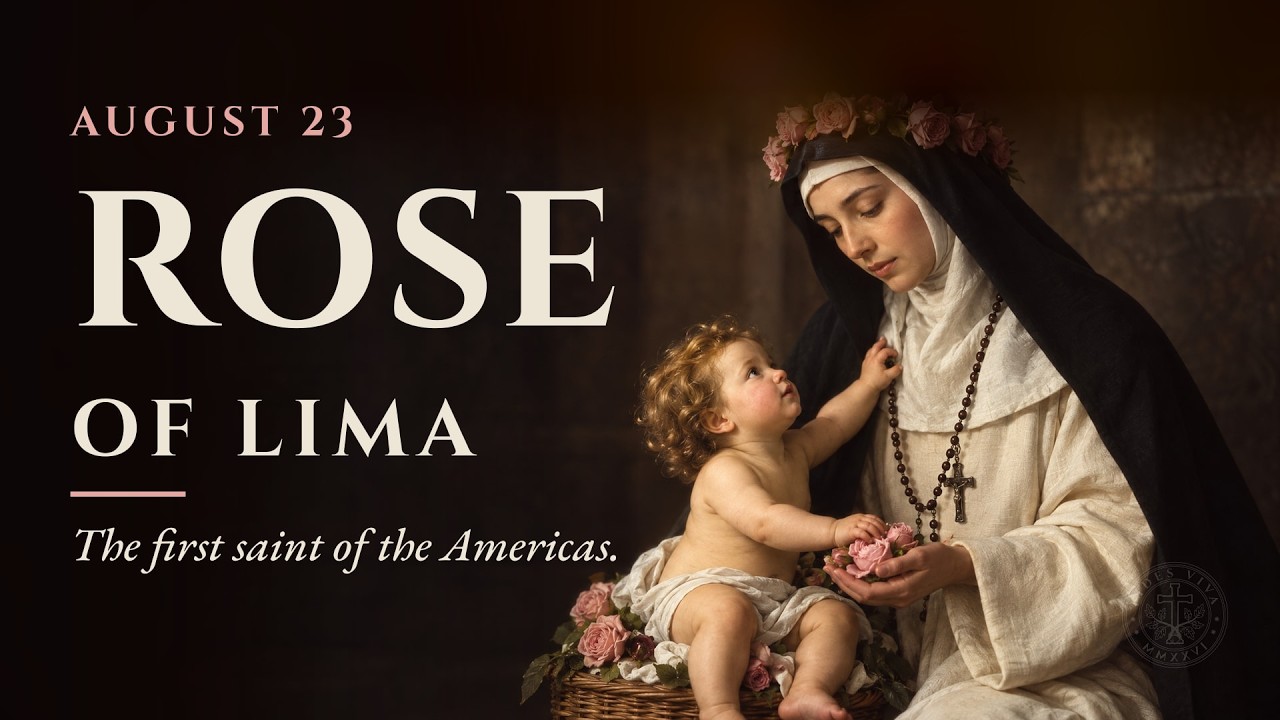
It is almost midnight and the house sleeps. By the light of a candle, a young woman loosens her braid before a small mirror. That same afternoon her mother crowned her with flowers so that suitors might admire her: her beauty is the only fortune left to the family. She looks at the mirror. She raises her hand. She brings scissors for sewing.
A single cut. The braid falls to the floor.
We are in the City of the Kings—Lima—capital of the Viceroyalty of Peru, toward the year 1600. A city where a young Creole woman, poor and beautiful, has only one honorable path ahead: a good marriage. That night, with a gesture of seconds, she cancels it entirely. The household would remember afterward that she had made a vow in secret: she would belong to no man. She would belong to Christ.
The suitors would stop coming. Her mother would never understand that choice. And she would remain under the same roof, sewing at night so that her own could eat.
One day, the entire capital of the viceroyalty would come to a stop for her. The Plaza Mayor full from end to end; the cathedral overflowing. And in Rome, half a century later, something would be done for her that had never been done for anyone born in these lands. For anyone, in an entire continent.
They called her Rose.
But before the scissors came a baptism, a nickname that became destiny, and an archbishop who came down from the Andes to confirm her.
A Child in the City of the Kings
The Lima of the late sixteenth century was two cities in one. Through its streets laid out in a grid passed the silver of Potosí, processions under canopy, and the carriages of the royal judges; and in the courtyards of those same churches slept indigenous beggars and nameless laborers. Twenty-five thousand souls, friars of four orders within a few blocks, a viceroy, an Inquisition tribunal watchful over everything. A capital that displayed all things, full of people who had nothing. In that gap between splendor and hunger a response would find its way that no one expected. Not a famous preacher. Not a bishop. Just an ordinary girl.
On April 20, 1586, in one of those adobe houses with an interior courtyard, a girl was born. Weeks later she was baptized in the parish of Saint Sebastian with the name Isabel: Isabel Flores de Oliva, fourth of the many children of Gaspar Flores and María de Oliva. Gaspar was a harquebusier in the viceroy's guard, born in San Juan, Puerto Rico; María, a Creole woman of Lima from a family fallen on hard times. Honored name and a thin purse: a soldier's wage, a dozen mouths to feed, a mother who counted coins each night by candlelight.
No one in that house called her Isabel for very long. The family would remember afterward that her mother, leaning over the cradle one day, saw the child's face bright and beautiful as an open rose, and from then on called her by that name. Rose. At first it was only a mother's pet name, one of those names spoken within walls. With time it became a name, and much later, the name of a continent at prayer.
Around 1597 the family's fortune tightened still more, and Gaspar took work in the mines of Quives, a village in the Chillón Valley, in the highlands, far from the capital. For the eleven-year-old girl, the world changed at once: tawny hills, a river carved into stone, mine dust in the air, and a fruit orchard beside a white adobe chapel. And to that remote chapel came the archbishop of Lima one day.
His name was Turibius of Mogrovejo, and he was no armchair pastor. He traveled on foot and mule through the harshest roads of his vast diocese, confirming tens of thousands of indigenous people in towns and valleys where a bishop rarely came. On his visit to the valley he confirmed the harquebusier's daughter as well. The oil upon her forehead sealed her as a witness of Christ; and with the sacrament, the nickname from the cradle was fixed forever: Rose. In a village chapel, where no one could have known it, a future saint was confirming a future saint.
Later the family returned to Lima, to the house with the garden. The girl with the braid was growing, and with her grew something her mother watched with a hope that became less and less concealed: she was beautiful. The witnesses who testified after her death would repeat it, one after another. And in the City of the Kings, the beauty of a poor daughter was no ornament: it was the only capital the house possessed, the only door to a good position. No one could have suspected then what destiny awaited a girl so ordinary in a city so extraordinary. Her mother already had plans. She, in silence, was beginning to have others.
The Beauty and the Secret Vow
The plans of María de Oliva were not vanity: they were arithmetic. A house with more than a dozen children, a soldier's wage, and everything held together by a thread. A good marriage for the beautiful daughter could save them all. That is why the mother did what so many mothers of her time did: she dressed her, she combed her hair, she showed her off. At visits, at Mass, at feast days. And so that no eye would pass by, she placed upon her head a garland of fresh flowers, cut from the garden itself.
The young woman let herself be combed and crowned, and lowered her eyes before the visitors. She obeyed in all that she could obey. But it would be said afterward, among those close to her, that beneath those flowers she hid thorns that pricked her forehead: a crown of celebration on the outside, a crown of thorns within. No one noticed. And that was the point: that no one should notice.
Because by her fifteenth year, those who knew her said, Rose had already made the greatest decision of her life, and made it alone. In silence, without ceremony or witnesses, she promised her virginity to Jesus Christ: she would belong to no suitor, however rich he might be. An invisible vow, made by a girl in a house full of people. And invisible vows have a problem: the world does not see them. The suitors kept coming to the door. Some brought a good family name; others, promises of a future. Her mother received them with hope. Her daughter, with an impenetrable courtesy.
Then she took the step her mother could not forgive for years. The household remembered that night this way: she took the scissors with which she embroidered to earn bread and cut her braid at the nape of her neck. And that same memory adds that she went further: that she rubbed her face with pepper and lye, to wither the beauty that served as bait. Where her mother saw a treasure, she saw an obstacle between her soul and Christ. She removed it.
The storm came. Reproaches, tears, a struggle of years between two kinds of love that could not understand each other. One was a poor mother who wanted to save her own. The other was a daughter who already belonged to another Lord. She did not answer with speeches: she answered by staying. She remained under the same roof, obedient in all else, and became the quiet support of the family. With silk and gold thread she embroidered flowers on cloth for others, while real ones grew in her garden. She sewed until dawn by candlelight, tended the flowers of the garden and sent them to be sold. From those hands her parents and brothers ate; the hands that might have worn rings grew thick with calluses. To this work she added fasts and penances so severe that her confessors had to restrain her. And she obeyed them too.
Yet one question remained open: if she belonged to Christ, was not the convent her place? She believed so for years. Around 1605, nearing twenty, it is said that she resolved to ask for entry into the monastery of Saint Clare, behind the walls of enclosure. The memory of Lima recalls that day almost step by step. She left home resolved, and on the way she entered to pray before an image of Our Lady of the Rosary, the devotion of her whole life. She prayed. She tried to rise to continue on. She could not. She tried again, and her knees would not obey, as if a gentle hand held her to the ground. When at last she stood, she did not walk toward the monastery: she turned back home. She had understood the sign. Her enclosure would have no walls.
Besides, she was needed at home: her father was growing old, the purse remained tight, the younger brothers were growing. To stay was also a surrender, though no one would call her religious for it. A vocation like that fit no known mold in the City of the Kings: neither wife nor cloistered nun, consecrated among needles, household accounts, and pots. Could such a deep surrender survive, pressed between the duties of the house and the expectations of all? She would invent the answer. She only needed to give it a visible form. And that form came at last, dressed in white and black.
The Orchard and the Hermitage: A Cloister Without Walls
One morning in 1606, in the church of the Convent of Santo Domingo of the Dominicans of Lima, a young woman of twenty years knelt before the altar and received upon her shoulders the habit of the Third Order of Saint Dominic. A white woolen tunic, a white scapular, a black mantle, a veil that would cover her short hair forever. She did not enter the cloister nor pronounce the vows of a cloistered nun: the tertiaries were consecrated women who continued to live in their homes, in the midst of the world, under a rule of prayer and penance. It was exactly the mold her life already had. That day the name the household had given her as a child was sealed in religion with the form the city would never forget: Rose of Saint Mary.
She had chosen the model long ago. Saint Catherine of Siena, the Third Order Dominican of the fourteenth century who never lived behind the walls of a monastery, was her mirror: a laywoman who showed that total surrender does not need walls. What Catherine had been in Siena, she wanted to be in the City of the Kings.
But the habit needed a place, and she built the place herself. With help from one of her brothers she built an adobe hermitage in the family orchard, around 1607. It was a cell of barely a few paces on each side, with a low door and a small window through which came the little light she needed. There was room for a cross, an image, and a person on her knees. Nothing more. Other young women of Lima dreamed of parlor seats and balconies; she had measured her cloister with her own steps, and it had space to spare.
There she spent her nights. When the tasks of the house were done, when the curfew bell tolled over the city and the braziers went out street by street, she crossed the orchard in darkness among the roses. There she locked herself in to pray. Hours on her knees before the crucifix, speaking with Jesus Christ as one speaks with someone present. The little sleep she allowed herself she took on a bed she had made from logs and roof tiles: to sleep, for her, was another form of vigil. She kept in the cell a small image of the Child Jesus whom the devout would later call "the Little Doctor," and before it she recited the rosary that hung at her belt.
From that inner life something more than testimonies remained: there were papers. On pages written and drawn by her own hand — what are known as the Mercies and the Spiritual Ladder — she traced hearts, ladders, and emblems to give form to what she lived in prayer: the favors received, the degrees by which a soul rises toward God. A woman without theological schooling, drawing with ink the map of her own soul. Centuries later, those drawings of hers would still puzzle those who tried to read what she lived alone in a cell of mud.
Because what is astonishing about those years is the balance. The mystic of the night was, by day, a tireless worker. At dawn she left the hermitage, rolled up her habit, and returned to the frame: embroidery and sewing by commission. The flowers of the orchard — roses, lilies, jasmine — were cut in the early hours and sold in the city. The same orchard gave her family their bread and her prayer its silence. The same hands that at night held the rosary, by day wielded the needle and the pruning shears. No one who saw her haggle over the price of flowers would have suspected the hours that woman spent on her knees.
She was not alone in that Lima of hidden saints. A few blocks away, in the same Dominican convent where she had taken her habit, a lay brother named Martin de Porres, a mulatto, cared for the sick and gave bread to the poor. In the Plaza Mayor, the Franciscan Francis Solano — who would die in 1610 — shook the city with his preaching. In the Dominican cloisters it was told for generations that Rose knew them and spent time in their company. Three sanctities crossed the same streets, never knowing that one day they would share the altars The most splendid city in the Americas was quietly raising its saints.
Can sanctity grow where no one sees it? In that orchard it grew as the roses grew: without witnesses, through water and countless nights. But a surrender like that could not stay locked behind four walls of adobe. On the other side of the wall was a city full of the sick whom no hospital would receive. And the door of the Flores house was about to open for them.
Charity and the Dark Night
Around 1610, a room in the Flores house changed its purpose. Where other Creole families placed chairs and a dais to receive visitors, she spread mats on the floor. And on those mats she began to lay the sick. They brought them in from the streets of Lima. Indigenous people from the highlands, fallen ill far from home through forced labor; Africans enslaved and no longer useful for work, claimed by no one; and nameless beggars. The city had hospitals, but they were not enough for all: there were sick whom none would receive, and they lay in doorways, visible to everyone. She gathered them in.
She cared for them with what she had. Herbs from her own orchard, bandages of linen sewn by her hand, water, broth, and the money from her embroidery: each finished piece of needlework in the nights became medicine for one of those sick. María de Oliva protested, and her protest had human reasons: that room was the family's dignity, the little that was left of their standing. Her daughter, on her knees on the floor, washed the wounds of an indigenous sick man in the same place where she had dreamed of receiving Lima's good society. Rose did not argue. She went on washing. For her, each of those broken bodies was the body of Christ, and she touched them as one touches something sacred.
Her own body paid the price. Hands reddened by cold water, dark circles under her eyes that no longer faded, a thinness that frightened her friends. To the embroidery of the day and the prayer of the night had been added a third labor, and she gave up none of the three. She fed with her own hands those who could not hold the bowl, kept vigil over the dying. The memory of Lima would later see in that room the seed of care for the sick of an entire nation; she saw only the person in front of her. The witnesses who knew her then remembered the same thing: a serenity that never broke.
And yet the hardest part of those years was invisible. It happened at night, in the hermitage. She entered, knelt, began the prayer as always… and found nothing. Not a voice, not a tear, not the least inner comfort. The God for whom she had cut her braid and canceled a future was silent. And that silence did not last a week or a winter: it lasted fifteen years. Fifteen years of praying in darkness, keeping the schedule hour by hour, as one keeps a promise made to someone we love even though they do not answer. Her confessors knew it and noted it with wonder: the dryness did not make her bitter, did not loosen her surrender, did not take from her the serenity that everyone remembered. From her lips were preserved words that sum up those years better than any explanation: "Let all men know that after tribulation comes grace." And others, even more bare: "Without the weight of afflictions one does not reach the summit of grace." They were not theories from a book. They were the map of her own nights.
A woman like that could not pass unnoticed. Lima was the seat of the Tribunal of the Inquisition, and the Tribunal closely watched local pious laywomen and visionaries: and suspicion fell quickly on anyone who claimed to receive favors from heaven. Rose was talked about too much: about her fasts, her penances, about what she said she had received in prayer. Around 1614 came what was inevitable: an examination. Dominican and Jesuit theologians questioned her at length about her spirit, her visions, and her mortifications. With them was the doctor Juan del Castillo, physician and theologian both, a man trained in both medicine and theology. It was, in effect, a trial of her soul. She answered everything simply, without defending herself or adorning her words, and accepted the verdict beforehand, whatever it might be. The judgment left her in peace: that spirit, they concluded, came from God. And the physician who had come to judge her stayed to guide her: Juan del Castillo would be, from then on, one of the guides of her inner life.
A year later, the city knew fear. In July of 1615, a corsair squadron under the command of Joris van Spilbergen appeared off the port of Callao. For Catholic Lima that was more than a military threat: the Dutch were enemies of the faith, and the city feared the sacking of its temples. There were families that fled inland, treasures hidden, men half-armed running toward the harbor. Lima kept from those days a memory it still repeats: while the city came undone in panic, Rose went to the church of Santo Domingo and took her stand before the altar. She was resolved to defend with her own life the Blessed Sacrament — Christ himself, present in the tabernacle — if the invaders entered to desecrate it. A slight woman, unarmed, facing a squadron of war. The ships waited off the coast. And then, without attacking the city, they withdrew. That is why so many images of her show her holding an anchor: the hope that held Lima firm during that week in July.
When the Dutch sails were lost at sea, Rose was twenty-nine years old and her body worn like an old woman's. She had given her beauty, her sleep, her hands; that night she had shown she was ready to give her blood as well. What sustains a faith that prays fifteen years without answer, passes the judgment of the learned, and keeps vigil before an altar waiting for a raid? Something that does not depend on what we feel or what others think. She called it grace, and she knew its price.
Two years of life remained for her. And what awaited her in them was not more darkness, but the most luminous calm of her entire path.
Espousals and Agony: The Total Gift
Palm Sunday came in 1617. Lima smelled of palms and olive; the bells of the convents answered one another tower to tower, and the crowd filled the church of Santo Domingo to open Holy Week. Among that multitude, almost invisible, a Third Order Dominican tertiary in white and black habit withdrew to the Rosary Chapel, in the same convent where eleven years before she had received her new name.
The friars of the Rosary kept forever what was told of that morning. Praying before the image of the Virgin with the Child, Rose heard what she had been waiting half her life to hear: Jesus took her as his bride. The vow whispered at fifteen, the braid cut with sewing shears, the fifteen years of silence in darkness — all of it received at last its answer. That is why so many images of her show a ring on her hand and the Child Jesus in her arms: the spouse of Christ, in a chapel in Lima, on a Palm Sunday.
It was not the beginning of a new stage. It was a farewell. Shortly after, she fell ill, and this time the body, worn by more than fifteen years of fasts, vigils, and labor, did not rise. Her last months she spent away from her parents' house, in the home of her friends Gonzalo de la Maza, an accountant of the Santa Cruzada, and his wife María de Uzátegui. They loved her as a daughter, and gave her the rest that her own house, full of the sick and of hardship, could not give her. The illness was long and cruel: pains that were paralyzing her limb by limb, nights without relief. Those who cared for her would remember that she herself had announced the date of her departure, and that she awaited that day without fear, as one awaits a wedding. She was not pretending. In the midst of the pains she repeated what she had learned in her own nights: "If mortals knew what a great thing it is to possess divine grace, how beautiful, how noble, how precious." For her, that suffering was not a punishment: it was the last stretch of the road to the Bridegroom.
On August 24, 1617, surrounded by her friends and those who had cared for her to the end, Rose died. She was thirty-one years old. In the room there were no cries: the witnesses spoke afterward of a strange peace, as if death had entered on tiptoe. The face that illness had sharpened held, they said, the hint of a smile.
And then something happened that would fix her face forever. That same day there entered the house the Italian painter Angelino Medoro, then living in Lima and well known in the city. He set up his easel beside the bed and painted her face from life, before time could erase it. The fine oval of her face, the straight nose, the thin lips, the crown of roses that her friends had placed over her veil. From that sketch taken before death were born all the portraits the world knows of her. It is not an idealized altarpiece image: it is her true face, seen by a man who painted quickly, with an entire city waiting outside the door.
Because behind the door was Lima. The news ran through the city faster than the bells: the saint had died. And the capital of the viceroyalty, which had kept her hidden in an orchard for ten years, discovered all at once how well it knew her. The sick came whom she had healed in the room of the mats. The ladies came who had commissioned embroideries from her without knowing whom they were feeding with them. Indigenous people, Africans, mestizos, friars, scholars came. The multitude that wanted to see her, touch her, say goodbye, was such that the burial had to be delayed: the city, simply, would not let her go. Her funeral in the cathedral brought together the authorities of the viceroyalty, and her body was taken to the Convent of Santo Domingo, to rest among the friars whose habit she had worn.
How could a life so quiet call an entire city to mourn her? Perhaps because the secret was never so secret. Each sick man washed, each bowl of broth, each flower sold had left a silent trace through the streets of Lima, and at her death all those loose threads tied themselves together at once. The city of pageantry and processions understood, before that coffin, that its true treasure had not been in the galleons of Callao, but in a hermitage of adobe the size of a few steps.
And Lima was not willing to let that certainty cool with the candles. Before the funeral tapers had grown cold, there were already those beginning to write what they remembered.
Memory and Miracles: The Saint of the Americas
The Archdiocese of Lima opened the process that very year of 1617, when the funeral was still being spoken of on every corner. Before the notaries came her mother, her brothers, María de Uzátegui, the treasurer De la Maza, friars, lawyers, physicians, the sick whom she had healed with her own hands. Between the first process and the second, two hundred and ten witnesses swore and told all they knew: the hermitage, the fasts, the nights of prayer, the mat-lined room, the fifteen years of silence. And her confessor, Friar Pedro de Loayza, only two years after her death, set down in writing the first life of Rose, with the domestic details that only he knew. The woman who had fled from every glance became, folio by folio, a record of two hundred and ten sworn voices.
Those papers crossed the ocean. In 1634 the cause was formally presented in Rome, and there began another wait, as long as it was patient: the Church does not canonize in haste, and least of all a laywoman from the far end of the world. Decades passed. But by the end of the 1660s Pope Clement IX declared her blessed, and the feast was celebrated in Santa Sabina, the Roman house of the Dominicans: on the Aventine, among ancient columns, there sounded for the first time on an altar the name of a woman of Lima.
What came after was still greater. On August 11, 1670, before even canonizing her, Clement X proclaimed her principal patroness of the New World: an entire continent placed under the care of the girl of the orchard. And on April 12, 1671, having approved four miracles obtained through her intercession, the same pope inscribed her in the catalog of the saints. Rose of Saint Mary was now, officially, Saint Rose of Lima: the first person born in the Americas raised to the altars, patroness of Peru, of the Americas, of the Indies and of the Philippines.
The weight of that was not small. For a century and a half, the Americas had been missionary land: the continent that received the faith of Jesus Christ, never the one that gave it back. Now a daughter of that land, a Creole seamstress who lived almost her entire life in her parents' house, was held up as a model to the universal Church. When the news reached Lima, the city poured out as it had at the funeral, but this time in celebration. Triumphal arches in the streets, poetry contests, facades adorned, processions with her image in white and black habit and crown of roses under the gray sky as always. The capital that had kept her hidden paraded her now on litters through the very streets she had walked with her head bowed.
And from that pride was born a legend that Peru still tells with a smile. Popular memory says that in Rome, as the cause was examined, the pope himself exclaimed in disbelief: "A woman of Lima, beautiful and a saint? Not unless roses rained down" — and that in that instant petals began to fall upon his desk. It is not recorded in the acts; it lives elsewhere, in the celebration and in the tenderness of a people who wished to answer that way to Europe's doubt. What is recorded are the two hundred and ten sworn voices that upheld the cause: the holiness of Rose was not proved by petals, but by the testimony of the sick she had washed and the nights she had kept vigil.
Thus it was that a life so silent became a banner and comfort for generations: not for her ecstasies, but because an entire continent recognized itself in her. And that devotion, far from fading with the centuries, was only just beginning.
The Living Legacy: Rose Today
Four centuries later, the house still stands. Today the first block of Tacna Avenue is pure traffic and car horns, and amid the noise the sanctuary opens: the orchard, the rosebushes, the remains of the adobe hermitage that she built with her brother. And the well. Each August 30th—a national holiday in Peru, though the Roman calendar celebrates her on the 23rd—thousands of people wait in line for hours under Lima's gray sky. They come to that stone rim and drop a letter written by hand. They ask for health, work, a child, forgiveness. In recent years letters also arrive by email, from countries she could never have imagined. Almost twenty meters below, in the dark water, the confidences of a continent accumulate.
A few blocks away, in the Basilica of Santo Domingo, her bones await her visitors. The skull of Rose is venerated in an marble urn plated with gold and silver, alongside the relics of Martin de Porres and John Macías. The three saints of that Lima remained together, beneath the same roof where she received her habit. Before that urn, every day, tourists, schoolchildren, women kneel and pray to her in low voices as one speaks to someone in the family.
And her story continues to be written far from home. On January 31, 2026, in the Vatican Gardens, Pope Leo XIV—who spent long years of his ministry in Peru—blessed a statue of her carved in white travertine from Huancayo by the young Peruvian Artesanos Don Bosco. The image shows her with her Dominican rosary and the anchor of hope, the same one from Callao, presiding today over a corner of Rome. The city that took half a century to believe in a saint from Lima now keeps a place for her among its gardens.
Her name is everywhere: parishes throughout the Americas and the Philippines, towns, schools, hospitals, and whole generations of women baptized Rose in her memory. She is patroness of embroiderers and gardeners, of nurses and police, of the indigenous peoples of the Americas, of those mocked for their faith in Christ. The girl who hid from every glance became one of the most looked-upon saints in the world.
Perhaps because her greatness fits in any house. She left no treatises, no foundations: she left an orchard, a needle, a well. And that, precisely that, is what people still come to seek in that orchard today.
The Hidden That Blooms
That gesture before the mirror left a question hanging in the air: what moves someone to renounce everything the world applauds. Rose answered it without speeches. She answered by cutting a braid, by raising a cell the size of her own footsteps. She answered by washing wounds on the floor of her house, by praying fifteen years without feeling anything. Everything her world offered her she placed, whole, in the hands of Jesus Christ.
We know that question too, though it comes dressed in another way. It reaches us one ordinary day. In the job that can vanish overnight, in the diagnosis heard in a hallway, in the ordinary morning when no one notices what we do or thanks us for it. What is the worth of what we give when no one is watching?
She chose what was small, again and again: the embroidery frame before the mirror, the vigil before the feast, the sick before the suitors. And what was small, with the centuries, became immense. The girl who hid in an adobe cell now holds the hope of millions; her name is prayed on every continent; her face crowns altars she would never have wanted for herself. Nothing of what she gave in silence was lost. The flower that no one saw grow is today patroness of an entire continent.
Saint Rose of Lima, patroness of Peru, of the Americas and the Philippines, model of hidden life and charity, pray for us.