A stone cell. On the straw, a thin prisoner who has not spoken his name in five years.
One sentence would be enough. His family has a voice in the government of his own city; the surname alone would be enough for someone to write a letter for him.
He does not say it. Not the first winter, not the fifth.
He dies in there, with no trial and no name, and the jailers bury what they take for an ordinary spy.
The year is 1327, in Voghera, and no one in that prison knows who they have just put in the ground.
That man had given away an entire inheritance before he turned twenty. Then he walked into plague-stricken cities that everyone else was fleeing, and knelt beside sick people their own families would not touch.
Until it was his turn. No one drove him out: he went alone, at night, to a wood at the water's edge, and built himself a shelter of branches barely larger than his own body.
And then the bread began to appear. Every day, a loaf beside the entrance. No neighbour brought it, and no relative.
It was a dog.
His name was Roch. Roch of Montpellier.
To understand how the heir of a powerful house ends up dying nameless in a foreign prison, we have to go back to the day he opened his house and began to give everything away.
Promise and Inheritance
Montpellier, at the close of the thirteenth century. The city smelled of spices, of leather and of scribal ink; through its gates came caravans climbing up from the sea and students arriving from across half of Europe. Under the Crown of Aragon, it was a merchant's plaza and home to one of the most celebrated schools of medicine in the Christian world: whoever fell ill in the south came here seeking a cure. And yet it was a world that lived in fear, because it knew that fevers traveled in ships and that no wall could stop a plague.
In that city, memory places the birth of Roch, around the year 1295. Some push that date, and everything that followed it, half a century later; this account follows the chronology the city itself preserves, and the years heard from here on are its own. Other voices move it forward two generations, to the days of the great pestilence, but the heart of his life does not change.
There lived a couple of comfortable station: John, whom memory recalls among the men of the city's governance, and his wife, Libera. They had a roof, lands, and respect; what they lacked was the one thing money cannot buy. The years passed and no child came. In their waiting, tradition says, they made a vow: if God granted them a child, their goods would go to the poor, in whom the faith of that time recognized the very face of Christ.
And the son arrived. One alone, long awaited, born so late that his cry must have sounded in that house like a bell. They called him Roch. Memory, more tender than exact, adds that the child bore a mark of birth: a small reddish cross on the left side of his chest, as if his calling had arrived written before his name.
He grew up sheltered, among chests full and tables well served. His father taught him what in that house was custom before it was doctrine: to open the door to those who ask, to aid the poor without asking their history. The boy learned early that the wealth of his line carried an ancient debt, contracted in a vow.
That childhood ended abruptly. While still very young, scarcely at the threshold of adulthood, he saw his father die and then his mother, one after the other. The house fell silent, and all that it held—the lands, the coins, the name—fell upon the shoulders of a boy alone.
Heir to all, master of nothing he had asked for. Others in his place would have managed, prospered, founded a dynasty. He spent his afternoons before the open chest, gazing at that fortune as one gazes at a question. And with each passing day, his eyes turned more often toward the door.
The Renunciation: A Road Without Return
The decision did not come like lightning. The year was 1315. It ripened in those silent afternoons, among accounts he did not care about and servants waiting for orders. In the churches of Montpellier, a gospel was being read in those days that many heard standing, with reverence, and then left behind in the temple as they departed. Words of Jesus to another young man of wealth: "Sell what you have, give the money to the poor, and you will have treasure in heaven."
Those who came after remembered it this way: that young man heard them as if hearing his own name. In them lay the ancient promise of his parents, the debt of his house, and something deeper still: a freedom no one had taught him to desire. There were no years of doubt, no weighing of accounts. He decided, once and completely.
For days, the door of his house stood open wide. The poor of Montpellier came in—those who begged by the churches, the widows, the sick beyond remedy. They left with coins, with grain, with blankets, with the fine clothes of an entire line scattered across other shoulders. There were no speeches. There was a young man counting money into weathered hands, one by one, until nothing remained to count. Some neighbors spoke of holiness; others, of madness. He answered neither.
What could not be given by hand—the lands, the rights, the legal weight of a name—he left to an uncle of his to manage. He kept nothing for himself: not a single income, not a key, not the family ring. At twenty years old, the heir of one of the well-off houses in the city possessed nothing in this world.
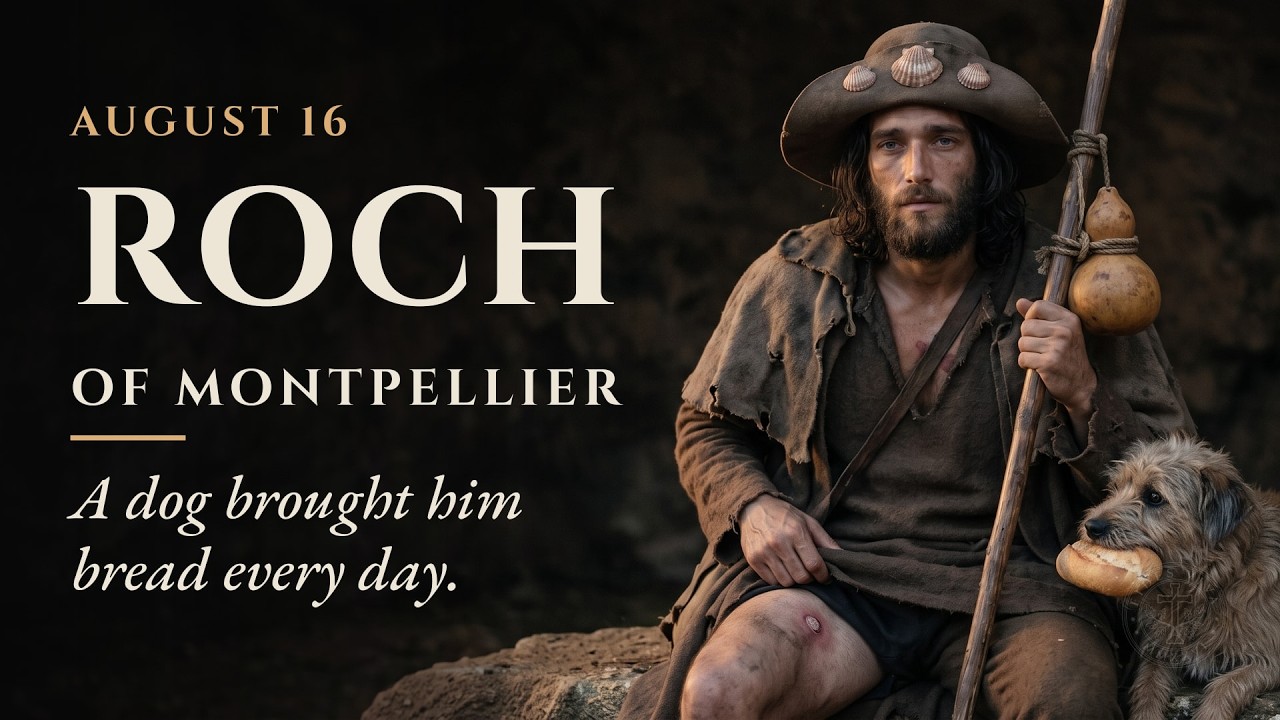
One last gesture remained, and it was the most visible. He took off the fine woolen coat that declared his rank to anyone who passed him in the street, and dressed himself in rough wool, undyed, the color of earth. A rope belt. A short cloak across his shoulders, for the rain. A felt hat with a wide brim, bearing the sewn-on badge that marked the pilgrims of God. At his side, a leather satchel; in his hand, a tall walking staff with a water gourd tied to it. It was the complete equipment of his new life: the little that suffices.
And one morning, early, he left. There were no bells, no public blessing, no procession to see him off: only the sound of the staff on stone and streets still half asleep. He crossed through the city gate—that moment which the city did not know it should remember. He left behind the house of his childhood, the tomb of his parents, the name by which he was known there. Before him lay hundreds of leagues: the pilgrim road that descended toward Italy, toward Rome, toward the tombs of the apostles.
He walked toward a destination, and still believed that destination was a city. Feet without calluses would soon learn what dust is; unspoiled hands would learn what it is to beg. But in that first day's journey there was only the horizon, open like a promise that had not yet spoken its name. What he would find on that road, no one had imagined: not he, nor those who saw him depart.
The First Hospital: Where the Mission Begins
Weeks of walking lay behind him. The year was 1316. Provence fell away, then the roads descending toward the south, then the plains of Italy, stitched together with bell towers. He learned to sleep in pilgrim hospices, to eat what was given to him, to keep silent in languages he did not understand. His feet hardened; his skin darkened in the sun. And somewhere along the road toward Rome, the landscape began to change in a way that no map had shown: villages with doors shut in broad daylight, fields half reaped, smoke from fires where clothing burned. Bells that tolled too often.
So he came to Acquapendente, a town of dark stone perched on rock, in lands belonging to the pope. The plague had arrived before him. The streets were nearly empty; those who could flee had fled, and those who remained locked themselves in with their sick or left them to die alone. The fear was so thick you could breathe it: fear of the air, of water, of the neighbor, of a hand's touch.
Any sensible traveler would have gone around the city. He went in. Those who kept his memory tell it this way: he walked straight to the hospital, where the afflicted lay with scarcely anyone to tend them. He asked to stay and serve. He left his hat and staff by the door, rolled up his tunic, and began with the simplest things: giving water, washing wounds, steadying heads burning with fever. Over the sick he traced the sign of the cross, calling on the name of Jesus Christ, and many were healed against all hope. The pilgrim who had come in passing stayed.
At night, the ward became a world apart. Pallets lined in shadow, oil lamps, smoke from herbs burned against corrupted air. The few who helped covered their faces with cloth; he was the only one who worked with his face uncovered, bent over each body as if contagion did not exist. It was not recklessness. It was a way of saying to each dying man: you do not frighten me, you are not alone, you are still someone.
There, among those pallets, something reordered itself within him without a sound. He had left Montpellier walking toward a holy city. He discovered that his destination was not a place: it was people. Rome could wait; the man dying that night could not.
When the plague loosened its grip on Acquapendente, he did not return to his route like someone resuming a plan. He followed the trail of the sickness. In Cesena, in Romagna, the same scene awaited him, and he answered with the same gestures—city after city, with no one keeping count. The tunic wore thin, his hands grew cracked, the badge on his hat lost its shine. Service became his way of walking.
Each hospital door he crossed was a wager with his own life, and he knew it. A calling born of others' suffering has no natural end: there is always another city, another ward, another body burning. The question was how long his own body could keep paying the price.
Rome and the Encounter with Power
Rome appeared at last before his eyes, and it bore no resemblance to any pilgrim's dream. It was 1317, and he would remain there close to three years. The pope lived far away, in Avignon, and the city of Peter was then a field of inhabited ruins: ancient basilicas among tall grass, towers of warring families, flocks grazing between fallen columns. Pilgrims arrived from all of Christendom to pray before the tombs of the apostles, and many brought with them hunger, fever, sickness. He stayed there about three years. Not in courts or great altars, but where he already knew how to be: beside those whom no one wanted to touch.
The tradition holds that among those sick there was one dressed in purple: a cardinal, whom memory gave the name Anglic Grimoard. The pilgrim from Montpellier tended to him as he did to any other, traced over him the sign of the cross calling on Jesus Christ, and the cardinal was healed. Grateful, he wished to do for him the only thing a prince of the Church could do: bring him before the pope. Memory, in keeping those names, mixed the times: set one beside the other, the years do not quite fit together. But what it meant to say through them remained clear: for a moment, hidden holiness brushed against the visible power of the Church.
And power looked at it. That audience remains in memory as an almost silent scene. The pontiff—Urban V, in the recollection—fixes his eyes on the gaunt, sun-burned walker, and sees in his face something the mirrors of courts never show. A question hung in the hall: who was this man, where did he come from, what name did he carry? One word would have been enough to change his life. Son of a notable house, connected—it was remembered—to the government of his city: the doors would have opened on their own.
He did not speak it. He received the blessing, bowed his head, and returned to the street, to the clay bowl and the pallets, as if nothing had happened. No honors, no office, no place at court: nothing that would weigh more than his satchel. A life can hide itself even when light calls it by name; his proved it in the very center of Christendom.
One day, without farewells, he took up his staff again and left Rome heading north, with the same long stride with which he had arrived. He was turning back toward his own land, from hospital to hospital, leaving behind the only court that had nearly held him. He could not know that the road home would ask of him more than all the years of service together.
The Contagion: From Healer to Healed
The road northward was a chain of wounded cities. Between 1320 and 1322 he made his way through them one by one. Rimini, by the sea; Novara, wrapped in mist; Piacenza, on the banks of the great river. In each one he stopped, and in each one he did what he had always done: set his staff by the door, roll up his sleeves, find the ward where no one wanted to enter. But the years of walking were written now in his body. He was thinner, darker, his hands cracked and split, his stride no longer as long. He had given his strength the way he had given his inheritance: without keeping anything back. And strength, like money, runs out one day.
In Piacenza, those who kept his memory tell us, the sickness found him. One night, among the pallets, he felt a fire in his leg that was not weariness. He drew apart to a corner, lifted his tunic, and looked: on the inner side of his left thigh, a dark swelling, tight and angry with redness all around it. He had seen it hundreds of times. He had washed it on others, covered it with linen, held the hand of those who carried it. He knew exactly what it was. And he knew how it would end.
He did not cry out, did not wake anyone. In a single moment he understood that he had crossed to the other side: for years he had been the one who bends down, and now he was the one burning. He understood something else too, and that decided everything. A sick man among the well is a threat; his breath alone can empty a house. That same night he gathered his satchel, took his staff as a crutch, and left the city without saying goodbye. He crossed dark fields until he reached a forest by the Trebbia River, and there, with branches and leaves, he built a shelter the size of a body. No one forced him to go. He went, for love of those he might harm.
Then came the days of fever. The sun filtered green through the leaves, and he trembled beneath that beautiful light that warmed nothing. Lips cracked, eyes sunken, thirst like a nail, and a trembling in his hands that would not let him be still. The man who had walked beside so many deaths now had not a single hand near him. No mother, no city, no name that anyone could speak. Everything he had given away in his life—wealth, health, company—he lacked now, all at once. One thing remained, the only thing he had never given away because it cannot be given: he spoke to Jesus Christ in a low voice, among the dead leaves, as one speaks to someone sitting beside you. He did not ask to turn back. He asked for water, and to endure.
Thus the devotion of his people kept the memory: in that forest, as the story goes, a spring broke forth between the stones beside his shelter, and one morning something moved among the trees. It was a dog. Large, a hunting dog, white with tawny patches, ears hanging low. It carried in its mouth a round loaf of dark bread. It left the bread beside the sick man, looked at him a moment, and went away. The next day it came back with another. And the next day again. One loaf each day, taken from a table the animal knew well: the table of its master, in the castle nearby at Sarmato.
The master was called Gotardo Pallastrelli, a lord of those lands. Day after day he watched his dog take a loaf from the table and disappear, until curiosity overcame him and he followed. The animal led him through the trees to the shelter, and there Gotardo found what any other would have fled from: a man consumed, bearing the mark of plague on his thigh. He did not run. He knelt where no one knelt, gave the stranger water, cleaned his wound, came back with food and blankets. And the man who had set out as a hunter left changed: the account adds that after tending to that unknown one, he gave away his own goods and embraced a life of penance. And in the loneliness of that forest, tradition tells, an angel bent over the wound and began to close it, with a comfort that came from no medicine.
Slowly, day by day, the fever loosened its grip. The skin of his thigh faded until only a drawn scar remained, and strength returned bit by bit to a body that had nearly surrendered. One loaf, one dog, a stranger who stayed: with these God held him when all else was gone. When he could stand again, he took up his staff and looked toward the west, toward the mountain passes that led to his own land. He knew he must return. What he could not know was who would receive him, or whether anyone, seeing him arrive, would recognize in that worn body the son of Montpellier.
The Return and the Silence of Prison
He set out on foot with the short stride of a man still healing. It was 1322. Behind him lay the forest, the spring, and the friend who had saved his life; ahead, the Lombard plain, cut through with rivers and suspicion. These were hard years in those lands: the lords of the cities warred among themselves, and at every gate a guard looked twice at any stranger. A walker thin and burned by sun, with clothes in tatters and a scar from plague on his leg, did not stir compassion. It stirred suspicion.
So he came to Voghera. At the gate they stopped him. Who was he, where did he come from, whom did he serve? The man before them carried no letters, no coins, not a single thing that could speak for him. Only a worn staff and a name he would not give. In times of war, a stranger who stays silent is a spy. They took him there and then, took his hat and his staff, and brought him between two guards to a cell of stone.
And here lies the deepest mystery of his whole life. One sentence would have been enough. To speak his family name, to name his house in Montpellier, to ask that someone write a letter. He came, as his own people would remember, from a house with a voice in the government of his city; a single word could have opened the door. He did not speak it. He had given away his inheritance, he had spent his health, and now he released the last thing a man keeps when he has nothing left: his own name. He was silent, not from pride or fear, but because for years he had ceased to belong to himself. His cause lay in God's hands, and he did not mean to take it out.
Five years, those who kept his story tell us, he spent in that cell. Five winters and five summers between four walls of stone, with a shaft of light that entered through a high opening and crossed the floor slowly, like the hand of a clock no one was watching. He learned the geography of that ray: where it fell at dawn, where it died at dusk. The straw on the floor, a bowl, a chain. His body faded away; his arms grew thin as sticks, his skin lost the color of the road, his wrists bore the marks of iron.
Yet the silence of that cell was not empty. He who had spoken to Jesus Christ in the dead leaves of the forest went on speaking to him on the straw of the prison, in a low voice, day after day, with the patience of one who expects nothing more from men. The jailers saw a prisoner who did not protest, did not curse, did not demand. He was a spy without a cause, a case forgotten in a ledger. No one in Voghera knew who slept on that straw. And memory, more tender than exact, adds that beneath the rags, on the left side of his chest, a small cross had been waiting more than thirty years to be seen.
His life was ending there within, without witnesses, without trial, without a name. Everything he had been—the heir, the pilgrim, the one who healed in the hospitals of half of Italy—fit now in a wasted body on the straw. It seemed the truth would be buried forever beneath that silence. One night was all that remained to cross.
The Cross Revealed: Death and Recognition
It was the sixteenth of August, 1327. Memory holds the day with more firmness than the year, because that morning the jailer found the prisoner still on the straw, his face turned toward the opening, toward the place where each day the light entered. He had died alone, in the night, without a physician, without a priest, without a hand to hold his own. The man who had accompanied hundreds of the dying in the hospitals across half of Italy crossed his own death with no company but Jesus Christ. To him he had given, one by one, all the things of his life.
No one knew whom they were burying. And yet he had to be wrapped, because even a spy deserves a grave. They brought linen cloth, water, hands to wash him. And when they drew back the rags from his chest, someone stopped. And there, as memory has kept it, on the left side of his heart lay a small cross, drawn on his skin as if traced by a finger. The mark with which he had been born, thirty-two years before, in a house in Montpellier. So the devotion of his people held it: beside the body appeared also a note with his name written, and those who read it were left without words. The prisoner without a name was called Roch. Roch of Montpellier.
The news ran through the city like water downhill. And then came an old woman, a relative who lived in those lands. Bent, small, with a dark cloth over her white hair, she leaned over the dead man and looked at his chest for a long time. She knew that mark. She had seen it on a newborn, in another life, in another tongue. She laid her hand on the cross and spoke the name aloud, in front of everyone. It was the first time in five years that anyone had said it beside him. It came too late for his ears; it came in time for his memory.
The city that had locked him away as a spy gave him a funeral of honor. They returned his hat and his staff, and placed them on the body, as weapons are returned to a soldier. Neighbors came who had never spoken a word to him and wept for him as one weeps for a debt that can no longer be paid. They buried him with candles and with song, and over that simple grave something began to happen that no one had foreseen. People came back. They brought the sick, they brought candles, they brought names whispered in prayer. The unknown man of the cell was becoming the friend of an entire region.
A life that had hidden itself until the end was beginning, precisely then, to be unable to hide any longer. And that grave in a province was barely the seed.
From the Grave to the World: The Legacy of Roch
Years passed, and with them came the plagues again. Each time the sickness entered a city, someone remembered the pilgrim who had not fled, and the road to Voghera filled with people. By around 1481 the grave was already a destination for multitudes: the sick, mothers, travelers who came from far away to ask shelter from the one who had died without a name. The archives had not written his life; the feet of pilgrims wrote it.
Venice, which knew plague better than anyone, wanted him near. In 1485, the Patriarch Maffeo Girardi announced to the city's government that the saint's body had arrived from Voghera, and certified that it was indeed him. How it left there is another question: the accounts differ, and perhaps it will never be fully known. What is certain is that Venice built him a church of his own, and on the third of March, 1490, the body of Roch was placed within it, where it rests still. It was an immense confraternity, the Scuola Grande bearing his name, that raised that temple, dedicated to caring for the sick as he had cared for them.
Rome came afterward, step by step, following the people. Alexander VI authorized the Roman confraternity of the saint, and Paul III had his name inscribed in the Franciscan book of the martyrs. Later, Gregory XIII fixed his feast on the sixteenth of August—the day on which the memory of his people held him to have died. He also wrote his name in the Roman Martyrology, the book where the Church keeps its saints. And in 1629, Urban VIII solemnly approved his veneration: three centuries after that cell, the whole Church certified what mothers and the sick had been affirming from the beginning.
Art did the rest. In 1564 Tintoretto painted Saint Roch in Glory for the upper chapter room of his confraternity. For decades he filled those walls with one of the greatest pictorial enterprises of Europe. In 1576, in the midst of plague, Venice declared him her co-patron. Tiepolo painted him still, toward 1730, a pilgrim among clouds. And in thousands of churches across Europe and the Americas the same image was repeated: the wide-brimmed hat, the walking staff, the exposed wound of the thigh, and at his feet a dog with bread in its mouth.
When the world came to know an epidemic again, in our own days, his name returned to people's lips. During the pandemic, from Spain to Brazil, from Italy to the Philippines, people lit candles for him again, carried him in procession, asked him for the sick and for those who tend them. Seven hundred years after, each sixteenth of August, entire towns celebrate his feast and bless bread and dogs in his honor.
From that nameless prisoner nothing remained of his own time—not a single document. What remained was something harder to destroy: a grateful memory, passed down from mothers to children across seven centuries. And it remained, kindled in each candle, a question about what that hidden life continues to say today.
When All Is Gone: An Invitation in Silence
What moves someone to give everything away and never look back? The answer did not come in words: he distributed his inheritance, he stayed beside the sick when everyone else fled, and he surrendered his own name until death. That road led him to resemble Jesus Christ in the deepest way: to give everything without being recognized.
We too know the wilderness: a diagnosis spoken in a hallway, work that crumbles overnight, a home we return to changed. What holds us when everything fails?
He chose to trust, and to wait for the bread of each day. He lived without archives and without witnesses: a candle, centuries later, was enough for his name to be spoken again.
Saint Roch, protector of the sick, comfort of the abandoned, patron of pilgrims and hope of those who suffer, pray for us.