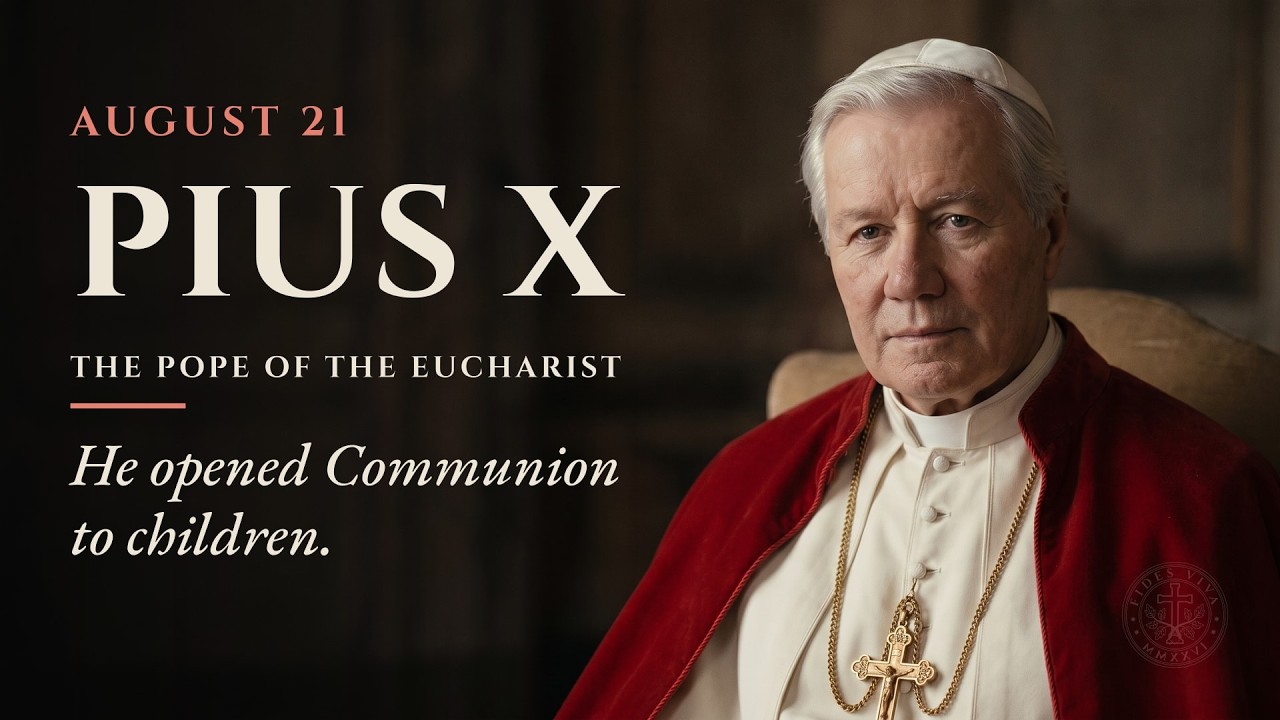
One Sunday morning, in a stone courtyard ringed by galleries, an old man dressed in white sits down in a wooden chair. There is no throne, no guards, no ceremony. Before him, on folding chairs, wait seamstresses, bricklayers, mothers with children. He opens a worn little book and begins to explain the faith, slowly, in words anyone can understand.
That man is the Pope.
It is Rome, at the start of the twentieth century. The man who governs the whole Church spends his Sundays on the humblest task of any parish: teaching doctrine to plain people.
And there is more. One August day he will put his signature to a brief document, and from then on seven-year-old children will be able to come forward to receive Communion. Millions of first communions, to this day, trace back to that signature.
He was not born in a palace. His father delivered mail through a village. His mother sewed for others. He was the second of ten children. And his will asked for only one thing: to leave this world as poor as he had entered it.
His name was Giuseppe Sarto. The Church venerates him as Saint Pius X, the Pope of the Eucharist.
To understand how the son of a mail carrier came to occupy the chair of Peter without ever ceasing to be a parish priest, we must go back many years, to the dirt road a boy walked every morning so he could study.
The Boy from Riese
The Veneto plain answers, in those days, to the eagle of the Austrian Empire; Italy, as a nation, does not yet exist. It is a world of cornfields and mulberry trees, of slow carts and bell towers that order the day. People live off what the land gives, and the land gives little. In winter, fog erases the roads, and hunger is not a word: it is a tally kept each night around the table.
Into that world, on June 2, 1835, a boy is born in Riese, a village of low houses in the Marca Trevigiana. The next day he is carried to the parish church to be baptized and given the name Giuseppe Melchiorre. He is the second of the ten children of Giovanni Battista Sarto, mail carrier and messenger for the municipality, and of Margherita Sanson, a seamstress. At home, simply, they call him Bepi.
The father leaves before dawn, leather bag at his side, and walks the villages on foot delivering letters and municipal notices. The mother sews for others until the light runs out, her back a little more bent each year. In that house where everything is counted twice — the bread, the oil, the candles — one firm conviction holds nonetheless: a son is not denied learning. And this second son learns faster than anyone manages to teach him.
At eleven he is sent to the liceo in Castelfranco Veneto. Seven kilometers there and seven back, every day, through the July sun and the November frost. The memory of Riese keeps one detail that paints him whole: the boy carried his shoes slung over his shoulder so as not to wear them out, and put them on only on reaching the city walls. His feet could bear it; his shoes could not. He walks with a bundle of books tied with string, going over his Latin under his breath, while the plain wakes around him.
There is no complaint in that walking. There is a poverty that does not humiliate, because it is carried with head held high, and a purpose that grows with every step. Whoever passes him on the road sees only a thin, barefoot boy; no one yet imagines how far that step will carry him.
At fifteen a door opens that his family could never have paid for on its own: a scholarship, secured through the mediation of the Patriarch of Venice, wins him a place at the Seminary of Padua. In 1850 he dons for the first time the black cassock of a seminarian, with a white clerical collar of stiff cardboard, and enters a world of pale stone cloisters, dark wooden benches, and silence. Eight years of Latin, of theology, of discipline. And one certainty takes root: what he learns of Christ is not to be kept to himself, but explained one day, in plain words, to those left behind in the fields.
When that formation ends he will be twenty-three, with a proven mind and no property to his name. What does a man have left when all he owns is what he is wearing? In Bepi Sarto's case, what remains is the essential: faith, the memory of the road, and an enormous eagerness to teach. With that baggage — and nothing more — he will present himself for ordination. The mail carrier's son is about to become a shepherd of souls.
Learning to Teach
On September 18, 1858, a bishop anoints the hands of that lean young man from the road. He is twenty-three years old. From that day forward he is a priest of Jesus Christ, and he will be so with all that he has, which remains almost nothing. There is no banquet to celebrate and no career to plan. There is a destiny, and it arrives soon: Tombolo, a village of cattle dealers and peasants, lost in the plain between Padua and Treviso.
There the archpriest Antonio Costantini, a veteran pastor awaits him, sick and in need of young hands. He discovers at once that this assistant has not come merely to go through the motions. Don Giuseppe rises before dawn to hear confessions and crosses the fields to visit the sick. In the afternoon he gathers the children and explains the doctrine, patient, assuming nothing is already known. When night falls he opens a school for adults: full-grown men, their hands hardened by the hoe, learn to read and write. And they learn to know better that Christ to whom they have prayed since childhood without anyone ever explaining why.
When the village sleeps, the assistant's window is still lit. He studies theology, liturgy, sacred chant, late into the night. But in Tombolo no book stays on the shelf: what he learns in those early hours, that same week he puts within reach of a laborer who can barely read. There, in those nine years, is born the method of his whole life: the faith explained in plain tongue to those no one explains anything to.
The old Costantini watches and is not mistaken. He yields more and more of the parish's governance to him—the preaching, the catechesis, the accounts—and those who knew him would remember afterward a phrase of his: that this assistant of his would go far. In 1867 the first step arrives: at thirty-two years old, Don Giuseppe is named pastor of Salzano, a parish in the Veneto plain with its church, its fields, and its people. He does what he always does: he arrives, he listens, and he sets to work. He reorganizes the catechesis, he orders charity so that no poor person is left without help, and he gives away what little is his when someone needs more than he does. The rectory empties as fast as it fills: in that pantry nothing lasts.
And then, in 1873, comes a trial no one chooses. Cholera enters the plain. It is a swift and filthy disease that empties a body in hours, and fear runs faster than contagion: marked houses close, neighbors flee, even family members hesitate at the threshold.
The pastor does not hesitate. He enters.
House by house, night after night, with an oil lamp in one hand and the holy oils in the other. He cleans, he comforts, he watches the dying, he organizes food for those who remain. And he brings them what no doctor can bring: Christ himself, the Viaticum for the last journey. He does not withdraw from a single infected house. He knows what he risks each time he crosses a doorway, and he crosses it again the next day.
When the epidemic passes, Salzano knows something it will never forget: its pastor is not one of those who leaves. Charity, in him, is not a sermon; it is a door that opens when everyone else closes theirs. Can someone remain the same when serving begins to cost his own life? He has just answered without words. But the echo of that answer already crosses the bounds of the village, and in Treviso there are those beginning to ask whether a pastor like this is not called to tend a much greater flock.
The Humble Root and the Weight of the Ring
The answer comes in 1875. Treviso calls him to its cathedral: a canon of the chapter, chancellor of the diocese, and spiritual director of the seminary. On paper it is a promotion; for him it is the first of his farewells. He leaves Salzano as one leaves a family, and he discovers a sorrow that will repeat itself his whole life: each time he sets roots in a place, someone tears him from it. He obeys without complaint. And in the city he does what he did in the village: he teaches. Only now his students are seminarians, future priests, and to them he passes the lesson of Tombolo: theology that does not end in the mouth of a peasant has not yet been learned.
The seminary is not enough for him. In an Italy newly unified, where the new State and the Church regard each other with suspicion, that village priest accomplishes something that seemed impossible: he brings catechism into the public schools of Treviso. Now Jesus Christ is explained to the city's children in words they understand, inside the classroom, like any other subject. For him it is not politics. It is what it has always been: no one should grow up without someone explaining to them what they believe.
From those years the Salesian tradition preserves a memory, difficult now to date: a crossing of paths between Canon Sarto and Don Bosco, the apostle of the boys of Turin, in which the old teacher is said to have glimpsed how far that Venetian would go. Whatever the truth of that meeting, both men were shaped by the same conviction: catechism saves the poor.
And in 1884, the Church asks him for more. Leo XIII chooses him bishop of Mantua. It is not a reward: it is a wounded diocese, with the seminary half empty, the clergy scarce and aging, the faith grown cold by decades of tension between the Church and the new Italy. On November 16, 1884, he is consecrated bishop. He is forty-nine years old. Now he wears purple, carries a golden cross at his chest, and a ring on his right hand; inside he remains the postman's son, and everything that shines frightens him a little.
From those days his family kept a scene that speaks louder than any speech. Margherita, his mother, is now an old woman: small, dressed in black since the death of his father, her back bent from half a lifetime of sewing. She takes her son's hand and looks slowly at the episcopal ring, the new gold, the weight of the office. Then she raises her own hand, small and wrinkled, and shows him her wedding ring: a thin band, worn by half a lifetime of work. And she tells him, with the calm of one who knows exactly what she is saying, that without that humble ring the other would not exist.
There is nothing to add. All the root of a life fits in that gesture.
With that root on his shoulders he governs Mantua, and he does not govern it from a desk. He travels the diocese parish by parish, on foot and by carriage, in a pastoral visit that leaves out not even the poorest village. He convenes a synod—an assembly of all the clergy to order together the life of the diocese—and he places his heart where the wound is: the seminary. He reforms it, he seeks vocations, he treats the seminarians with a plainness that disconcerts the ceremonious and wins over the young men. Nine years later, the diocese he found exhausted breathes again.
What sustains a pastor when each promotion is also a loss? Perhaps exactly that: a worn ring in the hand of a mother, the memory of where everything comes from. He will need it. Because his work in Mantua has not gone unnoticed in Rome, and the next call will come dressed in scarlet, from a city built upon water.
Venice and the Conclave: The Shepherd Before the Election
The call comes with a date: June 12, 1893. Leo XIII makes him a cardinal and names him Patriarch of Venice. But the postman's son discovers soon enough that purple, too, knows how to wait: the Italian government withholds the exequatur, the civil authorization that the State then required for a bishop to take possession of his see. For nearly a year and a half, Sarto is patriarch of a city he cannot enter. He does not protest or campaign in the newspapers. He waits in Mantua, working as if nothing has changed, with the patience of one who has walked far.
In November of 1894 he crosses the lagoon at last. Venice receives him with the gold of Saint Mark's, the mosaics, the marble, the gondolas in their finery. And he answers by remaining himself. He descends to catechism as he did in Salzano; he explains Jesus Christ in Venetian dialect, the tongue of his childhood, so that the gondoliers and the fishwives understand every word. He knows his priests by name, and his door opens to anyone who knocks. The splendor does not change him: it passes through him. That same year, the memory of Riese tells us, Margherita dies. His mother lived to see him bishop and cardinal; she departs when her son has risen higher than she could have imagined. The root says farewell in silence, but what was planted remains.
In the summer of 1903, after a quarter century of pontificate, Leo XIII dies. The patriarch travels to Rome for the conclave: the assembly of cardinals who, locked beneath the frescoes of the Sistine Chapel, must choose the successor of Peter. He enters that room like any other, without fuss, almost without baggage.
Inside, the votes begin to gather around Cardinal Rampolla, secretary of state to the dead Pope. Then Cardinal Puzyna rises, bishop of Kraków and subject of the Austrian Empire, and announces something that freezes the chapel: the emperor Franz Joseph vetoes the election of Rampolla. It is the last imperial veto in history, an ancient right by which Catholic crowns could exclude a candidate. The cardinals reject it, indignant; no crown commands in that room. But the damage is done. The majorities fracture, and the votes begin to shift, ballot after ballot, toward the patriarch of Venice.
He sees it coming and he is terrified. He begs the cardinals not to think of him. He weeps. He asks them to lift that burden from him. It is not theater or false modesty. It is a man of sixty-eight years who knows exactly what is being asked of him, and knows that there will be no return home. On August 4, 1903, when the votes leave no way out, he bows his head and accepts. As one accepts a cross.
He chooses to call himself Pius X. And he chooses a program of a single line, taken from Saint Paul.
Instaurare omnia in Christo: to restore all things in Christ. It is not a slogan for an office. It is what he has done all his life, village by village; only now his parish is the world.
Five days later, on August 9, Saint Peter's Basilica fills for the coronation. The tiara, the triple crown of the popes, descends upon the white hair of the man from Riese. The ceremonial fans of feathers, the chair that others carry on their shoulders, the protocol of centuries: all of it makes him uneasy, and it shows in his eyes. Beneath the new white breathes a parish priest who would prefer a courtyard, a bench, and children in front of him. Can someone remain a pastor when the whole world watches him as Pope? Rome is about to find out. Because that man has not come to reign: he has come to teach.
The Pope as Teacher: Catechism and Reform with a Human Face
Soon, every Sunday morning, he will give his lesson; and not in the basilica. In the Cortile di San Damaso, a Renaissance courtyard of superimposed loggias in the heart of the Vatican, someone arranges benches, folding chairs, and a seat without ornament. Simple people begin to arrive from Rome: porters, laborers with their caps in hand, mothers with children clinging to their skirts. And he arrives, in white, with no instrument but a catechism. He sits, opens the book, asks and explains, corrects with patience, smiles when a child gets it right. The pontifical court does not quite know where to look: this does not appear in any ceremonial. He does. If the successor of Peter cannot explain the faith of Jesus Christ to a Roman porter, something has gone wrong; and he has come precisely to set it right.
The reforms begin almost at once, and all of them bear that same mark of a teacher. On November 22, 1903, the feast of Saint Cecilia, patroness of music, he signs a document on the singing in churches (sobreimpreso: "Tra le sollecitudini, 1903"). Out with the theatrical styles that had turned the Mass into a concert for an audience; back comes the Gregorian chant, the ancient and naked melody that any people can learn by heart. And among those pages, one phrase that will travel for a whole century: the active participation of the faithful in the sacred mysteries. The coadjutor who had studied sacred music at dawn in Tombolo wants the people, now, not to attend the liturgy as spectators but to pray it by singing.
In January of 1904 he closes, with a few lines, the wound of his own election: the right of veto for the crowns in conclaves is abolished forever. Never again will an emperor speak a word inside that chapel. He decides it without rancor, with the serenity of one who extinguishes a candle that has burned for centuries where it had no business burning. That same year, on his desk pile volumes of laws scattered across centuries of documents: he sets in motion the task of gathering them into a single code, clear and manageable. Years later, in 1911, he will do the same with the breviary he himself prays each day, so that whoever prays in the name of the people prays better. Reforms without fanfare, made with the steadiness of one who has set village sacristies in order.
But his real battle lies elsewhere, and he has known it since childhood: religious ignorance. In the spring of 1905 he signs an encyclical that makes his old habit into universal law (sobreimpreso: "Acerbo nimis, 1905"): in every parish in the world there shall be catechism on Sundays for children and for adults. What a lean priest did in a village church in the Veneto is now the obligation of every pastor on earth. No one, in any corner, will be left without the right to have Jesus Christ explained to them in words they understand.
In December of that same year he touches the deepest door. For generations, a rigorism handed down had kept the faithful from the altar: to receive Communion was the business of the few, of the nearly perfect, of two or three times a year. The decree he signs dismantles it without ceremony (sobreimpreso: "Sacra Tridentina Synodus, 1905"): frequent and daily Communion, as a thing most earnestly desired by Christ our Lord and by the Catholic Church, lies open to all the faithful. The state of grace and an upright intention are enough. There is no need to be a saint to draw near to Communion; one draws near, precisely, in order to become one. From then on the Catholic world begins to call him the Pope of the Eucharist.
And like every true teacher, he also knows how to say no. In 1907 he publishes two grave documents. A decree condemns sixty-five propositions; an encyclical describes modernism—the currents that dissolved dogmas into mere sentiment and Scripture into pure criticism—as the synthesis of all heresies. For him it is not a quarrel of academics: he is convinced that confusion of faith wounds the simple first, those without libraries to defend themselves. Yet this must be said too: the application of that condemnation was sometimes harsher than the shepherd who had ordered it. A network of informants, animated by Monsignor Benigni, sowed suspicions and denunciations within the Church, and historians still debate how much the Pope himself knew and approved. It is the shadow in a work of teaching that was, in every other respect, luminous.
In the early morning of December 28, 1908, the earth opens in the south of Italy. An earthquake razes Messina and Reggio; entire cities are reduced to rubble. Before the State organizes its response, the Vatican is already in motion: provisions, money on a vast scale, and the very offices of the pontificate thrown wide open to orphans and refugees. The shepherd who had entered the houses of cholera opens his whole house now. The charity of Salzano, on the scale of the world.
There remains the signature by which millions remember him without knowing his name. It is August 8, 1910. In his time, children made their first Communion at twelve or fourteen. The decree that leaves his desk that day (sobreimpreso: "Quam singulari, 1910") moves it forward to the age of reason, around seven, and admits even earlier the children who are ill. The reasoning is pure parish priest: if Jesus called the children to himself, no one has the right to make them wait. A few lines, and behind them a whole century of mornings of first Communion not yet born.
Through his office pass, in those years, other saints. The memory of the pontificate holds his meeting with Frances Xavier Cabrini, the small missionary who spent herself on Italian emigrants in America, whose work he encouraged and blessed. And it will be remembered afterward that, among his last acts, in 1914 a cause opened in Rome for a Carmelite who had died young in Lisieux: Thérèse of the Child Jesus. Holiness offered to the small and the simple: exactly what he had been teaching all his life.
Those who knew him well also kept memories harder to explain. A young priest, Ernesto Ruffini, came before him with a diagnosis of tuberculosis. The Pope sent him back to the seminary and assured him that this would be resolved; within days no trace of the illness remained. He himself, already a cardinal, declared it before the judges of the cause. Another day, in an audience, a man begged him for his paralyzed arm. The Pope took it between his hands: "Have trust in the Lord... only have faith and the Lord will heal you." The arm moved. And Pius X put a finger to his lips, asking for silence. He did not want fame as a miracle-worker. He wanted the glory to be Christ's, and his own, nothing.
Eleven years he has been teaching from the seat of Peter, and beneath the white cassock breathes the same man who sat children on the floor of a brick church. But while the old teacher spreads the bread of doctrine and the Bread of the altar, Europe sharpens its guns. Can a man go on teaching the children of the world when all of history darkens? The summer of 1914 will bring the answer, and it will cost him his life.
The Pain of the World and the Final Poverty
July of 1914. On the Pope's desk dispatches pile up, and none brings good news. Ultimatums, mobilizations, trains loaded with soldiers crossing Europe singing hymns that very soon no one will want to remember. He is seventy-nine years old, his lungs worn and his heart in turmoil. And then the request arrives: that he bless the weapons of one of the powers marching to war. To the postman's son of Riese, born a subject of an empire, they ask that he put God on the side of the cannons. Those who served him kept his answer engraved forever: "We bless the peace, not the war."
There is no diplomatic calculation in those words. There is a teacher who has spent his whole life explaining the Gospel of Jesus Christ to seven-year-old children, and he knows that Gospel does not fit in a rifle chamber. That memory holds something more: his desire to give his own life if it would avert the catastrophe. No one listens. By late July, the declarations of war fall one after another, like dominoes pushed over. The children of his parishes—the grandchildren of those laborers of Tombolo, of those sick in Salzano—board the trains with rifles on their shoulders.
And the old man breaks. His usual bronchitis returns with fever, and this time finds no resistance: the large body of the Veneto peasant no longer fights back. In the first days of August he barely leaves his rooms. Those who attend him find him sometimes at the open window, looking out at the city in the evening, silent. He does not ask about his health. He asks about the war.
On August 20, 1914, with the war barely begun and the first dead already in the trenches, he fades away in the Apostolic Palace. Without theatrical death throes, without last words carved for history. He dies as he had lived: in silence, facing God, with the pain of the world inside his chest. The doctors will speak of the bronchial condition. Those who loved him will say, more simply, that the war killed him.
Afterward his will is opened. And in it, a line that stands for all the speeches of his pontificate: "I was born poor, I have lived poor, and I wish to die poor." He leaves no fortune, no property, no inheritance to divide. The man who governed the universal Church dies with only the clothes on his back, just as that boy who crossed the plain with his shoes hanging from his shoulder so as not to wear them out. Seventy-nine years, four colors of cassock, and at the end hands as empty as at the beginning. The circle closes exactly where it opened: in the clean poverty of Riese.
What does a man leave behind when he dies as poor as he was born, having been shepherd of the world? Rome grieves him, and the simple people—those of the porters in the courtyard, those of the children at their first Communion—begin to pray to him before anyone tells them to. The answer to that question will not fit in a funeral. It will take forty years to write itself, and a multitude will write it.
A Legacy That Endures
It begins from below, as almost everything in his life did. In 1923, in Treviso, the Church opens the process into his virtues, and before the tribunal come those who knew him closely: his secretaries, priests of the diocese, elderly peasants who were children in his catechism lessons. They bring no fantastic stories. They bring details of a parish priest: that he gave away what he had as soon as he had it; that he explained the faith in words from the kitchen and the field; that at no step of his ascent did he cease to be the same man. The word holiness scarcely appears on their lips. It does not need to. It is in every detail.
Twenty-one years later, Europe burns again. On May 19, 1944, with war roaring at Rome's gates, his remains are exhumed in Saint Peter's Basilica as part of the process. Those who were there remembered afterward the silence of that morning: the body, which by his express will in his testament had not been embalmed, appeared remarkably preserved after thirty years. The Church has never declared that preservation miraculous, and it does not need to: for the Romans who file past him those days, it is enough to see again the face of the Pope who taught them the catechism on Sundays.
Meanwhile, the process examines two healings that medical experts declared inexplicable: members of religious orders and the sick with lung ailments who were cured after commending themselves to him. On June 3, 1951, he is declared blessed. And on May 29, 1954, Pius XII canonizes him before a multitude that overflows the plaza of Saint Peter's Basilica. As a young priest, that same Pope had worked on the codification of the law that Sarto set in motion. He is the first Pope raised to the altars in nearly two and a half centuries, since Saint Pius V. The Church had had wise, diplomatic, powerful pontiffs. It recognizes the parish priest as a saint. That day, among the crowd, there are elderly people from the Veneto who knew him as a priest, and mothers leading by the hand children dressed in white for their first Communion.
In 1969, the reform of the calendar moves his feast to August 21, and so the whole Church celebrates it from then on. His body rests today beneath the altar of the Presentation of the Virgin, in Saint Peter's Basilica, within a crystal and bronze urn, clothed in pontifical vestments, his face covered by a metal mask that reproduces his features. Before that urn kneel each day pilgrims from every continent. Many do not know his story. But almost all, without knowing it, owe him something: a morning in childhood, a white dress, the first time they received Christ at seven years old.
And far away to the north, the Veneto plain keeps the other half of his memory. The town where he was born is called today Riese Pio X: they changed the name of the whole village in his honor. The Sarto house still stands, with its poor rooms and brick walls, converted into a museum and destination for pilgrims. There his things are kept, few and worn, as they always were. And in 2024 a volume brought together nearly a hundred portraits of him—priest, bishop, patriarch, Pope—alongside the testimonies from Treviso: the broad face, the strong nose, the blue eyes. The real face, unidealized, still looks on.
Why, after so much time, does the example of that parish priest from the Veneto still have strength? Perhaps because his legacy is not of marble. It remains in the house of Riese converted to a museum, in the urn where pilgrims venerate him, in the real face that a hundred portraits still preserve.
What Endures: A Silent Invitation
At the end, everything returns to the beginning. A child walks through the early morning on a dirt road in the Veneto, and the memory of Riese tells how he carried his shoes slung over his shoulder so as not to wear them out. Sixty years later, an old man dressed in white signs his name to a decree that opens the altar to all the children of the world. Between the two images lies an entire life: a house with ten siblings, a village wrapped in mist, the throne of Peter. And yet, looked at closely, the distance vanishes. It is the same man. They are, in the end, the same shoes.
A question has walked with us all along: How did the son of peasants come to change the lives of millions without ceasing to be that boy from Riese? His works answer it. He taught the faith to farmworkers who could barely read, and he went on teaching it, now Pope, sitting in a wooden chair in a courtyard of the Vatican. He entered the houses stricken by cholera when prudence said to flee, and he opened his own house to the orphans of an earthquake. He brought Christ close to the little ones because he never forgot what it meant to be small. The cassock changed color—black, purple, scarlet, white—but the man who wore it remained always the same. He changed the world, precisely, because the world could not change him.
We too live changing clothes. A job that dissolves overnight, a move that packs a whole life into boxes, a new title on a business card, a retirement that erases the name from the door. All of that comes, sooner or later. And when it comes, when the office changes, the house changes, the clothes change—what remains of who we are?
He left his answer in a testament of few lines, written in the same plain hand as always: he wished to leave the world as poor as he had entered it. Of everything he held—a diocese, the purple, the tiara—he kept nothing, because none of it defined him. What remained was what had been at the beginning. The plain faith of that house and his seamstress mother, the heart of a parish priest, the worn shoes of someone who made the whole journey on foot. Perhaps that is the invitation his life leaves open, without demanding it: that what is great is held up from below; that a prayer explained to a child, a visit to the sick, a gesture no one sees, can last a century.
The cartman's son of Riese arrived at the highest place on earth without letting go of anything he carried from below. And there he remains, before his people, poor and faithful.
Pius X, Pope of the Eucharist, teacher of the simple, faithful shepherd of the Church, pray for us.