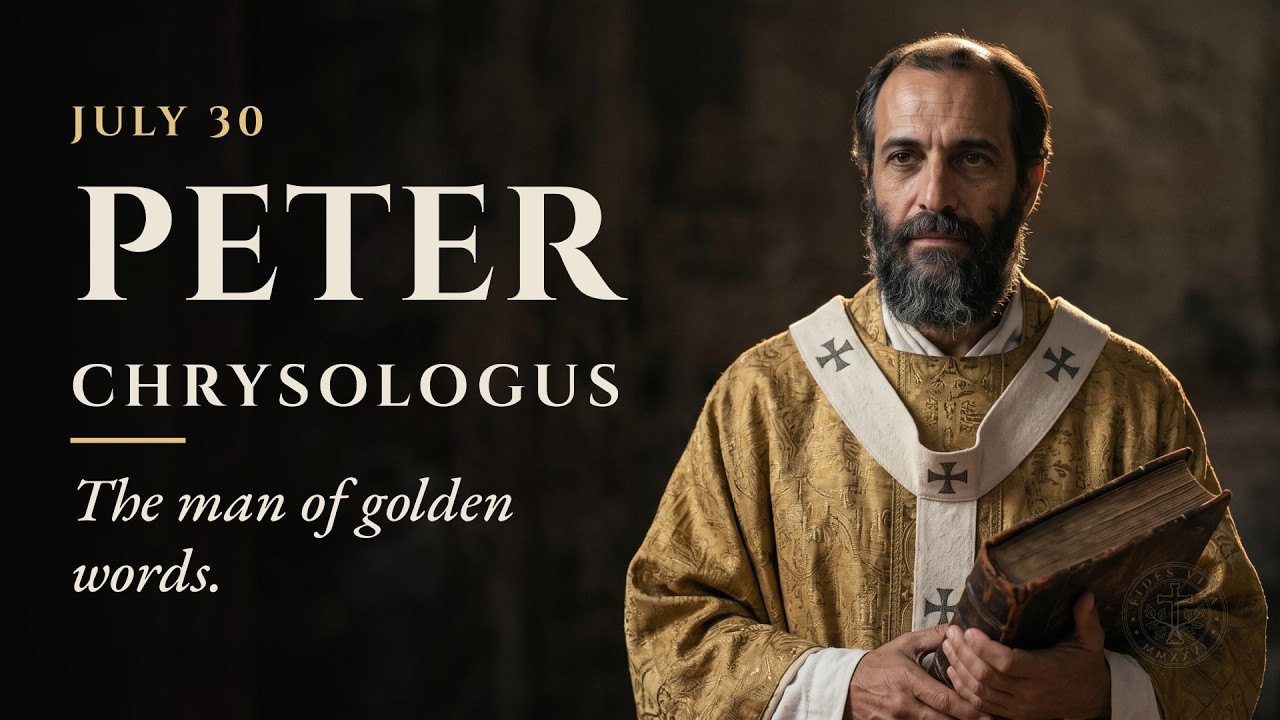
A basilica of gold. A crowd falls silent. At the marble ambo, a thin man, no ornament, before the most powerful woman in the West. He could dazzle her. He speaks few words, and speaks them clear. What power fits in so little?
A Child on the Via Aemilia
The late fourth century. The Western Roman Empire is an old body still walking: the roads hold, the markets open, the walls still get repaired. But in the wayside inns, travelers speak low: whole peoples are on the move beyond the Alps, the legions no longer suffice, and the old gods console no one anymore. The world that thought itself eternal has begun to shake. And in the middle of that unease, faith in Jesus Christ grows without noise, mouth to mouth, in plain brick churches, the way wheat grows while no one is watching.
Along the Via Aemilia, the straight road that stitches together northern Italy, stood a small town called Forum Cornelii — present-day Imola. A modest forum with brick porticoes, small workshops, fields of wheat, and vineyards climbing the hills beyond. No one passed through on the way to glory. Ravenna would later remember that in that town, around the year 380, a boy named Peter was born into a Christian family. No signs in the sky, no prophecies. One more child among the sons of Emilia.
Beside the boy grew the name of that town's bishop: Cornelius, who was like a father to him. The one who baptized him, the one who opened the Scriptures to him, the one who taught him to pray. Faith did not come to him through distant treatises. It came through the hand of one particular old man, through the cold water of baptism, through the wax tablets where he copied, letter by letter, the words of the Gospel. From Cornelius he learned that Christ is not an idea to argue over, but someone to follow. And he learned by watching: how his teacher cared for the poor, how he listened before he spoke, how he spent his life without making noise.
He was just past twenty years old when power itself came to settle down close to his home. Emperor Honorius, seeking shelter for his court, moved the capital of the West to Ravenna. It was a city ringed by marshes and canals, hard to storm, its harbor open wide to the Adriatic. Behind those still waters, what remained of the empire would hide from then on. The court's wagons passed not far from the fields of Imola. The center of the world had moved next door.
Six years later came the blow no one thought possible. Alaric and his Visigoths entered Rome and sacked it for three days. Eight hundred years the city had gone without falling to an enemy. As the news ran down the roads, some believed the world itself was ending; and in a way, one world truly was. Along the Via Aemilia came refugees with nothing but the clothes on their backs, telling what they had seen. In Imola, a young man of about thirty listened, and kept studying, serving, praying. As though he already knew the answer to such ruin would not be a sword.
That was how Peter grew up: in the shadow of a bishop, in a town with no name in the great histories. Far off, the empire cracked like an old wall. Nothing about him drew attention. No wealth, no lineage, no ambition. Only a life ordered around the Word, a sober character, and a daily faithfulness. What calling could pull a man like that out of obscurity? For now, none. First came the years of silence — the years when hidden formation slowly becomes service, and service, unnoticed by anyone, quietly forges a man.
Years of Silence
Around the age of twenty-five, Cornelius laid hands on him. A deacon: in the Church of that age, the one who serves — at the altar, at the table of the poor, in everything the bishop cannot do alone. The name suited Peter well. Serving was what he had watched the man who baptized him do his whole life, and now it was his own In the liturgy he carried the Gospel book; outside it, he carried bread.
Then came years no chronicler recorded, and perhaps the most fruitful of his life. Whole nights bent over Scripture, by the light of a single oil lamp. He read slowly, letting each saying of the Lord Jesus settle inside him until it became his own. Days spent tending the sick, handing out alms, listening to those no one else listened to. And a quiet discipline: fasts that sharpened his body, prayer that ordered his soul. No audience, no teaching post, no hurry.
In time, Cornelius made him his archdeacon: first among the deacons, the bishop's right hand in governing the diocese. The old man trusted him with nearly everything, and he answered that trust without wanting anything more. He was entering middle age now, the first gray showing at his temples, and holding to one simple conviction: that following Christ was exactly this, this and nothing else.
Meanwhile, a few days' journey away, the wider world kept moving on its own strange course. In the year 425, a boy of six was proclaimed emperor of the West: Valentinian III. Wrapped in purple, wearing a pearl diadem, he was so small that his head barely rose above the floor. And from Ravenna he would rule. Behind him, the one who truly ruled was his mother, Galla Placidia, a woman of deep faith and an iron will. All the power of Rome rested in the hands of a child and the resolve of a widow. That is how fragile what once seemed eternal had become.
Two worlds, with no bridge between them in sight. In the capital, a throne too large for its owner. In small Imola, an archdeacon nearing fifty, content in his corner of the world, with no other horizon than serving beside his old teacher to the end. Nothing suggested the capital would ever notice him. But one day news came down the road: the bishop of Ravenna had died. And a journey Peter had never asked for began, without his knowing it, to take shape.
The Journey He Never Chose
Trim the additive phrases flagged below (D2, D3, D5, D6, D9) to bring the chapter back within ±10% of 484 words (~435-533). The clergy and the people of the capital chose their own candidate, as custom required, and gathered a delegation to carry him to Rome, where only the pope could confirm and consecrate him. Traveling with them was Cornelius, bishop of Imola, now very old, and beside him walked his archdeacon, steadying his master through the long days of the road. No one gave a second glance to the thin man with the graying temples. He was there only as an attendant. One more face among the faces.
Rome received them both wounded and alive. Two decades after Alaric's sack, the scars still showed on its walls, yet the city kept filling with new basilicas; Pope Sixtus III was raising Saint Mary Major around that very time, and faith seemed to grow strongest exactly where the empire was shrinking away. Before that man, builder of churches and maker of peace, the delegation from Ravenna came to stand.
And here is an image Ravenna kept alive for centuries, though no one was there to see it. They say that Sixtus, the night before, had a dream: the Apostle Peter and Saint Apollinaris, the first bishop of Ravenna, stood before him and pointed to a man. And they showed him that this one, and no other, was the man who should fill the empty see. When the delegation filed past him, the pope studied every face in turn. And he stopped at the archdeacon from Imola. It was the face from the dream.
Sixtus set aside the candidate the city had already chosen. In his place, to the astonishment of everyone present, he pointed to the attendant. The one who had never put himself forward. The one who had come only to steady his old teacher's arm along the road.
Toward the year 430, in a basilica in Rome, Sixtus laid his hands upon him and consecrated him metropolitan bishop of Ravenna — the first man to hold that see who had not come from the East. Over his shoulders he placed the pallium: a narrow band of white wool marked with crosses. It was the sign of the chief shepherd of a province, and of his communion with the See of Peter. Under the gold of the mosaics, the thin figure seemed smaller still. A man from the provinces, with no famous name and no ambition anyone had noticed, had just been given the very city where the emperor lived.
He had not sought it. And perhaps that was exactly why he could carry it. That morning he learned, in his own flesh, something he would later repeat to his people in a thousand different ways: the call of Christ is never conquered; it is received. One only holds out open hands. Cornelius, who had baptized him as a child and shaped him over decades, watched his disciple leave for a see neither of them had ever dreamed of.
The road home carried him, now a bishop, toward a capital that did not know him at all. Waiting for him were a court dressed in purple, an empress of iron will, and a people who had wanted a different man entirely. All of them carried the same silent question: who was this stranger. The answer would come the first time he opened his mouth.
Golden Words
The morning of his first homily, the Ursian Basilica was full to the doors. It was the cathedral of Ravenna: five naves, marble columns, an ambo of pale stone reached by a short flight of steps. In front, pressed close together, stood the people who had wanted a different bishop. And in the place of honor sat the court: silk, purple, pearls. Among them was a woman once a captive of the Goths, then wife to a Visigothic king, and later to an emperor. Now she ruled the West in her son's name: Galla Placidia.
The new bishop climbed the steps. Ravenna knew great orators; it expected long sentences, quotations from the poets, the polish of school rhetoric. This thin man did something else. He spoke little. He spoke plainly. He spoke of Jesus Christ, true God and true man, in words a fisherman from the port of Classe could follow and a senator could not forget. And when he finished, the silence that filled the basilica was not the silence of protocol: it was the silence of people who had just eaten after going hungry a long time.
So the city that watched him preach would remember it afterward: the empress, full of admiration, called him Chrysologus, the man of golden words. As in the East they had called John of Constantinople Chrysostom, golden-mouthed. The name stayed with him for the rest of his life. And Galla Placidia, mother of the emperor and mistress of the court, became patroness of his works: she raised basilicas; he filled them with the word.
For twenty years, that voice fed the capital of the empire. His own sermons tell the story: about a hundred seventy-six survive, and they are still read today in the Liturgy of the Hours, the daily prayer of the whole Church. He explained the Gospel of every Sunday. He unpacked the Creed and the Lord's Prayer for the catechumens, phrase by phrase, the way one teaches a child to walk. He preached the Incarnation: that in Jesus, God had truly become man, with flesh, with weariness, with tears. And he urged frequent communion, receiving the Body of Christ as daily bread, at a time when many hardly dared come near.
And all of it, always, brief. He feared wearing people out. He feared that one word too many might put out the words that mattered. So he sharpened his sentences until they could fit inside anyone's memory: "No one can rejoice with Christ in heaven who wants to rejoice with the devil on earth." A line like that is not argued away on the walk home; it stays inside, working.
Perhaps no page of his portrays him better than a Lenten sermon the Church still reads every year. "Three forces keep faith standing firm: prayer, fasting, and mercy. Prayer knocks, fasting obtains, mercy receives. Let fasting be the soul of prayer, and mercy, the life of fasting." Three sentences. The whole of doctrine. Others would have needed a treatise; a child grasps it, and no wise man exhausts it.
To ordinary Christians he taught their own greatness. "You yourself be sacrifice and priest to God," he told them: every baptized person is temple, victim, and priest, with no need of pulpit or pallium. In the streets of Ravenna, traces still lingered of the old paganism and of Arianism, the teaching that denied Christ was truly God. Against them he fought without raising his voice, armed only with clarity. Outside the liturgy he wore a plain dark tunic and ate little: in the city of gold, his only wealth remained the word.
The people, meanwhile, pressed in to hear him. So much so that when the great heat came, the bishop would suspend his preaching. He explained it with a joke Ravenna repeated for generations: in this stifling weather I won't preach to you, because you crowd in so close to listen, and with these temperatures the fainting starts — and then you blame my sermons for it. People laughed. And understood. Even his silence was a form of care.
That was the power that fit inside so few words: not brilliance, but bread. Beyond the marshes the empire kept cracking apart; inside the basilica, a whole people ate every Sunday from a voice that never wore them out. But from the East a dispute was drawing near, one capable of splitting the Church in two. And soon that same brief word, the one that had explained the Lord's Prayer to catechumens, would be called on to defend the whole of the faith.
The Heresy at the Door
The years went on working upon that voice. By 446 his steel-gray hair had turned silver-white and thin; his body, thinner still, had begun to stoop. But his gaze stayed sharp. In Rome a pope named Leo now ruled — history would call him the Great — and the two men understood each other, wrote to each other, defended the same faith. And the aging bishop of the Western capital had become, without seeking it, a counselor the whole Church turned to. The Church needed him: beyond the marshes, Attila's name passed from mouth to mouth, and the empire no longer merely cracked — it was coming apart in whole pieces.
In the year 448 a guest from very far away knocked at his door. Germanus, bishop of Auxerre, in Gaul: a former governor turned shepherd, seventy years old, weathered by the road, who had crossed the Alps to plead for clemency before the court on behalf of the Armoricans, his own people in Gaul. Two old men who had spent their lives on the same thing looked at each other for the first time, and recognized one another. The bishop of Ravenna received him with every honor, and welcomed him as a brother.
Germanus never returned to Gaul. He died there, in Ravenna, guest of the city and its bishop. And it was Peter who presided at his funeral: one saint sending off another, in the capital of a world that was ending. A cherished memory in Ravenna adds one detail: that he kept, as a treasure, the Gaul's worn hood and the rough hairshirt he wore beneath his clothes — the two poorest things he owned, the only ones worth keeping. From those days on, the aging bishop began to look at his own death differently. Without fear. Like a man who has watched someone die well.
A year later, the sea brought something else. Through the port of Classe came a letter from Constantinople, signed by a cornered man: Eutyches, archimandrite — that is, superior of monks — of the capital of the East. Old, influential, respected for decades, he had just been condemned by his own bishops. Fighting one error, he had run straight into another: he taught that in Christ, the humanity had been swallowed up by the divinity, that his flesh was not flesh like ours. A Jesus who was not truly man. And now he was writing to the great sees of the world in search of allies, hoping that Ravenna, seat of the imperial court, would side with him.
Peter had spent twenty years preaching exactly the opposite, in words a fisherman could follow: that Christ, true God, had become true man, with flesh, with weariness, with tears. His whole teaching stood on the line in this dispute. He could have said nothing. He could have flattered a powerful man. He did what he had always done: he answered briefly, clearly, without contempt.
By the light of a single lamp, the old man wrote — grieving for that lost brother, yet firm without ever needing to raise his voice. He did not enter the battles of the schools. He referred him to Rome, to the Apostle's successor. "We exhort you, venerable brother, to accept with obedience what has been written by the most blessed pope of the city of Rome, for the Apostle Peter, who lives and presides in his own see, offers the truth of the faith to those who seek it."
A few lines. Not one insult, not one concession. To the man, charity; to the error, not an inch. That letter is kept to this day among the acts of the Council of Chalcedon. Two years later, that same council would proclaim forever that Christ is true God and true man. Without armies, he settled what had threatened to split the Church in two.
The letter set out for the East and began a journey of sixteen centuries. The man who had written it would see almost none of that road. He dried the ink, put out the lamp — and in the silence of that night, something inside him already looked elsewhere: toward a small town on the Via Aemilia, where it had all begun.
The Road Home
The year 450 found the bishop seventy years old, his body worn down. The memory of his city would later tell it this way: God let him know death was near. He received the news without a tremor, like a man recognizing a familiar voice. Twenty years he had held the capital's chair, and had spent every one of them speaking to his people. He could have died there, among marble, surrounded by the people who loved him; they would have covered his tomb in gold. He wanted none of it. He wanted to go home.
Before leaving he gave the people of Ravenna his last instruction as their shepherd. He said nothing of himself, of honors, of monuments. He urged them toward a single thing: that they take the greatest care in choosing his successor; that they seek a man worthy of that people, not dazzled by that court. He had received the see without asking for it, and he gave it back without clinging to it. That was his whole farewell. Brief, like everything about him.
Then he took to the road. He left behind the walls, the marshes, the golden basilicas, and stepped onto the highway leading west, toward the Via Aemilia. It was summer; the fields of Emilia turned gold along the roadside, and the air smelled of cut wheat. He went on foot, with a walking staff, a dark traveling tunic and a hooded cloak; of all his rank he kept only the ring. Anyone passing him on the road would have seen just another old man. He was the bishop of the Western capital, undoing, step by step, the road of his own life.
Imola was waiting for him just as it had sent him off: small, built of brick, with its fields and its vineyards. There he had been baptized; there an aging bishop had taught him to read the Scriptures and to serve the poor. He may still have known a street here and there, a face grown old at the same pace as his own. And there Cassian slept, the martyr of his childhood, the patron of his city. Beside that tomb he wanted to spend his last days: the master of the word, in silence, before a witness who had given his blood.
He died there, probably on July 31 of the year 450. A peaceful death, with no struggle to tell: he went out the way a lamp goes out, when the oil has spent itself entirely in giving light. He went to meet the Christ he had preached his whole life: true God and true man. They buried him beside Cassian, in the land where he had been born. The bishop of the empire's capital came, at last, to rest beside the martyr of a small town.
Beyond that tomb, the world went on dying. Two years later, Attila would enter Italy. Five years later, the Vandals would sack Rome. The empire that had made Ravenna its capital had its days numbered, and with it would fall palaces, thrones, borders, everything that had seemed solid. And in the middle of so much ruin, one man remained who had left behind neither armies nor buildings. Only words. Words that were only just beginning to travel, that summer of 450.
What Does Not Grow Old
The news reached Rome without fanfare. A few years later, Pope Leo the Great wrote to Neon, the new bishop of Ravenna: a letter of Church business, nothing solemn. But between its lines the mark stayed: the see had another master; the friend of the brief word was gone. The world, busy just surviving, barely paused. And everything could have ended there.
It did not end there. The empire did: the West broke apart into kingdoms, Ravenna changed crowns and tongues, and of that purple court nothing remained but the still gold of the mosaics. But in the city someone kept copying the sermons of Bishop Peter. Two and a half centuries after his death, another bishop of Ravenna sought them out, gathered them, and kept them safe: a hundred and seventy-six pieces, the collection that has come down to us today. Bread stored away for winters he never knew.
More than a century later, a cleric of Ravenna, Agnello, set out to put into writing the memory of his church's bishops. When he came to Peter, he gathered what the city still told: the election in Rome, the admiring empress, the return to Imola. And he fixed there, on parchment, for the first time, the name the people still repeated: Chrysologus, the man of golden words. Living memory was becoming text, so it would not be lost.
And thirteen centuries after his death, in 1729, Pope Benedict XIII proclaimed him Doctor of the Church: the title the Church reserves for her surest teachers. The painters of that age dressed him in miter and staff, insignia he never wore in life; but the title speaks the plain truth: Doctor of the Homilies. It was not learning that was crowned; it was brevity. Since 1969 his feast has fallen on July 30, in the depth of summer — the very season when, out of love for his people, he used to fall silent.
And today. Any Lenten morning, in monasteries, parishes, and homes around the world, someone opens the Liturgy of the Hours and reads: "Prayer knocks, fasting obtains, mercy receives." Sixteen centuries have passed over those three lines. Of the empire that saw them born, only ruins remain, visited today; of the court, coins behind museum glass. And the words of that thin man still do exactly what they did in the Ursian Basilica: feed, with the essential truth of Christ, simple people who need to understand. A whole empire collapsed. A handful of short sermons survived. And that question — what power fits inside a few plain words — has not grown old. It waits, still warm, at the door of any ordinary life.
Saying What Matters
The ambo of the Ursian Basilica has stood empty for a long time now. But one image returns: the man with no ornament before the most powerful woman in the West, choosing to say little. Now we know what burned in those few words. It was not the gold of the mosaics, already there long before he arrived. It was not rhetoric; he had learned it and set it aside. It was the life behind them. A man who fasted spoke of fasting; a man who rose from his knees spoke of prayer; a man who feared tiring his people spoke of mercy with the tenderness of someone who practiced it. That is why his sentences never faded: each one arrived carrying a whole life behind it, and that life made them true. Christ was never a subject to him — he was the bread he broke every Sunday, with his hands and with his voice.
And the three doors he showed us stay open, every ordinary day. Prayer knocks: a moment of silence before the noise begins. Fasting pleads: giving up something small for someone who needs it more. Mercy receives: listening, giving, forgiving without keeping score. Three gestures within reach of any morning. They ask for no ambo, no pallium; they ask what he always asked: little, and truly.
We know that fear too. A day comes when it falls to us to speak: to a child drifting away, to a wounded friend, to someone waiting for a word from us that will help. And we feel what that man felt before the packed crowd: the fear of tiring, of saying too much, of missing what matters most. He already gave his answer: brief, clear, with a life behind it. Ours is still to be given; and no basilica waits for it — a table waits, a phone, a hallway at home. That silence before speaking is his; what we say inside it is ours.
Perhaps, in a world full of words, what burns is not what we say, but the life that carries it.
Saint Peter Chrysologus, Doctor of the Homilies, shepherd of golden words, bishop faithful to the See of Peter, pray for us.