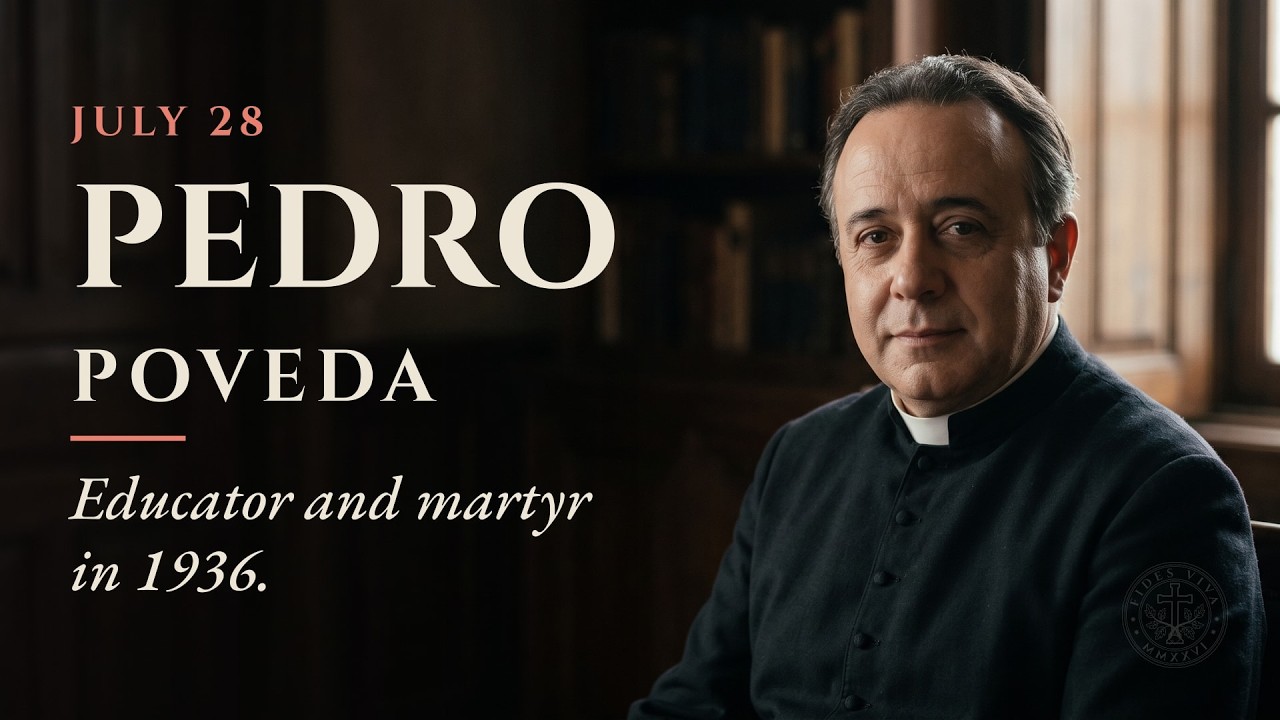
Before dawn. A house sits dark. Footsteps on the stairs. Once that door opens, there is no turning back. He knows it, and he does not hide: he presses the scapular to his chest. What makes someone say who they are?
Linares: Where the Restlessness Was Born
Decades earlier, in southern Spain, an entire city lived off lead. Linares, in the province of Jaén. Dirt roads, whitewashed two-story houses, and in the distance, smelter chimneys staining the sky gray. Every morning hundreds of men went down into the mine; every evening they came back with dust worked into their clothes and their breath. This was Spain at the close of the nineteenth century. A country of deep inequality, where countless children never once set foot in a school. Education itself was becoming a battlefield. No one suspected that in one of those humble houses, someone was about to be born who would turn that battlefield into a field for sowing.
On December 3, 1874, in one of those houses, Pedro Poveda Castroverde was born. He was the eldest of six children, born to a modest, faithful family, the kind that has nothing to spare and still knows how to share. They gave him a long name — Pedro José Luis Francisco Javier — though to everyone he would simply be Pedro. Winter pressed in outside; inside, a newborn lay wrapped in cotton cloths, and a mother gave thanks. Nothing set this cradle apart from any other cradle in Linares. And yet, something had begun.
He grew up between two murmurs. One was the street, with its carts, its peddlers, and the far-off echo of the mines. The other was the home, where faith was lived as naturally as the daily bread. Life in Linares was hard, and no one pretended otherwise. Children learned early what a day's wage cost, what an illness weighed, what it meant when a father did not come back up from the shaft. But in the Poveda household there was something the dust could not choke out: a quiet trust in God, passed on without speeches, in small and constant gestures.
Very early, the boy began looking toward the altar. Since childhood he felt a pull he could not quite name, but that would not let him go: he wanted to be a priest. He wanted to be near Jesus Christ, to serve at the altar, to live out what his home lived without grand words. This was no pious child's whim. It was a quiet restlessness growing in him the way roots grow: downward, without noise, searching for water.
It is hard to imagine less fertile ground. All around, everything spoke of lead, of wages, of survival; nothing invited dreams of altars. And yet the calling pushed through, right there, like grass between stones. How could a call so quiet grow in a world so harsh? Perhaps because harshness does not smother what is true; it tests it. And this calling was true.
At fourteen, fifteen years old, the boy was already looking past the chimneys. Beyond the gray smoke lay another horizon: a seminary, books, a whole life to be given away. Linares had given him what mattered most — faith, hard work, compassion learned in others' suffering. Now the road climbed toward Jaén. And he was ready to walk it.
Down to the Caves
In 1889, at fifteen, he passed through the gates of the seminary in Jaén for the first time. He traded his peaked cap for the black cassock with a colored sash across the chest, the mark of seminarians of that era. He traded the dirt road, too, for stone cloisters and orange-tree courtyards. The days fell into place like the beads of a rosary: prayer, Latin, theology, silence. And the boy from Linares soon discovered that studying, too, could be a form of prayer.
Five years later, in 1894, he moved to the seminary in Guadix, in the land of Granada, to complete his formation. Guadix is a small episcopal town of harsh light and wide skies, on a clay plateau that blazes red each evening. There, in the spring of 1897, the day he had awaited since childhood finally came: he was ordained a priest. He was twenty-two. When he lifted the consecrated bread in his hands for the first time, a circle closed. The same one that opened in that church in Linares, where a boy once stared at the altar, not knowing what to call what he felt. Now he knew: he belonged to Jesus Christ forever, and everything that followed would be born from that.
The first years of his ministry passed among desks — he taught at the seminary itself, and around 1900 he earned degrees in Theology and Education. Knowing was not enough for him; he wanted to know how to teach. Not far away, in Granada, a priest named Andrés Manjón had built schools for the poorest children; word of it reached him like a spark catching in dry kindling. Something was taking shape inside him, though it had no name yet.
The land itself would give it a name. On the outskirts of Guadix, where the town ends and the high plateau begins, the hillside is honeycombed with caves. These are not abandoned shelters — they are homes. Dwellings hollowed out of the clay pick by pick, whitewashed fronts set into the hillside, white chimneys rising out of the ground. An entire forgotten population lived there: landless laborers, large families, the elderly, barefoot children who had never once set foot inside a school. The town knew they were there. And it looked away.
He did not look away. Around 1902, the young teacher began going down. He carried bread, clothes, whatever he could gather from acquaintances. He crossed the threshold of a lived-in cave, and his clean cassock came away stained with red earth. Inside there was dimness, smoke, a straw mat against the wall, and eyes that watched him with the wariness of one used to no one ever coming. He came back the next day. And the one after that. Little by little, faces softened, doors began opening on their own, and children came out to wait for him when they spotted his dark shape on the road.
And then he understood something that would govern the rest of his life. Today's bread runs out tomorrow. Clothes wear thin, alms run dry. But a child who learns to read is never the same again — what is learned stays with him for good. Relief eases poverty for an afternoon; teaching begins to defeat it. He had come down to the caves to hand out bread, and he was going to stay to open a school.
Between 1902 and 1905 the work took shape. He opened schools for the children and workshops where adults learned a trade, because dignity needs both: letters and work. He gathered slates, primers, benches; he sought help, knocked on doors, kept insisting. The scenes were simple, and that is exactly why they moved people. A blackboard propped against a clay wall. A slate pencil in hands that until yesterday had known only the hoe. A row of children sitting for the first time before something like a school desk. In every gesture beat the same conviction: these children whom nobody claimed were children of God, and deserved the best.
Not everyone understood. A young priest, with degrees and a future ahead of him, spent his best years amid the clay and smoke of a neighborhood on no map. What drives someone to stay where no one else wants to be? Perhaps this: he had recognized Christ in those faces weathered by the plateau sun, and knew no other way to serve him. There he discovered that charity, to be complete, must also teach.
In those caves a seed was planted whose full measure he could not yet grasp. He believed he was tending to a forgotten neighborhood. In truth he was discovering a mission: to educate is to evangelize for the long haul, and forming one person is the deepest charity there is. But for that insight to unfold, another landscape would be needed, another silence. Far from the sun of the plateau, in the north of Spain, green mountains waited, wrapped in fog.
Covadonga: Where the Mission Takes Root
The mountains came in 1906. That year he was named canon of the basilica of Covadonga, in Asturias — a priest of the sanctuary's chapter, with his place in the choir stalls and the daily recitation of the Divine Office. From the scorched plateau of Guadix he passed into a narrow, green valley. There the basilica of rose-colored stone rises among beech forests, and the Holy Cave of the Virgin hangs from the rock face above a waterfall. After years under a harsh sun, fog now wrapped around him.
Seen from outside, it looked like a restful posting: a quiet honor for a priest who had worked hard. For him it was something else. It was a silence where he could finally listen. In the choir, vested as the canons of that time were, he sang the hours; in the Cave, before the Virgin, he carried in prayer the weathered faces of the plateau. He spoke with Christ about what he had seen, and what he had left behind. And in that silence, a question began to grow, and it would not let him go.
The question was this. One school in one cave can change one neighborhood. But Spain is full of neighborhoods like it, of towns without letters, of children no one is waiting for. And every school, good or bad, depends in the end on one person: the one standing at the blackboard. Whoever forms a teacher reaches every student that teacher will have in a lifetime. Whoever forms the teachers of a country is forming the country itself.
The nights at Covadonga became a hidden classroom. He requested books and journals on education, studied the state of schooling across Spain, wrote letters, consulted experts, filled page after page by candlelight while the fog erased the mountain outside. Little by little, the insight born in the clay of Guadix took the shape of a project: to form Christian teachers, women and men, as well prepared as the very best. Present in the public schools, in the teacher-training colleges, and in the universities. Not to build a world apart, but to stand inside the one that already existed, with competence and with faith. And there was a further boldness, quiet and enormous for its time. To entrust that mission, above all, to women, in a Spain that had scarcely opened the doors of higher study to them.
In 1911 the idea came down from the mountain. In Oviedo, with a small group of young women collaborators, he opened the first Academy: a modest house where future teachers prepared for their examinations and degrees. There he joined rigorous study with a deep Christian life. No one, seeing that house, would have guessed that something great was beginning there. But that is how a school in a cave becomes a project meant for all of Spain. Not in a single leap, but by letting the same charity learn to look further.
And there was something else, almost invisible, that defined his way of sowing: he never placed himself at the front. He prepared, accompanied, trusted, and stepped back so other women could grow. The vision now had a body of its own, and the mountain had grown too small to hold it. The mission came down from Covadonga to seek its place in the Church and in the society of its time.
Sowing Amid Contradiction
In 1913 he returned south. He was named canon of the cathedral of Jaén — with its great Renaissance façade and twin towers — in the very province where he was born. He was thirty-eight now, the first gray showing at his temples, and something none of his earlier postings had given him: a young work of his own to carry. Fragile, small, held up by a handful of young women teachers and by the certainty that God wanted it. Between the choir prayers and the high vaults of the cathedral, the Jaén years would be years of putting down roots.
The Academies multiplied. What had begun in Oviedo as a simple house spread to other cities: centers where students training to be teachers found lodging, a library, academic rigor, and a life of faith woven into their studies, not set apart from them. In Jaén the work received the bishop's approval: it stopped being one canon's personal project of handwritten pages and became an association recognized within the Church. It had a name now: the Teresian Association. And it had a style that unsettled many: women who studied in depth, sat for public examinations, and won posts in the public schools. And prayed.
Among those young women stood out a teacher from Jaén named Josefa Segovia — trained at the Higher School of Teaching, calm, of firm intelligence. In her he found what he had spent years looking for: someone capable of governing the work, and governing it well. And he did what few founders dare to do: he entrusted her with its direction. It was no empty gesture. It was his way of understanding the mission: trust placed in others as the highest form of hope. He would go on writing, guiding, sustaining from behind the scenes; but the helm stayed in the hands of a young woman, in a Spain where that, simply, was not done.
Watching them set out became his deepest joy. Young women of twenty, twenty-five, freshly graduated, went out to village and city schools carrying a mission larger than themselves. They went alone, often far from home, to places where no one waited with open arms. He accompanied them as best he could: with steady letters, with a calm word that restored their courage. He did not promise them it would be easy. He gave them something better: the certainty that they were not alone, and that what they did in a forgotten classroom mattered to God.
Not everything was growth. The work moved forward with scarce resources, amid misunderstanding and suspicion. In a Spain where the school itself had become a battlefield — some wanted faith driven out of the classroom, others distrusted public schooling altogether. His proposal unsettled both sides: too modern for some, too devout for others. Doors were slow to open, funds failed to arrive, hasty judgments fell on the canon who trained women teachers. What sustains a young work against misunderstanding and scarcity? In his case, the answer took the shape of an altar. The morning Mass, the daily encounter with Christ in the Eucharist: that was the ground everything else stood on. From there he drew the calm to leave attacks unanswered, the patience to wait, and that quiet boldness that never needed to raise its voice.
In 1921 came a new posting, the last one. He was named royal chaplain in Madrid: a post serving the palace chapel, in the heart of the capital. The priest of the cave-dwellings now walked among streetcars and cafés, in the same black cassock, round wire-framed glasses over his clean-shaven face; his hair, gray now, receding from his brow. From Madrid he directed the work's expansion, answered a stream of letters without rest, and kept in touch with the teachers now spread across half of Spain. Those trained at the first Academies now taught in public schools in towns and cities, and in turn prepared others younger than themselves. The seed had become a method.
And years later, by then in Madrid, the recognition of Rome would also come. It was the pontifical approval that made the Association a work of the whole Church, no longer of a single diocese. What had begun in a cave-dwelling in Guadix and grown in the silence of Covadonga now had branches he himself could no longer see.
Up the stairs of his house on Alameda Street climbed, in those years, visitors from all over Spain. One kept returning. He was a young priest from Aragón, Josemaría Escrivá, founder of a work just born: Opus Dei. He came for the first time on the seventh of December, 1931; after that he returned, again and again. The veteran of the cave-dwellings listened, encouraged, and opened the statutes of his Association to the young founder, who studied in them a path much like his own. In the autumn of 1934, Poveda returned the visit at Escrivá's first university academy. Neither man knew it yet: two founders recognizing each other, with no certainty but that of walking the same road.
But as the work matured, the air of the country grew heavier. The 1920s ran out; the 1930s arrived, bringing with them a tension felt in the newspapers, in the public squares, in the tone of conversation. Spain was dividing and hardening, and the school — his field of mission — stood at the very center of the dispute. Poveda watched it from his desk, nearing sixty now, with the clarity of a man who knew his people and saw the storm coming. For a man who had made trust his method, the question was no longer how to grow. It was how to endure. And the answer that had been ripening in silence for years bore an old and disarming name: meekness.
The Price of Meekness
In 1935 he put it in writing. On a sheet of paper, in the same steady hand as always, he set down a line that ran against everything the street was saying: "We must not deceive ourselves: meekness, kindliness, and gentleness are the virtues that conquer the world." It was not naivety. It was the conclusion of sixty years of life. He had seen what a school could open and what a shout could close; he knew the method Jesus had used with his own, and he had decided to use no other.
A man who writes like that has not missed the storm coming: he has taken its measure. And he chooses, with his eyes open, the way he is going to lose. Because meekness, in times of fury, is not a tactic: it is faithfulness. It is following the Lord Jesus, meek and humble of heart, when everything around demands the opposite. In those last years he insists again and again: never answer hatred with hatred; and in those same years he repeats that meekness is not weakness, but the strength of the Christian.
In July of 1936 the storm broke. War erupted. From the first days, a religious persecution began in Madrid that would cost the lives of thousands of priests, religious, and laypeople for the sole crime of believing. To be a priest, in that Madrid, was to carry a sentence already hanging over him. Many went into hiding; others managed to leave the city. He stayed in his house on Alameda Street, sixty-one years old, his heart at peace. He kept praying, kept writing letters, kept celebrating the Eucharist every morning in the small oratory of the house.
On the morning of July 27, he went up to the altar for the last time, though he did not know it. A Mass said in a low voice, with no bells, on a simple table, while the city held its breath behind closed shutters. For nearly forty years he had spoken those same words, since the spring of 1897 in Guadix; they had never weighed so much as now. He consecrated the bread, adored it, received communion slowly. The Christ he had served in the caves, in the classrooms, and in his letters came to his house hours before they came for him.
That same day, knocks sound below, at the entrance. Footsteps climb the stairs, the same ones heard those days in so many houses across Madrid. The door opens. There is no struggle, no shouting: a thin man, gray-haired, in round glasses, lets himself be led away without resistance. Under his clothes he wears, as he has for years, the scapular of Our Lady of Mount Carmel, that small piece of cloth the devout wear as a sign of her protection. He hides nothing. There is nothing left to hide.
The early hours of July 28 find him already far from home, in the hands of those leading him away, under the still air of summer. They ask him who he is. He could stay silent. He could give any name, any invented trade; a small lie would be enough to buy time, perhaps to save himself. He had spent his life teaching others to tell the truth, before the children of a cave and the women teachers of half of Spain. He was not going to take it back in the final lesson. What stayed fixed in the memory of those who knew him was a single sentence, spoken without a tremor:
"I am a priest of Christ."
And he gave his life.
In that sentence lies everything. The boy from Linares who grew up among the smelting chimneys. The young priest who made the cave-dwellings of Guadix his first field of mission. The canon who wrote at night in the fog of Covadonga. The founder who placed his work in the hands of young women when no one else did. He could have said "I am a teacher," "I am a founder," "I am a writer," and every one would have been true. He said the one thing that explained him whole: the root from which everything else had grown.
Can an entire life be summed up in a single sentence? His could. But only because every day of sixty-one years had been writing it: in chalk, in letters, in bread given away, in trust freely handed on. The sentence spoken that morning was no sudden burst of courage. It was the signature at the foot of a page written over an entire lifetime.
Afterward, silence. Over Madrid, dawn began to break on a July 28th that looked like any other day. No one, at that hour, would have wagered anything on the future of a work whose founder had just died. But seeds are never seen growing in the night. Buried in the hard ground of that summer, his was beginning, in that very hour, to bear its deepest fruit.
A Seed That Does Not Die: The Legacy
Whoever found him the next morning kept one detail forever, and that is how it has come down to us: over his chest still lay the scapular of Our Lady of Mount Carmel. The small piece of cloth he had carried for years was not lost that final night. That plain piece of cloth was itself the devotion of the poor he had served, worn over his heart for years without anyone noticing. His own understood without needing words: the Mother he had prayed to so often had walked with her son to the end of the road.
The Association, though, was left out in the open. That same summer the persecution reached his own as well: on August 12, in Hornachuelos, a town in the province of Córdoba, Victoria Díez died a martyr, a thirty-two-year-old teacher trained within the Association. She had learned from him that a classroom could be mission ground, and she professed her faith in Jesus Christ with the same serenity as her founder. The two fell two weeks apart, each at their post.
But what had been planted did not die with them: the Association carried on, and over the years it spread, country by country, classroom by classroom. Josefa Segovia, that young teacher from Jaén to whom he had entrusted the governance of the Association, led it for decades. And in April of 1955, while she was still general director, the Church opened the cause for his beatification. The woman who once received his trust became the keeper of his memory.
A few years after that cause opened, his remains found rest in the mountains outside Madrid, among pines and granite: the chapel of the Santa María de Los Negrales center, in Alpedrete. A simple tomb beneath the altar, clear mountain light, silence. The man who never sought monuments has rested, ever since, in a place made to his measure.
As the hundredth anniversary of his birth came around, recognition arrived also from outside the Church: so it is remembered by those who knew him, UNESCO honored him as a humanist and educator. The priest who had begun by teaching children to read in a cave-dwelling now entered the memory of the world through the door of the classroom.
The Church, which looks deeper, spoke its word on October 10, 1993: in Rome, John Paul II declared him blessed. And he was not raised to the altars alone. Beatified alongside him was Victoria Díez, the teacher of Hornachuelos. Fifty-seven years after that terrible summer, teacher and student stood together again before the whole world.
The homecoming was still to come. On May 4, 2003, Plaza de Colón in Madrid woke covered with the faithful: more than two million people. On the façade hung an enormous tapestry bearing his true likeness: the clean-shaven face, the round glasses, the barely suggested smile. Before that crowd, John Paul II proclaimed him a saint alongside four other Spaniards. He was already elderly and ill: that journey would be the last he made to Spain. "Saint Pedro Poveda," the Pope said that morning, "grasping the social importance of education, carried out an important humanitarian and educational work among the marginalized and those lacking resources." Madrid, the city where he had been killed before dawn, now acclaimed him in the full light of day.
And what remains when a life ends? Those who received it remain. Today the Teresian Association is alive in dozens of countries: schools, universities, educational projects. Thousands of men and women believe, as he did, that teaching is a form of love. Every morning, in many languages, someone opens a classroom the way he opened the first one in the red earth of Guadix. They do not carry his name on the door; they carry his manner: trust, meekness, work done without noise. And in every one of those gestures, the Association that priest built keeps growing, the way the things of God grow: slowly, in silence, toward the light.
One Life, One Sentence: An Invitation to Trust
And there it remains, open since that dawn, the question that started it all: what leads a person to say who they are, without fear, when everything is at stake.
His life had answered it long before anyone came knocking. The sentence was not born that night; he had been saying it for sixty-one years, without ever speaking it. He said it descending into the cave-dwellings of Guadix with a basket of bread, and staying to open a school. He said it through the nights in Covadonga, writing into the fog a project others would watch grow. He said it by entrusting his work to a handful of young teachers and stepping aside. When the hour came, he did not have to search for words. What remained in the memory of those who knew him — "I am a priest of Christ" — was only the summary of everything he already was. That calm had not come all at once: it had been forming, school after school, letter after letter, until that final moment.
And there is something more, almost a mystery: that life was fruitful precisely because he did not keep it for himself. He placed it in the hands of others — some teachers, some children, a mission — and that is why it kept bearing fruit once he was gone. Whoever teaches, whoever cares for another, whoever walks beside someone without applause, recognizes that way of being in the world: saying who they are with their hands before their lips.
We too stand, now and again, before a small version of that door. An ordinary conversation at the table, where speaking the name of Jesus Christ aloud feels a little uncomfortable. There are no stairs, no footsteps in the night; yet the question is the same. At what moment do we also say who we are, without fear, in small things and in great ones?
He gave his answer. Each person's own answer stays where it is born: in silence. That question has not aged. A whole life fits, sometimes, into a single sentence. His has not stopped being spoken.
Saint Pedro Poveda, teacher and apostle of Christian education, pray for us.