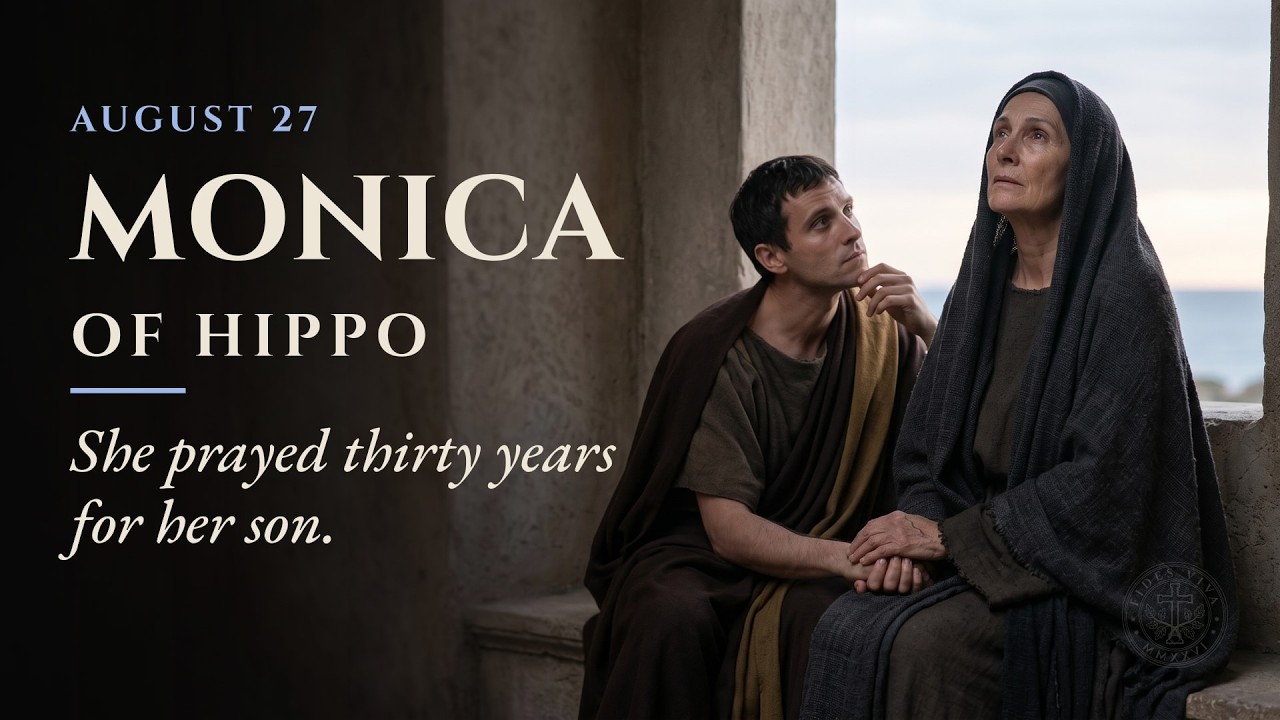
Evening falls on a courtyard in North Africa. Inside the house, a woman listens to footsteps she knows by heart: she heard them crawl across these same stones once. Now they stop at the door.
It is her son. And the door does not open.
She herself has arranged it this way.
This is Roman Africa, in the fourth century. The woman is a widow. The young man waiting outside is her pride and her wound: a brilliant mind who has given himself to a sect she holds as ruin. Rather than watch him sit at her table speaking against Christ, she chooses the bolted door. No one taught her that gesture; she is inventing it in the dark, between prayers.
One night, that door will open again. Whatever moves her to open it will have to sustain her a long time yet, because the waiting has barely begun.
She founded nothing. She wrote not a single line. She worked no wonders in her lifetime that crowds would remember. Her work was waiting: nearly thirty years asking for the same thing, with no weapon but pleading and a gentle firmness.
The Church honors her as Saint Monica. And the son waiting outside, on the other side of that bolt, will be Saint Augustine.
But before the door, before the sea and the weeping, there was a house with jars of wine, and a girl who did not yet know how to wait.
Before the Weeping: The Girl and the Word That Wounded
Olive trees cover the hills of Numidia. Tagaste is a small town on the plateau: houses of mudbrick and stone turned toward their courtyards, a forum with a colonnade, cisterns, threshing floors, ochre dust under a light that shows no mercy. It has been barely a generation since the Empire stopped persecuting Christians. Now churches rise in plain view, but pagan altars still smoke in the same streets. And Africa's own Church is split by a bitter dispute among Christians. In the houses, people pray in Latin and haggle in Punic. It is a mixed world, rough at the edges, still unsettled.
There, around the year 331, a girl was born into a comfortable Christian family — the kind that in that land almost certainly descended from old, Romanized Berber stock. The date is reckoned backward from the end of her life — no one recorded the day it began — and every one of her years is counted from there. They gave her a name of the land, Monnica, an echo of an old regional goddess: a Christian girl bearing the name of a Libyan deity. That was Africa then.
Her upbringing was not her mother's doing but an old servant woman's — respected by everyone in the house, and as hard as the plateau itself. She ruled the girls with severity: outside mealtimes, not even water. Let thirst be mastered early, she reasoned, so it would not grow into a mistress's vice on the day they held the keys to the pantry.
And yet it was wine, not water, that nearly bent her out of shape. Her parents sent her to the cellar to draw wine from the jar, the way a task is trusted to a sober daughter. Before filling the pitcher, the girl would wet her lips at the rim of the cup — barely a sip, almost a game. The next day, a little more. And more. Sip by sip, day by day, she came to drink nearly full cups in secret.
No one in the house knew. The servant who went down with her knew; and one day, in the middle of a quarrel between the two of them, she spat it in her face: little drunkard. One word, meant to wound. And it did. Shame rose inside her like fire; she saw herself in that word, hated what she saw, and never touched wine in secret again. Never again.
Decades later her son wrote it down, hiding nothing, and it is through him that we know it. It was not the love of her family that corrected her, nor the old servant's watchfulness: what corrected her was one servant's insult, thrown with no intention of saving anyone. The word meant to wound was the one that healed her.
Something of that cellar stayed with her forever. Her virtue was not a gift she was born with: it was something learned, through the blows of shame. Whoever knows her own cracks so well learns to look at the cracks of others without flinching. One day she would face those of a husband. Later, those of a son. And she would know how to wait before them without breaking.
The girl with the braid grew up learning to fall silent at the right moment and to save her words for when they were needed. She would need that skill. Because the adult world had no intention of asking her anything: the moment childhood ended, others would decide her household, her husband, and the whole life ahead of her.
The House of Patience: Wife and Mother in Tagaste
She was barely sixteen or seventeen when her parents closed the agreement. The man chosen was called Patricius: a decurion of Tagaste, a member of the city council, a landowner of modest means. A pagan. Of a temperament hot as embers, and of fidelity scarce—a thing no one in that world much blamed in a husband.
Into that man's house came the girl with the braid, now wearing the veil of married women over her hair. And in that house lived another woman: Patricius's mother, an old woman who received her with suspicion. The servants filled her ears with complaints against the young wife, and the old woman believed them.
When her husband's anger flared, she learned a tactic that no friend had taught her. When Patricius raged, she did not answer: not a word, not a gesture to feed the fire. She waited. And when the storm had passed and she saw him calm, only then would she explain what she had done and why. The tongue kept silent in the moment of fury, and offered in the moment of peace.
Other wives of Tagaste came to visit her with their faces marked by blows from husbands milder than hers. They marveled: how was it possible that Patricius, with that temper, had never laid a hand on her? And she, half joking and half in earnest, told them the fault lay in their own tongues, which caught fire when they should have stayed silent. Harsh counsel from a woman with no power in a harsh world. But beneath it lay something else: a freedom within that no one could strike down.
With her mother-in-law she used the same slow weapon. She did not answer gossip with gossip; she served, kept silent, endured. And the old woman, who had entered the household war poisoned by the servants' talk, ended up surrendering to what she saw with her own eyes each day. It was she herself who finally denounced to her son the gossiping tongues in the household. The servants were punished, and between the two women there grew a peace that no one would have wagered on at the start.
In the midst of that patience, children came. At least three grew to adulthood: Navigius, a daughter whose name no one wrote down, and a boy born on the 13th of November in the year 354. They called him Augustine. His mother brought him to the church as a newborn and had him marked with the cross and given salt to taste—the signs by which catechumens were enrolled. It was a way of saying that the boy was pledged to Christ. But baptism, by the custom of the time, was put off for later.
That later date almost came sooner than planned. When the boy was eleven or twelve, he fell gravely ill, and he himself asked for baptism. Everything was made ready in haste. But the fever broke, the danger passed, and baptism was put off again, to wait for when he was grown. That delay would weigh on both of them like a stone in memory.
And there remained the oldest waiting of all: Patricius himself. She never dragged him into arguments about Christ; she preached to him without words, through the conduct of each day, trusting that life itself would speak where arguments would have clashed. Twenty years passed this way. Around the year 370 or 371, the hot-tempered decurion asked to be enrolled as a catechumen; he received baptism, and died soon after, reconciled at last to the Christ of his wife.
The first waiting of her life had come to fulfillment on the very edge of death. She was about thirty-nine years old, and a widow. There remained the other waiting, the long one: the waiting for the brilliant son who studied in Carthage, and who was beginning to walk in a direction she could not follow.
The Closed Door: The Son Who Is Lost and the Dream That Sustains
Letters and travelers brought news from Carthage of the son. Good news, if you looked at his career: young Augustine stood out in the schools of rhetoric, and everyone promised him a future as a master teacher. Bad news, if you looked at his soul. Around the year 373 he had joined the Manichaeans, a sect that divided the world between light and darkness. They mocked the simple faith of the Church and despised the Scriptures his mother held sacred. And he did not keep it quiet: he preached it, with all the eloquence he had just learned.
When he came back to Tagaste with those doctrines on his lips, he found something he had not expected. His mother did not argue with him. She closed the door. She would not give him her table or her roof while he spoke that way of Christ: that was all. The woman who had tamed a husband's anger with silence for more than twenty years now used silence as a wall. It was not a lack of love; it was the hardest form of love she knew. To share bread with a son who blasphemed seemed to her to consent to the lie that was carrying him away.
And yet she wept for him more than mothers weep for sons who are dead. By day she worked, served, kept silence; by night she asked Christ for that boy as one digs in stone. Until one night her weeping received an answer.
Her son told it afterward, in the book he wrote about his own life, which was also the story of hers. She dreamed she was standing on a wooden ruler, sunk in sorrow, and there came toward her a young man, radiant and joyful, asking her why she wept so. She answered that she wept for the ruin of her son. Then he told her to look carefully: where she stood, he stood also. She looked. And she saw Augustine standing beside her, on the same rule.
When she woke, she told him. And the student of rhetoric, skilled with words, tried to twist the meaning in his favor: perhaps the dream announced that she would come to where he was. The reply came without a moment's hesitation: she had not been told "where he is, there you will be," but "where you are, there he will be." Years later, he would confess that that calm answer had shaken him more than the dream itself.
That certainty opened the door again. She sat him at her table once more, shared with him the roof and the bread, without blessing his doctrines or turning every meal into a dispute. She had received a promise; now she had to learn to hold it. Nine more years he would remain among the Manichaeans. She did not know it.
But a promise received in a dream weighs less with each passing month against a son who keeps sinking deeper. She sought help. There was in Tagaste a bishop who knew the Manichaeans from within: his own parents had raised him in that sect, and he had left it by himself, through reading. Monica begged him to speak with Augustine, to refute him, to dismantle the error for him. The bishop refused. The boy, he said, was still too proud of the novelty; he would not listen. Through reading, he would discover the deception on his own. Let him be, and keep praying.
It was not enough. She pressed him, with more tears, again and again, until she wore the man down. And then the bishop, already vanquished by that persistence, spoke to her the words she would keep for the rest of her life: "Go now; as surely as you live, it is impossible that the son of so many tears should perish." She received it as if the voice had sounded from heaven itself.
A wooden rule seen in dreams and a word spoken out of weariness. That was all the baggage with which a widow from Tagaste would cross nearly a decade, asking Christ for the same thing each day, without seeing any sign of change. Because the son did not change. He prospered, taught, shone in Carthage—and began to look further, toward the other side of the sea. The distance between the two was about to become water.
The Night at the Port: Abandonment and Crossing
Rome. The name ran among the rhetoricians of Carthage like a promise: there the students paid better and caused less trouble, there an ambitious teacher could rise even to the court. In the year 383, Augustine decided to cross. His mother knew it almost at once, because she had spent years watching his every step, and she stood before him with a single choice: either he stayed in Africa, or he took her with him. She followed him to the very dock, determined not to let him go.
He did then what sons do when they dare not wound openly: he lied. He was not leaving, he told her; he was only seeing a friend to the ship, to say farewell when the wind rose. She did not quite believe him. But she agreed to withdraw for the night near the port, in a small chapel built in memory of Saint Cyprian, the bishop who a century before had given his life for Christ in that same city.
There she kept vigil. All night, on her knees on the stone, she asked for one thing alone: that her son would not sail. That the wind would not come. That the sea would hold him one day more, and another, until it softened his heart. Outside, in the darkness, the ship's rigging creaked.
The wind came at dawn. When she came down to the dock with the first light, the ship was already a small sail against the horizon. She stood looking at the empty water. Deceived. Abandoned by the son she loved most, at a port that woke behind her as if nothing had happened. She wept there, filled Christ's ears with her complaints, and searched for him with her eyes where he no longer was.
With the years, that night would find another meaning: heaven did not grant what she asked then, to grant what she had spent half a life asking. But that morning there was no meaning to be found. Only a mother alone before the sea.
She did not do what was expected of a widow of her time. She did not return to Tagaste to wait for letters. She gathered what she needed and embarked after him. A slight woman past fifty, alone on a merchant ship, bound for a country whose streets and cold she did not know.
In the midst of the crossing the sky closed in. The storm shook the vessel for hours, and the sailors, men seasoned to those waters, feared the wreck. In the midst of the fear something strange occurred: the passenger in the dark veil began to comfort them instead. They would reach port, she assured them. She did not say it as one who encourages, but as one who knows. Something had guaranteed it to her from within. So her son would tell it years later: she could tell, by a taste deep inside that she could not explain, the difference between those inner certainties and the mere wishes of the heart.
And they did reach it. She disembarked in Italy, crossed roads she did not know, and found her son at last in the north, in Milan, in the year 385. Augustine taught rhetoric now in the imperial capital; she found a man different from the one who had left her at the dock. He no longer defended the Manichaeans. But he believed in nothing either: he drifted, without doctrine and without harbor. Any other mother would have wept again. She answered with her quiet certainty as always: she was certain she would see him a faithful Catholic before she left this life.
Around her rose a city that looked like nothing from her world. Marble instead of clay, mist instead of dust, the courtly Latin of the imperial palace instead of the speech of her land. Under that northern mist, without knowing it yet, the wait of nearly thirty years was entering its final stage.
Milan: Obedience, Song, and the Fulfillment of Waiting
At the head of the Church in that city stood a man unlike anyone she had ever known. His name was Ambrose. He had been a Roman governor, and the people had acclaimed him bishop almost by force; now his voice filled the basilicas of Milan. A slight man, worn by fasting, with a penetrating gaze. Augustine came to hear him professionally: he wanted to study at close range the technique of that celebrated orator. But through that narrow opening in his technique, something else began to reach him. Sunday after Sunday, the Gospel of Jesus Christ, explained with a depth that no Manichaean had ever offered him, began to open its way inside him.
She understood it the first time she heard him preach. She loved that bishop as a father, because she saw in his words the path of her son's return. And Ambrose, when he crossed paths with Augustine, congratulated him on having such a mother.
Monica's obedience was won quickly, and in a way all her own. One day she presented herself at one of the basilicas with her basket as always: bread, cakes, and a little wine for the tombs of the martyrs, the custom she had practiced all her life in Africa. The doorkeeper stopped her at the threshold. The bishop had forbidden it, he said. She did not protest. She asked for no exception, she did not explain that in her land such piety was the work of generations. She accepted at once, left the basket, and from then on brought the martyrs a different offering: a heart laden with better gifts, and to the poor what she had once laid upon the tombs.
Perhaps she would not have yielded so easily to another bishop. She yielded because it was Ambrose: she loved that man for what he was doing, without yet knowing it, in the soul of her son.
The spring of the year 386 put that Church to the test. The imperial court demanded basilicas from Ambrose for its worship. They asked it of the young emperor Valentinian and his mother Justina, followers of the Arian doctrine, which denied the full divinity of Christ. He refused. And the people filled the temple to protect him, day and night, not knowing how that struggle with the palace would end. To sustain the crowd through the nights of enclosure, the bishop introduced something the West did not know. It was the chanting of psalms and hymns in alternation: two choirs answering each other in the darkness like waves. Among those voices was Monica's. The woman who had crossed the sea now kept vigil with an entire city, and she sang.
In August of that same year, in the garden of the house where they lived, the long inner struggle of Augustine came to its end. Alone, undone, he ceased to resist: he surrendered himself to Christ without condition. He came into the house and told his mother.
She heard the words she had been asking to hear for decades. She wept then too, but that weeping was unlike any of her own: it was the first time, in thirty-two years, that she wept for her son without pain.
That autumn they left the city. A friend lent them a villa in the countryside, at Cassiciacum, at the foot of the mountains: damp meadows, chestnut trees, a stream nearby. There all of his household gathered. Navigius, his other son. Alypius, the faithful friend from Tagaste. And Adeodatus, the boy Augustine had fathered in his youth, a grandson of fifteen whose intelligence commanded respect from his own father. They spent the hours in dialogue about the happy life and the order of the world, sitting beneath the trees, while the light of afternoon descended between the branches.
Augustine seated his mother in that circle of learned men. And the woman whom no one had ever asked for her opinion spoke with such acuteness, quoting from memory a verse from a hymn of Ambrose, that her son recognized it with astonishment: "I forgot completely that she was a woman, and it seemed to me that some great man was sitting with us." The mother whom all had seen weep turned out to be, besides, a woman who thought.
Easter came in the year 387. On the night of April 24 into 25, during the Easter Vigil, Ambrose baptized Augustine, Adeodatus, and Alypius in the baptistery of Milan. Thirty-two years before, a young mother had traced the cross on the forehead of a newborn and put salt on his lips. That night, beside the font, she saw the water complete what that gesture had begun. Her son left nothing written of what she said that night. Perhaps no word was needed.
She had asked for one thing alone for more than half her life. It had just been granted to her. But no one stops waiting from one day to the next: the question remained what a heart does when it has nothing left to ask for. They decided to return to Africa, to the land from which all of this had come, and set out toward the port. The answer waited for her beside the sea.
Ostia: The Window and the Eternal Instant
Ostia, at the mouth of the Tiber, was the last stop before the sea. A city of red brick, of grain warehouses and streets echoing with the screech of port carts; a city where everyone was passing through. They rented a house set back from the bustle, with an inner garden, to recover from the long journey while they waited for the ship that would carry them back to Africa.
She never boarded it.
One afternoon in that autumn, mother and son were left alone, leaning together at a window that opened onto the garden. They rested, speaking to each other alone with an immense gentleness, forgetting what lay behind and turning toward what lay before them. They wondered what the eternal life of the saints would be like: that life no eye has seen, the life Jesus Christ promises to his own.
So Augustine would remember it, years afterward, his eyes full of tears. The conversation began to climb. Together they traversed the things created—the earth and the sea, the sun, the moon, the stars—and left them behind, because none of it was what they sought. They entered deeper, passed through their own souls, and continued climbing toward the region where life does not end.
And there, for one instant, with all the force of the heart, they touched it. A single heartbeat. Only that. They brushed that Wisdom by which all things were made, and sighing, released it, and returned to the noise of words, where every sentence has a beginning and an end.
They had arrived together, mother and son, at the same place. The boy who had sailed away in secret and the woman who stood weeping on the dock had just looked upon the same thing. Hand in hand, reaching what she had asked for nearly thirty years. And as they descended from that height, Monica discovered something unexpected: she had nothing left to ask for.
Days later, with the light of the garden still in her memory, she said it to him in full words: "Son, as far as I am concerned, nothing in this life now gives me any pleasure. I wanted only to stay a little longer, to see you a Catholic Christian before I died. My God has granted this to me more abundantly."
It was not weariness, and it was not sadness. It was the freedom of one who has finished her task. The prayer that had sustained her through a difficult marriage, through a closed door, through a harbor at dawn and an entire sea, now had no purpose left. Her heart, for the first time in decades, was silent.
Five days later she came down with a fever. The marshes of the Tiber poisoned the air of Ostia every autumn, and the fever showed no mercy to exhausted travelers. The small body that had endured so many vigils surrendered quickly: sweat, cracked lips, a faintness in which she lost consciousness.
At her bedside stood her two sons. Navigius, with the simple sorrow of his nature, spoke aloud what all were thinking: that she might not die there, in foreign soil, but in her own. Because there was a detail everyone knew. For years, Monica had prepared her grave in Tagaste, beside Patricius: to rest at the side of her husband was the desire she had kept for the end of this world.
She looked at them, and then looked at Augustine. "Bury my body anywhere, and let not the care of it trouble you at all. This only I ask: that you remember me at the Lord's altar, wherever you may be."
And to those who lamented that she would die so far from her land she answered with the last lesson of her life: "Nothing is far from God, nor need we fear that at the end of the world he will not know where to find me and raise me up." The woman who had crossed the sea for love of a son now released the last thing that bound her. The earth itself, the grave beside her husband, the return home. She needed no place. The altar's remembrance was enough.
On the ninth day of her illness, that believing and devout soul was freed from the body. She was fifty-six years old.
Augustine closed her eyes. Young Adeodatus broke into loud tears, and the others quieted him: it seemed to them that a death like this ought not to be wept over as defeats are wept over. Augustine himself held his grief inside and restrained his tears before all. But true mourning cannot be commanded. That night, and in the days that followed, when he was alone and without witness, the son wept at last for his mother: for her and for himself, for all that those small hands had wept for him.
They buried her in Ostia, far from Tagaste, far from Patricius, as she had accepted. The return to Africa was delayed still, and when it came, she no longer traveled in the ship. And yet that woman who renounced even her own tomb was about to begin the longest of her journeys: the journey of her name through the centuries.
The Memory and the Marble: Legacy and Presence
Over her tomb in Ostia, with the years, someone placed a stone with verses. The verses have been attributed since ancient times to a Roman consul, Anicius Auchenius Bassus, and they called Monica the most chaste of mothers; they said that another light of Augustine's merit rested there. It was an elegant gravestone in a port cemetery. Nothing suggested that her name would outlast its stone.
The first to carry it far was her own son. Back in Africa, now bishop of Hippo, Augustine wrote the book of his entire life, and within it, page by page, the life of his mother: the wine cellar, the closed door, the harbor at dawn, the window. Whoever opens that book, for sixteen centuries now, has known Monica.
Ostia, by contrast, faded with the centuries, and her tomb with it. In 1430 her remains were carried to Rome, to the Church of Saint Augustine in Campo Marzio, the mother house of the order that bears her son's name. They rest there still, in a chapel of their own, beneath the altar.
The stone with the verses was lost. It was known only from medieval copies, until in 1945 some boys digging a hole beside the Church of Saint Aurea in Ostia struck an ancient fragment of marble. It was the original stone. Fifteen centuries later, the name of that woman rose from the earth again.
Pilgrims from every corner of the world pass before her urn in Rome today, and above all mothers: women who pray for sons estranged from the faith, and who recognize themselves in her without need of explanation. Pope Francis prayed there, more than once, on the feast of her memory. And on May 8, 2025, Leo XIV was elected—the first Augustinian pope in history. He was ordained a priest in a Roman chapel dedicated to Monica, and today he wears relics of her and her son in his pectoral cross.
She asked for one thing: to be remembered at the altar of the Lord. The woman to whom the place of her body no longer mattered rests today beneath an altar where her name never ceases to be spoken. The stone keeps her name. But what lives on is not the marble: it is the waiting that mother held, and the question of what held her.
When the Waiting Ends: An Invitation to Silence
The answer lies in her deeds: she asked for the same thing for nearly thirty years, and the door she had once closed to her son, she opened again.
We too are waiting: the child who drifts away, the call that does not come, the prayer that does not tire. How long can we love without an answer?
She loved to the end. Her certainty stands: nothing is far from God.
Saint Monica, mother of Saint Augustine, patroness of mothers and of wives who wait, pray for us.