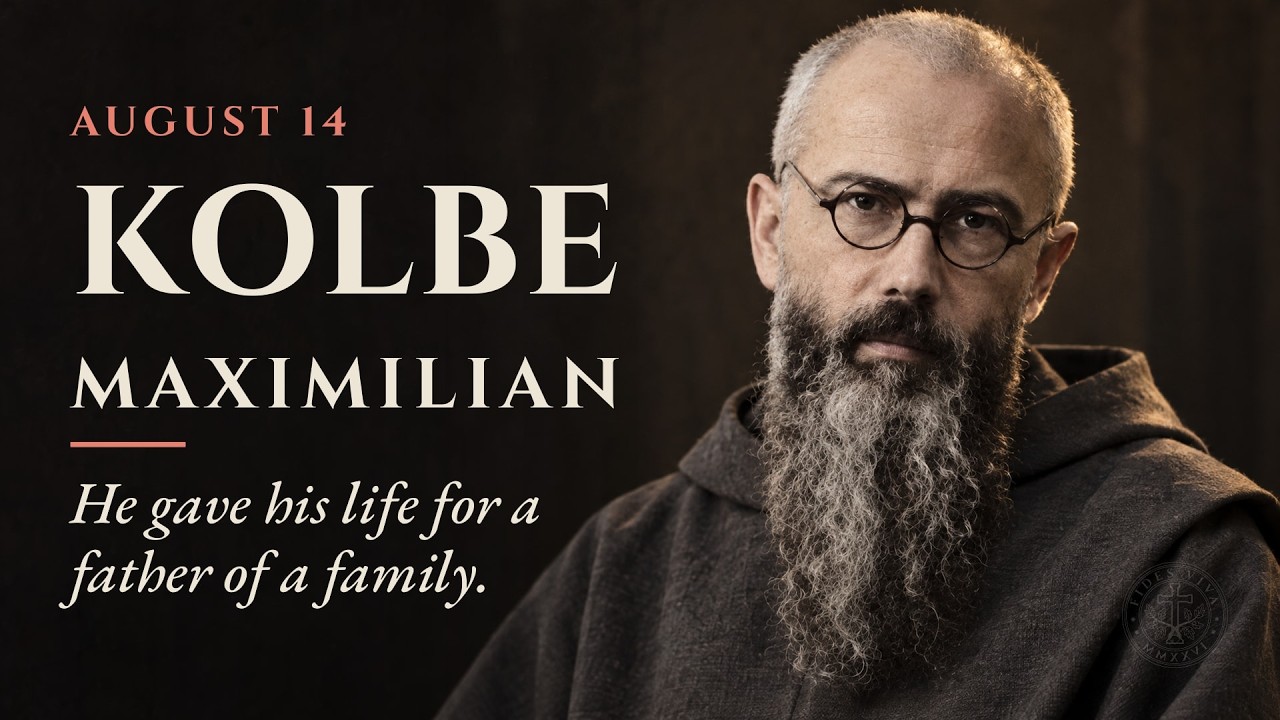
A concrete yard under the August sun. Hundreds of men in line, heads down. An officer picks ten to die of hunger in a bunker. One of the chosen breaks and cries out for his wife and children.
Then a thin prisoner, a number sewn to his chest, steps forward. He does not ask for mercy. He asks to die in that man's place.
The officer asks who he is. He answers: a Catholic priest.
It is 1941, in Auschwitz, and the number sewn to his uniform is 16670. What happened afterwards in cell 18 no one expected: where the guards counted on screams and men clawing at the door, they found prayers and singing. Two weeks later he was still alive, and they had to come in with a syringe of carbolic acid to finish it.
The sergeant he saved, Franciszek Gajowniczek, survived the war and spent more than fifty years telling the story of that step forward.
And there is something almost nobody knows: that friar had spent a whole life preparing. At twelve he said yes to a question that changed his destiny, and as a man he built in Poland the most populated friary in the world, with seven hundred friars and a printing press turning out a million copies a month.
His name was Maximilian Maria Kolbe.
To understand where that step came from, we have to go back to a town of weavers, in a Poland that did not yet exist on any map.
The Two Crowns
At the end of the nineteenth century, Poland does not exist on the maps. Three empires divided it a century earlier, and its central strip belongs to the Tsar of Russia. In the textile villages of the plain, the sound of looms fills the houses before dawn. The Polish language is kept behind closed doors; faith in Jesus Christ and his Mother is lived in the church, because it is almost the only thing no empire has been able to confiscate.
In one of those houses, in Zduńska Wola, a child is born on January 8, 1894. He is the second son of Juliusz Kolbe and Maria Dąbrowska, poor weavers and believers to the core. They baptize him Rajmund. The house is workshop and home at once: a wooden loom, whitewashed walls, an image of the Virgin. Before it, the family prays the rosary each night. The father reads patriotic newspapers in secret; the mother, weaver and midwife, holds the household together with steady hands and a faith without cracks.
As the years pass, the family moves to Pabianice, a city of chimneys and cobblestone streets. There Rajmund grows up: a small, alert boy, the kind who takes things apart to see how they work inside. He helps in the family shop, serves as an altar boy at the parish church, and more than once exasperates his mother with his pranks.
One day, when he is about twelve years old, she scolds him more harshly than usual. The boy does not answer back. He goes to the church, nearly empty at that hour: whitewashed walls, the smell of wax, the small flame of candles before an image of Mary. He kneels before the altar and asks her, through tears, what will become of him.
What happened on that bench went untold for years. His mother would tell it afterward: the Virgin appeared to him holding two crowns, one white and one red. The white was the crown of a pure life. The red, the crown of martyrdom. She asked if he wanted either one. And the boy answered that he wanted both.
He returned home without saying a word. For a long time he told no one. His mother only noticed the change: the restless son became serious, prayed more, spent long stretches before that altar. On the surface nothing was different—the shop, the looms, school—but inside, something had been decided. The white and the red. Purity and blood. A child had just accepted, without fully understanding it, the complete map of his life.
A promise like that, made at twelve years old, could have dissolved with childhood. Many do. But there are answers that, without anyone noticing, begin to order an entire life. How does one keep, day after day, for decades, a promise made as a child? The boy does not know that yet. He knows that the two crowns are not asked for separately, and that saying "both" is saying "everything." Soon after, the church door opens onto the street, and the street, onto a world larger than Pabianice.
One Idea: From Lwów to Rome
In 1907, at thirteen, the boy leaves Pabianice and travels south, to Lwów, in Galicia under Austrian rule. There the Conventual Franciscans have a minor seminary, and they accept him. The teachers soon discover a student of exceptional gifts: brilliant in mathematics and physics, his notebooks filled with sketches, calculations, and imagined machines. A boy like that, in a Poland that does not exist, has a natural path: the army, military engineering, armed struggle for the nation.
And temptation arrives. Around 1910, on the verge of taking the habit, the young man doubts in earnest. He loves his country; he has the talent to serve it with weapons and with plans. No one witnesses the interior battle of those weeks. There are no witnesses, no dramatic letters: there is a boy of sixteen weighing in silence two ways of giving his life. In the end he stays. He chooses a different militia, though he does not yet know how to name it. That same year he receives the black habit of the Conventuals, with its white cord of three knots, and a new name: Maximilian.
Two years later, his superiors send him to Rome, to the international college of the order. He is eighteen years old and wears round metal-framed glasses that he will not remove again. He studies philosophy at the Gregorian University and earns his doctorate in 1915; then theology will follow. Meanwhile, Europe burns: the Great War has begun, and the three powers that divided Poland kill each other on Polish soil.
On December 1, 1914, he professes perpetual vows and adds the name Maria to his own: from then on he will be Maximilian Maria. That same year, war tears from him something no vow can protect. His father, Juliusz, has joined the troops fighting for Poland's independence. The Russians capture him and execute him. The son receives the news far away, in Rome, unable to embrace his mother or see a grave. During those years his brother Franciszek also drifts from the family and disappears from sight. The pain does not appear in his notebooks; it appears, perhaps, in how he speaks, from then on, of giving everything.
In 1917, Rome shows him another kind of war. That year, movements openly hostile to the Church celebrate anniversaries and hold parades in the streets of the city. The order preserved the memory of those days: banners that defied the Pope. The Polish student sees them pass and feels no hatred: he feels that someone must answer, and that the answer cannot be another parade. He thinks of Mary, the Immaculata, the woman who crushes the serpent's head. He thinks of conquering for her—for Christ, through her—precisely those who shout against the faith.
From that thought a plan is born, with the name of a battle and the soul of prayer. On October 16, 1917, in a cell of the college, he gathers six companions. In the light of gas lamps, seven students found the Militia of the Immaculata: a movement of total consecration to Mary, whose aim is the conversion of sinners, including the declared enemies of the Church. Their weapon will be an object that fits in the palm of a hand: the Miraculous Medal, which he will call his "projectile." Nothing of violence; a campaign for souls. He is twenty-three years old and has just traced the program of the rest of his life.
In those months, and in those that follow, his body begins to exact a price: a cough that will not ease, fevers, the first flecks of blood. It is the early warning of tuberculosis. He notes it, as he would note any other fact in his calculations, and continues.
On April 28, 1918, he is ordained a priest. For his first Mass he chooses a place that says everything without words: the church of Sant'Andrea delle Fratte, before the altar where in 1842 a young Jewish man outside the Catholic faith, Alphonse Ratisbonne, saw the Virgin and was converted in an instant. There, where Mary won a soul that seemed lost, the new priest celebrates the Eucharist for the first time and asks her for victories like that one.
In 1919 he completes his doctorate in theology. He does not stay to build a career in Rome. He returns to Poland with a damaged lung, a medal in his pocket, and one idea in his head. He does not yet have a printing press, or money, or readers. But the devotion of a student has just become a movement, and movements, when they are real, do not know how to stay still. Waiting for him is a Poland newly reborn, free after more than a century—and hungry for words.
Printing Press and Mission: Niepokalanów and the World
The Poland that receives him is a country breaking in new borders, with old printing presses, paper in short supply, and a winter that shows no mercy to weak lungs. The young priest begins to teach in Krakow, begins to enroll the first members of the Militia, begins to dream in print runs. And then his body says enough. In 1920 tuberculosis strikes him down in earnest: high fevers, hemorrhages, a blunt diagnosis. His superiors send him to Zakopane, to the mountains of the south, to recover or at least not to die there.
He passes months between sanatoriums and silence. When at last he returns, he leaves behind a good part of one lung: he will breathe shallow for the rest of his life. Another man would have cut his plans to fit his hollowed chest. He does the opposite. From then on he counts the years as borrowed, and to anyone who asks for caution he answers with work. Illness does not enter his calculations as a brake; it enters as a deadline.
In January 1922, in Krakow, the first issue of a small, poor magazine comes off the machines: "Rycerz Niepokalanej"—the Knight of the Immaculata. Five thousand copies paid for with alms, written in large part by a single ailing editor. The project seems fragile, almost naive. But behind it lies a principle very simple: if the enemies of faith use the press, the Immaculata will have hers too, to lead souls to Christ through her hands. The magazine grows issue by issue, moves with the community, devours paper and asks for more. At the helm of it all, a friar in a workshop apron and sleeves stained with ink, who negotiates used machines as others negotiate land.
In 1927 the work needs a place worthy of it, and the place arrives as things arrive in his life: by an unlikely path. Prince Jan Drucki-Lubecki, an aristocrat who would later call that friendship one of the greatest graces of his life, donates land in Teresin, near Warsaw. On that flat field, Father Maximilian builds something that did not exist: a monastery that is also a publishing city. He calls it Niepokalanów, the City of the Immaculata. Wooden barracks, chapel, machine halls; everything poor, everything functional, everything in service of the same campaign.
What follows has the rhythm of a well-oiled machine. In little more than a decade, Niepokalanów becomes the most populous monastery in the world: more than seven hundred friars by 1939, among priests, lay brothers, and seminarians. From there come their own daily newspaper and magazines whose print runs approach a million copies monthly. He obtains permission for the national railroad to lay a track to the monastery gate. He installs a radio station with its own call sign, SP3RN, has an airstrip built, and dreams of making films. Faith, in his hands, has learned to measure itself also in reams of paper and in kilometers of railroad. And yet the heart of the compound is not the printing press: it is the chapel, where the friars take turns before the Lord. Prayer first, the founder repeats; the machines afterward.
With the Polish work in full swing, anyone would have put down roots. He looks at a map. In February 1930, with his superiors' permission, he boards a train and then a ship bound for the Far East. He travels with a few brothers, almost without money, speaking not a word of Japanese, with no one waiting for him. On April 24 he disembarks in Nagasaki, the city of the ancient Japanese martyrs, where faith survived centuries of persecution hidden in families that passed the Gospel in secret.
There he is received by Bishop Januarius Hayasaka, the first Japanese bishop. The Polish friar proposes a bewildering arrangement: permission to publish a Marian magazine in Japanese. In exchange, he will teach philosophy in the diocesan seminary. The bishop accepts. And what happens is what any reasonable calculation would have deemed impossible: within a month of his arrival, with no printing press of his own, without knowing the language, the first Japanese issue already circulates, "Seibo no Kishi." An entire issue in a language its editor still cannot read.
For the foundation he chooses land that makes everyone doubt: a hillside of Mount Hikosan, with its back to the city, on the wrong slope, far from the center. Many think that Polish friar is mad. He plants there Mugenzai no Sono, the Garden of the Immaculata: simple wooden buildings, a printing press with Japanese type cases, friars who work sitting on the ground because there is no furniture. Fifteen years later, in 1945, the atomic bomb will level Nagasaki; shielded by the mountain, the monastery will suffer nothing worse than broken windows. Devotion would later see in that hillside a maternal hand. Those who called him mad will have time to think it over twice.
He lives like this for six years, between fevers, headaches, and typewritten letters that cross half the world asking for machines, paper, and patience. In 1936 his superiors call him back: Poland needs him at the head of the mother house. He returns as guardian of Niepokalanów, with his beard now graying and features sharpened by the years and illness. He finds a City of the Immaculata larger than ever, hundreds of men in his charge, the presses turning day and night. Everything that once was a magazine of five thousand copies is now a work that is heard, read, and distributed throughout the country.
And precisely because of that, it is visible. Too visible. On the other side of the western border, another machine—one that does not print, but devours—is being set in motion. In the summer of 1939, Europe holds its breath. In Niepokalanów the presses keep turning, for now, while a shadow lengthens over Poland that no print run will be able to stop.
Stripping Away: War, Refuge, and Arrest
On September 1, 1939, German aircraft cross the Polish border at dawn. Within days the bombing reaches the Warsaw region, and Niepokalanów, with its railroad, its radio antenna, and its seven hundred men, is a target impossible to ignore. The guardian makes a decision that costs him more than any illness: he disperses the community. He sends most of the friars to their homes or to other monasteries, away from danger, and stays with a handful of brothers to wait for what comes. The work of twelve years empties in a matter of weeks. The presses fall silent; soldiers of occupation requisition the machines, plunder the workshops, carry away what can be used. Where mountains of paper once piled up, machine halls now stand in silence.
In those months they arrest him for the first time, along with several of his friars. He spends time in prison and they release him shortly after. He could have taken the hint. He returns to Teresin and does exactly the opposite of hiding: he opens the doors.
Because the war has filled the roads with people without homes. Toward the empty barracks of the City of the Immaculata the displaced from across the country begin to arrive: entire families with nothing but what they carry, the elderly, the sick. Among them, hundreds of Jews persecuted by the occupier. The friars who remain share with all the scarce food, the clothing, the workshops converted to dormitories. Those who lived through those months would speak afterward of thousands sheltered, without anyone keeping count: you do not count those you love. For the founder there is no new calculation to make. Serving Christ in the Immaculata had always been the program; now Christ arrives at the door with hunger, with cold, and with the armband of the star on his sleeve.
He even manages, for a brief time, to keep the presses moving; it will be the last thing they print. The Gestapo has been watching for months the friar who gives shelter to Jews and whose printing press the whole country knows.
On February 17, 1941, two black automobiles enter the compound. The agents ask for Father Maximilian Kolbe. There is no resistance, no commotion: the guardian says goodbye to his brothers and gets in the car. With him they take four friars from the house, among them Father Pius Bartosik, his right hand, and the young Antonin Bajewski. The charge: helping Jews and the Polish resistance. The car drives away down the same road by which the donated land once arrived, the railroad, the million copies. He will never return.
They lock him in Pawiak, the Gestapo prison in Warsaw: corridors of brick and iron, narrow cells with a small window high up, interrogations. He endures three months there, with his half lung and his fevers, still in the black habit growing more worn each day. Inside, he remains what he always was: a serene priest, attentive to those who share with him the cold and the waiting. At the end of May they load him onto a transport headed south, toward an open-air camp established the year before for Polish political prisoners, in Upper Silesia annexed to the Reich. The place is called Auschwitz. In the camp's records, priests are singled out for particular hatred: the occupation has decided to behead Poland, and its clergy is part of the head.
On May 28, 1941, he crosses the gate of the camp. What follows is a procedure designed to erase a man. They take from him the habit he has worn since he was sixteen and give him a blue-gray striped uniform. They shave his head bare and shave off his beard completely. They sew onto his chest a red triangle with the letter P, for Polish political prisoner, and a number: 16670. In the camp's papers, the founder of the largest Catholic publishing work in Poland, the missionary of Nagasaki, the son of Maria Dąbrowska, no longer has a name. He is a cipher among thousands, a forty-seven-year-old body with one useful lung, assigned to forced labor that breaks healthy men.
Everything outward has been stripped from him, layer by layer: the machines, the community, the habit, the beard, the glasses, the name. One might ask what remains of a man after that. What remains is the only thing no scissors and no register can reach: thirty years of a surrender rehearsed each day in small things, waiting without knowing it for the hour when it would be asked for in full.
Behind him, the iron gate closes. The world narrows to the limits of a wire fence, and within that fence the hour draws near.
Martyrdom of Charity
The summer receives him with forced labor that breaks healthy men. A kapo beats him; his back is left marked with wounds. He does not complain, does not report. Among the prisoners, in a low voice, he remains what he has always been: a priest. His companions would remember afterward the confessions heard in whispers, the ration shared with the one who had less, and how he spoke of Jesus Christ and the Immaculata to men who no longer expected anything: a body worn out, sustained by a serenity that nothing explained.
At the end of July, a count does not add up. A man is missing from his barracks: Zygmunt Pilawski. Later he will be found drowned in a latrine, but that night no one knows it. For the camp, it is an escape. And the rule of the camp is simple and terrible: for each fugitive, ten men from the same block will die of hunger. The entire barracks is held in the courtyard, standing, waiting for the reprisal.
On July 29, the subcommander Karl Fritzsch walks the lines. He walks slowly, looking at faces. He points. One. Another. Each finger is a sentence without trial or appeal. Ten men step out of formation. Among them, a Polish sergeant of forty, Franciszek Gajowniczek. And a cry escapes him, aloud: his wife, his children. He will not see them again.
Then something happens that no rule of the camp has foreseen. A prisoner steps out of the line. There, stepping out of line can cost a man his life on the spot. He is a thin man, forty-seven years old, his head shaved, his face angular, the number 16670 sewn to his chest. He stops before the officer. He does not shout, does not plead. He points with his hand at the condemned man and says:
"I am a Catholic priest from Poland; I would like to take his place, because he has a wife and children."
Silence. Fritzsch looks at him for a moment, without speaking. And he accepts. Gajowniczek returns to the line, not yet understanding what has just happened. The prisoner 16670 takes his place among the ten. There is no farewell, no speech. The whole thing has taken less than a minute.
The ten descend to the basement of Block 11. Cell 18: walls of damp cement, a barred skylight at ground level, nothing more. They are stripped naked. There will be no food. There will be no water. The method of punishment is to let hunger do the work, day after day, until the end.
Each day a Polish prisoner descends who serves as interpreter and attendant, Bruno Borgowiec. It falls to him to open the cells, accompany the guards, remove the dead. And what he finds in cell 18 he will never forget. Where the guards expect screams, howls, men clawing at the door, something else is heard: the rosary, recited aloud. Songs to Mary. Prayers to Jesus that the neighboring cells begin to echo, until the entire basement sounds, at certain hours, like a buried church. In the center of that sound is a man who holds the others, who calms them when delirium comes, who prays with the one who can no longer speak.
The days pass. The voices grow fainter. One by one, the condemned fade on the cement, and there are bodies to remove from the floor of the cell. The prayer, however, does not stop: it thins, lowers in tone, but continues. That song lasts two weeks, growing ever more alone.
On August 14, 1941, the vigil of the Assumption, he is the last one still alive. He has endured two weeks without food and without water, with a destroyed lung, praying. His captors decide to end it. A man enters the cell with a syringe of phenolic acid. The prisoner is sitting, leaning against the wall, conscious. He does not resist. He extends his arm.
At half past twelve he dies. He is forty-seven years old.
In a church in Pabianice, as his mother would later tell it, a boy answered that he wanted both crowns. The white one and the red one. He has just received the second.
The next day, August 15, the feast of the Assumption, his body is burned in the camp's crematorium. Devotion would see afterward, in those two dates, something like a signature: the man who had wanted to belong entirely to the Immaculata dies on the vigil of her greatest feast and disappears from the world on the very day of her glory.
For two weeks, a song had risen from the basement meant for terror. The prisoners who heard it could not keep silent: in a place designed to convince each man that he was worth nothing, one had given himself entirely for another, and all of them knew it. The news began to spread from barracks to barracks, in a low voice, the way word travels that keeps a man alive. That gesture of a minute had already begun its other journey: the one that would cross the barbed wire, survive the war, and reach far beyond what anyone, that morning in August, could imagine.
One Step, One Legacy
The man who returned to the line survived. That summer, the winters of the camp, the years of war still to come. Franciszek Gajowniczek survived more than half a century after that summer, and he spent it on a single task: to bear witness. To speak in parishes, in schools, at memorials, in any place that would listen, that a thin priest had stepped forward and died in his place. He did not seek admiration for himself. His entire life became that of a witness: the living proof that that minute in July had truly happened.
The Church, meanwhile, sought how to name that gesture. On October 17, 1971, in St. Peter's Square, Paul VI declared Father Maximilian blessed and recognized him as a confessor: a man of heroic virtue. But a deeper question remained open. He had not died by refusing to renounce the faith, as the ancient martyrs had; he had died out of love for one concrete man, within a system built on the contempt of all. Was that not also, and in a new way, a martyrdom?
The answer began to come through a countryman. In June of 1979, on his first pilgrimage to Poland as pope, John Paul II descended to the basement of Block 11 and knelt in cell 18. A Pole dressed in white, praying in the same cement where another Pole, stripped of everything, had prayed until the end. He said little that day. It was not necessary.
Three years later, on October 10, 1982, St. Peter's Square dawned covered in white and red flags. From the facade of the basilica hung a tapestry with the familiar portrait: the black habit, the short beard, the round glasses. And among the guests, in a place of honor, an elderly man with white hair looked toward the altar. Gajowniczek had come to see the man who had died for him canonized. Forty-one years after that courtyard, the saved man stood there, as the living answer to all doubt.
John Paul II declared him a saint. And he declared him a martyr: martyr of charity. In the homily he recalled the words of Jesus: "Greater love has no man than this, that a man lay down his life for his friends." That Polish Franciscan, he said, was granted the grace to fulfill them in an utterly literal way. He also called him patron of our difficult century. The century of barbed wire and numbers sewn to clothing had received, in its darkest hour, one of its most luminous saints.
Cell 18 ceased to be a cell. Today a paschal candle burns in it and there are flowers beside the wall. Years later, another pope, Francis, paused in silence before that iron door. He gave no speech. He left only a few words written in the visitors' book: "Lord, have mercy on your people. Lord, forgive such cruelty." In the place built to erase men, the successors of Peter come to bow before the memory of one.
And Niepokalanów still stands. Today the City of the Immaculata has a basilica, and in its southern wing devotion also gave his memory the form of a mosaic: the chapel of Saint Maximilian recalls him alongside his martyr brothers, those who were arrested with him and died, as he did, in the camps. One of them, Antonin Bajewski, asked, before he died, that it be said in Niepokalanów that he had died faithful to Christ and Mary. The brothers said it. They continue to say it.
Each year pilgrims from all over the world come to walk among the buildings he raised. In February of 2026, eighty-five years after the morning he was taken with four of his friars, the community celebrated a Mass there in his memory. The magazine he founded continues to be printed, and the Militia of the Immaculata continues to grow in countries he never set foot in. He is invoked as patron of the imprisoned, of families, of journalists and of radio operators, the worlds his own life crossed.
But his deepest legacy is not measured in buildings or in print runs. It is measured in the question that minute in July left planted in the world and that has not ceased to grow: what it means today to give one's life for another. An elderly man carried it with him for half a century. The popes have returned to ask it of themselves before an iron door. And it continues to wait, silent, in the common life of each day.
The Weight of a Single Decision
What moves a man to offer himself to die for another, asking nothing in return? The question hung open one day in July, in a concrete courtyard, and it has not stopped being asked since then. But the answer did not fit in that courtyard. It was scattered, in small letters, across forty-seven years. The step forward was not an impulse or a moment's whim. It was the last in a long chain of decisions that almost no one saw.
It was there in the boy who, before an image of the Virgin, asked for the hardest thing. In the brilliant student who let the uniforms and the careers pass by, and stayed with the habit. In the sick man who learned to count his years as borrowed and spent them, one by one, printing hope. In the founder who reached a million copies and went on living in a wooden barracks, as poor as the last of his brothers. In the missionary who landed at an unknown port with no money and no language. In the guardian who opened the doors of his convent to thousands of the persecuted, knowing what it could cost him. In the clandestine priest who broke his bread and heard confessions among the barracks. When they asked him for everything, he did not have to improvise anything. He had spent a whole life rehearsing surrender in small things.
Seen from the end, the two crowns of his childhood draw the exact map of his path. The white one wove itself slowly, in the unwitnessed faithfulness of each day: in the classrooms of Rome, among the presses of Niepokalanów, on the green slope of Nagasaki. The red one waited for him at the bottom of a basement, on the eve of the feast of his Lady.
And at the center of it all, a name. He did not die for an idea, nor for a passing impulse of compassion. He gave his life because he believed in Jesus Christ, the one who loved to the end, and because he had learned from the Immaculata to say yes without counting the price. In the place built to show that a man was worth nothing, he showed silently the opposite. A single man, given over in love, weighs more than all the machinery that tries to erase him.
There is something unsettling in that ending. Nothing in it was beyond reach: a sick body, long days, bills to pay, letters to his mother, headaches. A man who managed printing presses and budgets, who sat on the floor because there was no furniture, who coughed in the winters. Until the last day, his holiness wore the shape of the ordinary. The great decisions did not fall from the sky all at once: they were prepared in years of small decisions, made when no one was watching and nothing seemed to be at stake. No one knows what he carries inside until he is asked for everything. He had been carrying it since Pabianice.
We too live by small decisions. The shift no one wants to cover, the hospital visit we put off, the message we still have not answered, the seat we give up when no one is looking. They seem like nothing, and yet that is the stuff from which decisive hours are built. With what we choose today, on any given day, what surrender are we preparing without knowing it?
He answered with his whole life. He prepared, with that same ordinary matter, a step forward. And when the moment came to take it, his feet already knew the way.
Today cell 18 keeps silence. A candle burns where there was darkness; there are flowers on the bare cement. The number 16670, sewn to his clothes to erase him, has become one of the most luminous names of the twentieth century. And in the dimness of that basement, the small flame goes on saying what he showed: love reaches farther than fear. No night is dark enough to put it out. The boy from Pabianice kept his word to the end. He asked for both crowns, and both were given to him.
Saint Maximilian Maria Kolbe, martyr of charity, patron of the imprisoned, of families, and of our difficult century, pray for us.