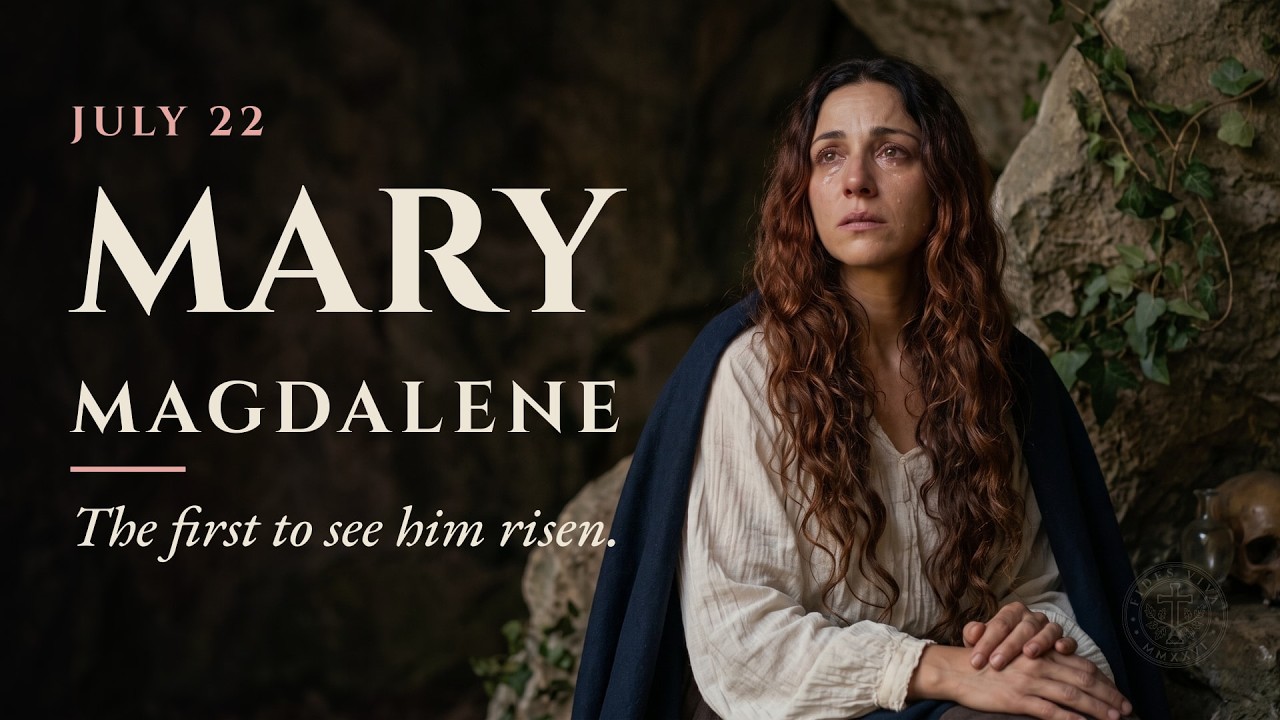
It is still night. A woman walks toward a tomb, a jar of perfumed oils cradled in her hands and her heart in pieces. She does not yet know that she will be the first to speak the words that will change the world.
The Woman of Magdala
It had all begun far from that tomb, beside a lake. Galilee, the first century. The boats set out before dawn and come back heavy with fish; along the roads pass pilgrims going up to Jerusalem and, now and then, guards of the tetrarch Herod Antipas. The region lives under tribute, in the shadow of Rome, and in the synagogues a tense expectancy hangs in the air: the hope that God will send, at last, the promised Messiah.
On the western shore of the lake stands Magdala, a prosperous fishing town whose name means "tower." It smells of salt, of wet nets, of fish laid out to dry; its salted catch travels far and leaves good coins behind in the town. It has a synagogue of black basalt stone with benches along the walls, and ritual baths fed by springs, where the townspeople purify themselves before prayer. A devout Jewish community, hardworking and well-off.
An ancient memory places the birth of a girl named Mary here. The town will give her its name forever: Mary of Magdala, the Magdalene. Of her childhood no account survives. All that remains is what she saw: the lake shifting color as the hours passed, the hills turning gold at dusk, the sails of the boats, the murmur of the market by the harbor. An ordinary life, like so many, in a busy corner of Galilee.
But when the Gospels meet her, already grown, they meet her wounded. Luke introduces her with a single phrase, brief as a scar: "Mary, called Magdalene, from whom seven demons had gone out." Nothing more. The text does not explain what they were or when they began; it puts no name to her affliction. And perhaps that is why the phrase reaches everyone: seven, in the language of the Bible, is the number of wholeness. A complete affliction. A darkness that filled the whole house of the soul.
She stands in the shadows of a basalt house, while outside the lake shines. Thin, worn down, deep circles under large dark eyes that look without seeing. Her restless hands find no rest; her veil hangs half-set, and a few strands of chestnut hair, glinting with copper, slip loose, and no one cares anymore. There is nothing monstrous about her. There is a woman who suffers. A woman who has slowly lost the government of her own life.
In a devout town, an affliction like this is not suffered only within; it is suffered in the street as well. Glances turn away from her; conversations fall silent as she passes. In Magdala there is water for purifying and stone benches for hearing the Law, but for her no door seems to open. She lives inside the walls of her town and, at the same time, outside of everything. Perhaps that is why all her loneliness fits into a single gesture: to walk into her house with no one waiting for her, to no longer hear her name spoken with tenderness.
Over the years, her town had given her up for lost. There are wounds a whole community learns to sidestep, and lives that close in silence, like a matter already settled. What could give life back to a woman from whom no one expected anything anymore?
And yet, in those very days, a rumor was beginning to move along the lakeshore. A rabbi from Nazareth was going from village to village announcing that the Kingdom of God was near; at his passing, they said, the sick were healed and the broken rose to their feet again. His paths ran beside the water, drawing closer and closer to Magdala. The meeting was about to happen.
Seven Demons Fewer
One day, the rumor became a presence. Jesus of Nazareth passed through the roads of Magdala as he passed everywhere: on foot, covered in the dust of the road, surrounded by people who wanted to touch him, to hear him, to lay their sick before him. And among that crowd, at some point no one wrote down, was she.
No one knows how that exact instant unfolded. The Gospel, sparing as ever, does not tell it. We can only imagine what she had not known in years: eyes that come to rest on hers and do not turn away. Her whole town had learned to avoid her; that man looked at her. Without fear, without disgust, without condemnation. The way one looks at someone who exists.
And at some moment in that meeting, the darkness that had filled the whole house of the soul was gone. Luke already said it, with no scene and no details, in a single line. What matters now is what remains when that number turns to zero. He describes no words, no gestures: only the silence of a house emptied of its evil. What the text affirms is the outcome: where there had been seven, not one was left. If evil had filled her completely, freedom filled her completely. It was not a half-relief, a truce. It was a whole house handed back to its owner.
Something new surfaces in that face. The same creased tunic, the same poor veil; but the eyes, for the first time in years, are still. The hands have stopped trembling. She breathes. She fits inside her own body again, hears the murmur of the harbor without pain, holds the light of midday. Anyone who has lived any form of inner captivity knows the weight of that first silence: the wonder of simply being, at peace.
Out of that hour something was born that would never fade again. Not a debt, for Jesus charged nothing; something deeper: a gratitude beyond all reckoning, a love that had known mercy in its own flesh and no longer knew how to live on anything else. A woman who has received so much cannot stay still. What would she do now with this new life, only just handed back?
She did not return to her old life. When the Master left the streets of Magdala behind and took to the lakeside road again, she gathered what she had and set out after the One who had given her back to herself.
The Women Who Provided from Their Own Means
From then on, her life took the shape of a road. Luke remembers it this way: Jesus traveled through towns and villages proclaiming the Good News of the Kingdom of God, and with him went the Twelve, and some women who had been cured of evil spirits and illnesses. First on the list is she: Mary, called Magdalene. And beside her, two names the text keeps the way one keeps something precious: Joanna, the wife of Chuza, Herod Antipas's steward, and Susanna. Of the others it says only that they were many, and that they served the group from their own means.
To provide from one's own means. Put that way it sounds small, and it was enormous. It meant buying the bread for each day, mending the cloaks, finding lodging or kindling a fire under the open sky. Sustaining, with real coins, a mission that had nowhere to lay its head. Mary's gratitude did not stop at feeling: it became bread, water, road. She loved as she had been loved, in deeds.
And what that meant in her world must be said plainly. In the Galilee of the first century, a woman's word carried no weight before a court; her testimony did not count. Many teachers would not even instruct them in the Law. And yet, in the group around Jesus, these women walk in full view of all, learn alongside the disciples, hold up the work with their hands and their wealth. No one hides them. At the very center of the road, the ones who did not count, count.
For Mary, each day was the same answer repeated: feet that no longer stop, eyes that no longer go dark. She had known the prison within; now she knew the free open air of the roads, the good weariness of one who walks behind someone worth every step.
But no road in Galilee stays in Galilee. Sooner or later, every one of them climbs toward Jerusalem. And in Jerusalem her faithfulness would be tested as it never had been before.
The golden light of the lake fell away behind them. The path began to climb south, toward the holy city, and the sky, day by day, turned to lead.
The One Who Did Not Flee
In Jerusalem, everything broke loose in the span of a few days. An entry among branches and songs, a supper in an upper room, a grove of olive trees in the night. Then the torches, the soldiers, the arrest. The men who had promised to lay down their lives for their Master scattered into the darkness, one after another.
The next day, Friday, a crowd was climbing toward a rocky hill outside the walls. They called it Golgotha, the place of the skull. There Rome nailed up its condemned. That morning it raised three crosses, and on the middle one was Jesus of Nazareth.
And the Twelve? They were not there. Fear proved stronger than three years of shared roads. Only one, John, the youngest, dared to come all the way to the foot of the cross. With him, a handful of women. The Gospel names them one by one: standing near the cross of Jesus were his mother, his mother's sister, Mary the wife of Clopas… and Mary Magdalene.
She stayed on her feet. She could not pull out the nails, nor stop the blood, nor bend the sentence of Rome. There was nothing she could do. And she stayed, the cold soaking through her cloak and the tears streaming down her face, without stepping back a single pace. Because love, when it can no longer do anything, can still remain.
Beside her stood the mother of Jesus, upright in her own silence. They said nothing to each other. There was no need. Two women and a young man held up, by their presence alone, all that was left of the community that had filled the roads of Galilee.
The hours passed slowly over the hill. The one who had called her to freedom breathed with greater and greater effort. In the middle of the afternoon, Jesus bowed his head and gave up his spirit. And over Golgotha fell a silence she had not known even in her worst nights in Magdala.
Little time remained. The sabbath began at sunset, and the law did not allow a body to be left on the cross. Friendly hands took him down and wrapped him in a clean linen cloth. They carried him to a nearby garden, to a new tomb cut into the rock, where no one had yet been laid.
She followed them at a distance, never losing sight of them. She watched where they put him. She fixed every detail in her memory: the path among the olive trees, the low entrance carved in the stone, the exact corner where they laid the body of her Lord.
Then several men rolled a great millstone of rock, a circular wheel that sealed the entrance. The dull thud of the stone settling into place was the last sound heard in the garden. And she stayed there, still, her eyes fixed on that slab, until there was no light left.
She knew where they had laid him. She would come back with perfumed oils to anoint that body, as soon as the law of rest allowed. It was the one thing she could still give to Jesus: the gesture of one who tends her dead.
Over Jerusalem the first star kindled. The sabbath was beginning. And with it, a whole day of emptiness that had to be crossed doing nothing, saying nothing, unable even to walk as far as the tomb.
The Sabbath Without a Voice
The sabbath dawned over a Jerusalem brought to a standstill. No fire lit, no work done, no burden carried along the roads: the law of rest covered the city like a mantle. For almost everyone it was a holy day. For her it was the longest day of her life.
There was nothing to do. That was the hardest part. No walking to the garden, no buying of perfumed oils, not even the small mercy of hands busy with some task that might cheat the grief. All that remained was to sit in the half-light of a silent house, her eyes swollen from weeping, while the hours fell drop by drop.
In that forced stillness, memory worked on its own. The lake at daybreak. The voice that taught from a boat. The gaze that one day had given her back to herself. All of it now lay behind a stone, in a garden on the far side of the wall. And yet, in the midst of the emptiness, she held on to a task. One last act of love for the body of her Lord.
When the sun set and the rest was over, she went out with the other women to buy perfumed oils: the balms and ointments with which her people honored their dead. Back in the house, by the light of an oil lamp, she filled a jar of alabaster. Her hands trembled a little. It was all she could still offer to Jesus, and she prepared it the way one prepares an offering.
After that she did not sleep. She waited with the jar close by, watching the window, counting out the night.
And while everything was still dark, before the city woke, she rose, drew her cloak around her, and went out. A woman walking through the dark toward a tomb, a jar of perfumed oils cradled in her hands. This time we will follow her to the end.
"Mary" — "Rabboni"
She reached the garden as the night began to give way. Among the olive trees, shapes were barely hinted at in a bluish gray; the air smelled of damp earth and dew. She knew the way: she had carved it into her memory on Friday, stone by stone. She pressed the jar of alabaster against her chest and moved toward the rock where they had laid him.
She stopped short. The stone was not where it should be. The great wheel of rock she had watched roll into place to seal the entrance now lay to one side, and the mouth of the tomb was a black hollow in the half-light. She did not think of wonders. She thought the only thing one can think before an open grave: someone had taken him away. Not even in death would they leave him in peace.
She broke into a run. She crossed back through the wall with her veil loose and her heart pounding, all the way to the house where the disciples were in hiding. She told them the only thing she knew: "They have taken the Lord out of the tomb, and we do not know where they have laid him."
Peter and John ran out. John, the younger, arrived first and stooped to look without going in; Peter went inside and found the linen cloths on the ground and the face cloth folded apart. They looked at that ordered emptiness and went back home in silence, not yet understanding.
She did not go back. Where would she go? That place was all she had left of Jesus, and it was empty. She stayed outside, close to the entrance, weeping. As she bent toward the inside she saw two figures dressed in white where the body had been, and not even that could tear her from her grief. Then she sensed someone behind her, among the trees. A man, backlit by the dawn. She thought he was the gardener. And the man asked her: "Woman, why are you weeping? Whom are you seeking?"
She begged him that, if he had carried him off, he would tell her where he had laid him: she would go and take him herself. A woman alone, offering to bear away a body. That was how she loved: without measuring her strength.
Then he spoke a single word. He spoke her name.
"Mary."
She turned: "Rabboni" — which means: Master.
In that name a whole life was held. She knew that voice: the same one that had looked on her without condemnation in Magdala, that had taught beside the lake, that had fallen silent on the cross. No argument woke her, no miracle: what woke her was her own name, spoken by the One who knew her completely. She had come seeking a body to anoint and found life standing before her. The tears had no time to dry: they turned to light across her face.
She reached out her hands toward him. She wanted to hold him back; who would let go of one who has come back from death? But Jesus drew away gently: "Do not hold on to me." It was not a refusal. It was a charge: what she had just seen could not be kept, and there were brothers hidden behind a closed door, waiting without knowing it. "Go to my brothers," he told her. And Mary ran to do something no one had ever done before.
I Have Seen the Lord
She ran a second time that morning. On the way there she had carried perfumed oils for a dead man; on the way back she carried an errand from one who lives. Jesus had entrusted her with the message word for word: "I am ascending to my Father and your Father, to my God and your God." She crossed the streets that were waking, the market opening its stalls, and none of it existed for her: only the door that waited.
Behind that door, shut fast out of fear, were the men who had walked so long with the Master. The ones who had seen the bread multiply and the lake grow still. The ones who had fled. Mary stopped at the threshold, backlit by the dawn, breathless from the run, her veil half back in place and her eyes still wet. And she spoke the first Easter proclamation in history, four words that were enough:
"I have seen the Lord."
Then she told them what he had said to her. Many did not believe her: it was too much, and it came from a woman. For there is a detail that makes this moment more astonishing still: in her world, the testimony of a woman counted for nothing before any judge. No one hoping to invent this would have chosen her as the first witness. And yet the Risen One chose her: the first voice of Christianity was the voice of Mary of Magdala.
The Church did not forget that sending. Centuries later, Saint Thomas Aquinas, commenting on the scene in the garden, would give her the title the liturgy would one day take up:
apostolorum apostola: apostle to the apostles. The one sent to those who are sent. Before Peter preached, before Paul wrote a single letter, a woman of Galilee crossed Jerusalem at dawn to say that Jesus Christ was alive. All the Church has proclaimed ever since is held in her words that morning.
And afterward? What became of the first witness once Easter had passed? Here the Gospels fall silent: her name never appears again in their pages. But the memory of the Church did not let her go. In the East and in the West, for centuries, people kept telling where she went, how she lived, where she rests. More than one memory, and all of them kindled by the same morning.
The Memory of the Church
The first of those memories was born not on a road, but in a pulpit. Rome, the year 591. Saint Gregory the Great preaches on the Gospels, and in one of his homilies he draws three separate women into one: Mary of Magdala, the nameless sinner who anointed the feet of Jesus with perfume and dried them with her hair, and Mary of Bethany, the sister of Lazarus. It was no oversight, but the tenderness of a shepherd: he wanted to see in her the whole face of mercy, the proof that no past weighs more than forgiveness. So the "penitent" of the West was born. For more than a thousand years, art would paint her with loose hair, the jar of perfume, and tears. She was not quite the woman of the Gospels; yet that image consoled whole generations, and it deserves to be told without irony: it is the story of a devotion.
And where did she go? The Christian East keeps an ancient memory: it carries her to Ephesus, the great city of Asia Minor, alongside the Virgin Mary and the apostle John. There she is said to have grown old and died, and from there, centuries later, her relics are said to have traveled to Constantinople. The icons of the East show her veiled in red, with the jar of myrrh in her hands; and at times with something more: an egg dyed scarlet. For an Easter legend, beloved throughout the Byzantine world, sets her before the emperor Tiberius announcing "Christ is risen." And the egg she held in her hand turned red. From that tale comes the Eastern custom of giving one another red eggs each Easter.
The West, for its part, tells a beautiful story. A boat with no oars and no sails, pushed out to sea to be lost, crosses the Mediterranean with Mary, Lazarus, Martha, and Maximinus aboard, and comes gently to the shores of Gaul, present-day Provence. Mary is said to have proclaimed Jesus Christ in Marseille, and then to have withdrawn for thirty years to a high grotto among wooded cliffs, the Sainte-Baume, where — the legend says — the angels lifted her up seven times a day. It is a story the faith has loved for centuries; not a chronicle, but a way of saying that this woman ended her life as she had remade it: in contemplation.
That memory left stones behind. In the eleventh century, the hill of Vézelay, in Burgundy, became one of the great shrines of Europe: crowds of pilgrims climbed to its golden basilica, longing to be near the Magdalene. In 1279, at Saint-Maximin, prince Charles II of Anjou had an ancient tomb attributed to the saint opened. Those who were present spoke of a wondrous scent of perfume that filled the air. Over that place a Gothic basilica rose from 1295 on. In its crypt a skull attributed to Mary is venerated to this day, kept since 1860 in a reliquary of gilded bronze that gleams in the shadows. Science cannot prove that it is she; devotion does not need it to: it is a venerated relic, not an argument.
The last chapter of this memory is recent. In 1969, the Church gave the feast of July 22 back to the Mary Magdalene of the Gospels, distinguishing her at last from the anonymous sinner and from Mary of Bethany. And on June 3, 2016, by the will of Pope Francis, her memorial was raised to the rank of feast — the same liturgical honor the apostles receive — with a preface of its own that proclaims her title: apostle to the apostles. [SOBREIMPRESO: Apostolorum apostola, 2016] Fourteen hundred years after Gregory, the Church looked again at the woman in the garden.
Today, beside the Sea of Galilee, excavations have given her city back its face: since 2009 the first-century synagogue, the ritual baths, and the Magdala Stone with its carved menorah have risen from the ground — the stones she once knew. And every July 22, in Provence, the gilded reliquary is carried out in procession on the shoulders of bearers, among lit candles, guarded by the Dominicans. Among so many memories — Ephesus and Marseille, Vézelay and the grotto — one remains untouched and needs no proof: the woman who was called by her name and sent to proclaim. Twenty centuries on, her proclamation is still burning, and one last look remains: ours.
Called by Our Name
It is still night. A woman walks toward a tomb, a jar of perfumed oils in her hands and her heart in pieces. This is how it all began: no names, no light, only the cold weight of alabaster and a love that no longer expected anything. The night had left a question hanging in the air: what would she find at the end of the road, and why would her words change the world.
Her whole life is the answer. She went to anoint a body and found a stone rolled away. She searched for a dead man, and a living voice spoke her name. The woman her city had given up for lost, the one who once carried seven darknesses and no future, came back from the garden. She brought four words that have crossed the centuries: "I have seen the Lord." She did not change the world with an army or with a book. She changed it because she stayed, because she searched through her tears, and because when Jesus spoke her name, she knew how to turn.
We know that night too. Each of us knows the name of our own chains: the one that returns every dawn, the one no one else sees. And every heart knows the grief of standing before a grave: a chair left empty at the table, a phone that will never ring again, an ordinary morning when we have to rise and go on without knowing how. We walk in the dark more often than we admit, our own perfumed oils in our hands, ready to tend what we believe is lost forever.
Mary gave her answer in a garden, at dawn. Ours is still ours to give. Only the question she left open remains, still warm: in what darkness are we waiting for someone to speak our name?
She taught us to wait for it without giving up. For since that morning, the last word no longer belongs to the stone: someone searches in the night, and in the first light, is called by name at last.
Saint Mary Magdalene, witness of divine mercy, first witness of the Resurrection, apostle to the apostles, pray for us.