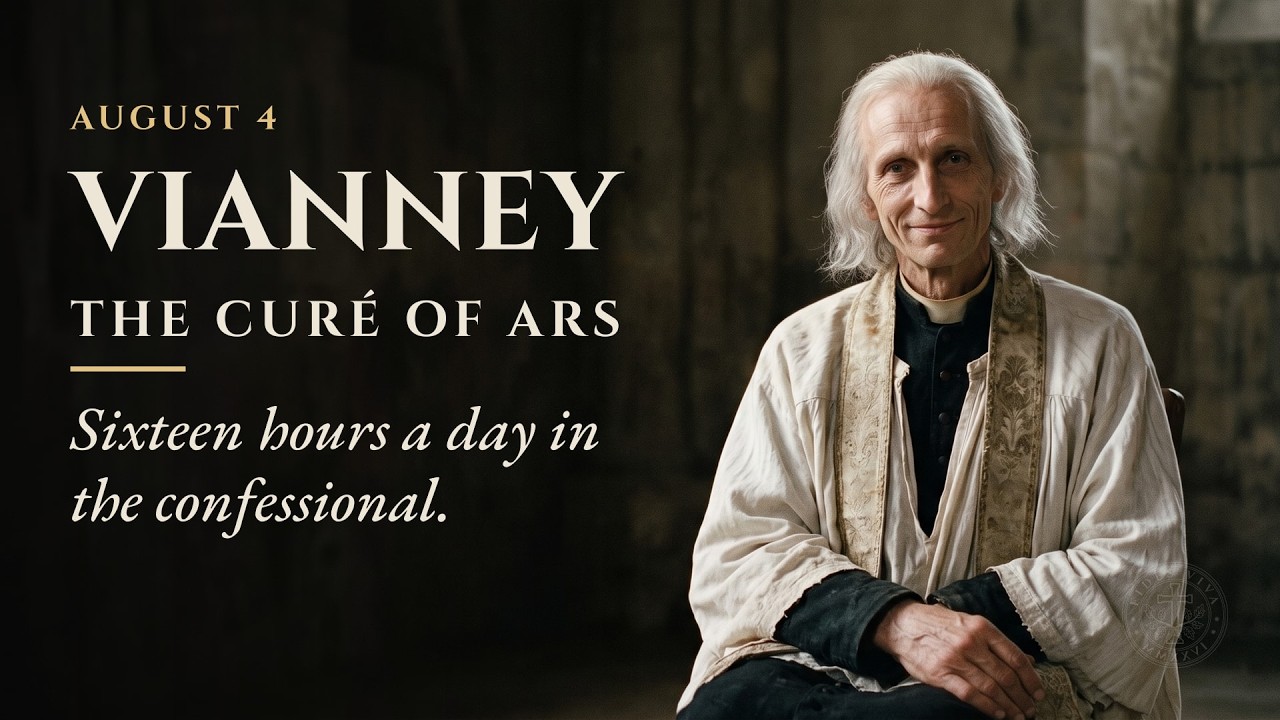
A wooden bench, a church in shadow. Behind the lattice, a stooped figure listens without rest. Outside, the line never ends. What does a village priest have that makes the whole world come searching for him?
Childhood at the Edge of Fear
The answer begins far from that line, in the hills of the Lyonnais, when the old kingdom of France still had years of peace ahead. A storm was gathering, ready to close the churches, to melt down the bells for cannon, and to put a price on the heads of priests. The faith of the countryside—ancient as the roads themselves—would have to learn to hide.
There, in the village of Dardilly, on May 8, 1786, a child was born into a family of farmers. His parents, Matthieu Vianney and Marie Beluze, carried him to be baptized that same day. They named him John Mary. He was the fourth of their children, and nothing set him apart from the other boys of the valley: he would learn to tend the livestock, to harvest wheat, to share the table with the poor whom his father never turned away without bread.
He was three when the Revolution erupted, and seven when the Terror reached those hills. Priests loyal to Rome were hunted like criminals; saying Mass could cost a man his head. The Vianney family chose the risk: they hid fugitives in their farmhouse. At night, along paths between the hedgerows, they would slip to a barn where a priest waited with a chalice hidden in the straw.
The small John Mary attended with eyes wide open. A few candles, faces tense and turning toward the door at every sound, and an exhausted man risking his life to place Jesus Christ in the midst of his people. That image burned itself into him forever: the priest was someone willing to die for what he held in his hands. And at home, his mother taught him prayers in a whisper, from memory, as one passes on a treasure that cannot be written down.
The memory of those close to him held fast to a scene from those years. Around 1802, in a private house, with the windows shuttered so no light would betray the gathering, the boy made his First Communion. He was about sixteen. In absolute silence, he received Christ in the consecrated bread for the first time. He never forgot that faith had come to him this way: contraband, by candlelight, sustained by people ready to pay for it with their lives.
Years before, when he still kept his family's flock, he carried with him a small statue of the Virgin and a rosary of wooden beads. He prayed among the hedges while the sheep grazed. So the family remembered it: one day, the boy confided to his mother what he carried in his heart.
"If I were a priest, I would want to win many souls."
An enormous sentence from such a small mouth. Because that child had none of what the world demands for such an undertaking. He had scarcely set foot in a schoolhouse; the years of Revolution had left no room for books. It was said that at seventeen he could barely read, and letters remained foreign ground to him. To reach the altar required years of study, grammar, Latin; and he had only a worn rosary, a memory full of whispered prayers, and a desire he could not explain. Between the longing and the altar stood a wall that seemed impossible to cross. And yet, someone was about to reach out a hand.
The Latin That Would Not Enter
That hand had a name: Charles Balley, pastor of Écully, a priest formed before the Revolution, who had known the clandestine years and knew how to recognize gold beneath the mud. In 1806, when the young man from Dardilly knocked on his door, he was already twenty, his hands hardened by the plow. Others would have sent him away with a kind word. Balley looked at him, listened to his desire, and seated him at his table with a Latin grammar open before him.
Then began the longest battle of his youth. The Latin would not come. The declensions dissolved in his memory; what others retained in a day took him weeks. He knew the shame of the slow student, the despair of beginning again, always beginning again, the solitude before the page. More than once he thought this was not for him. But each morning he returned to the table, and each night he burned the candle reviewing what the next day would make him forget. Balley did not tire of him. Where others saw an incapable man, that teacher saw someone who loved Jesus Christ with a depth no examination could measure.
In 1809 the Empire needed soldiers, and the draft notice came for him too; the world was closing the door just as Latin was beginning to yield. On the way to the front he fell ill; when he left the hospital, his regiment had already marched without him. Without meaning to, he had become a deserter, and desertion was paid for dearly. He ended up hidden in Les Noës, a lost village in the Forez mountains, among snow and stands of fir, dressed in borrowed peasant clothes and sheltered only by the village's silence. Months of uncertainty under the mountain cold, far from his books, not knowing whether his calling would survive that exile. Only an amnesty gave him the road back.
He returned to his studies as one returns to a slope already known. At the minor seminary of Verrières, and then at the major seminary of Lyon, the classes were conducted entirely in Latin, and he still could not follow them. The professors doubted; some declared him insufficient. It was Balley who interceded once more, until he secured an examination in French, in his own tongue. And then the examiners discovered what the master had known from the start: this man understood the things of God. He knew little of books, but he prayed as few could, and he loved the Lord and souls without reserve. The Church, which needed scholars, decided it needed still more a saint.
One door remained—the one that for twenty-nine years had seemed shut forever. Beyond it an altar waited.
The Sending to Ars: A Land of Mission
On August 13, 1815, in Grenoble, a bishop laid his hands upon that head which had bent so many times in defeat over Latin texts. John Vianney was twenty-nine years old. When he rose, he was a priest of Jesus Christ. Everything the world had cast aside stood consecrated from that morning onward.
His first assignment was also the most fitting: Écully, as vicar to the man who had taught him everything. For two years, master and student served the same parish together, shared the same meager table and the same penances. Then in 1817 Balley died. With him went the only one who had believed from the beginning. The young priest was left spiritually orphaned, and the diocese had to decide what to do with a vicar of few letters and much prayer.
The decision came in February 1818. In the plain of the Dombes, a land of ponds and mist, there was a village of some two hundred thirty souls called Ars. A parish religiously cold, where the fields were worked on Sunday and people danced by the taverns, where for years no one had expected much of a priest. No priest asked for that posting. He was sent there.
He made the journey through the mud of the thaw, under a sky so low it blurred into the earth. The Dombes mist erased the path. What was always told in Ars was what happened then: a shepherd boy tending his flock showed the priest the way to the village. The priest promised him in return that he would teach him the way to heaven. With that promise on his lips he entered the village that had been entrusted to him.
What he found offered little reason to dream. A small, unremarkable church, with a modest bell tower. Low houses crowded around a dirt square. Faces watching from doorways—not hostile, not welcoming, simply measuring in silence the small man in the patched cassock. Beneath the gray February sky he stood before his church, breviary in hand. He looked at it for a long time, the way one looks at a field before sowing. The rectory awaited him almost empty, and he left it so: a bed, a table, his books.
Those first weeks of cold he spent on his knees. Before dawn, anyone crossing the square saw light behind the church windows: the new priest, motionless before the tabernacle, hour after hour, his breath turning to mist. He was asking Jesus Christ for the conversion of his people, and offering in return the only thing that was his: sleep, food, rest. He ate bread and potatoes cooked for several days. He slept little. He never complained.
How does one transform a place where no one expects anything? He had no strategy; he had a certainty: to win those souls he would have to love them one by one. He would learn the names, the stories, the griefs of each family. And so began the smallest mission in France: door to door, house to house, soul by soul.
Daily Mission: Mud and Bread
The doors of Ars opened slowly. The new pastor entered kitchens and stables, sat by the fire, asked about the harvest, the sick cow, the son serving far away. He did not arrive with reproach: he arrived with time. He listened, and when he left, he dropped a word about God like bread on a table. The farmers of the Dombes, little friends of sermons, began to discover that this small man knew their names, their sorrows, even their debts.
Each day he gathered the children in the church for catechism. He did not know how to ornament his words; he spoke of Jesus Christ as one speaks of someone from the house, in the language of the fields that everyone understood. At night, in the rectory, he prepared his sermons by candlelight, copying them with effort, learning them by heart as he had in the years at Écully. They cost him entire hours. He spoke them in a voice that broke, and that broken voice moved people more than any eloquence could.
With the church he did the opposite of what he did for himself. For himself he kept the patched cassock, the hard bread, the potatoes cooked for the week; for the house of God he sought the best he could afford: he restored the building, raised side chapels, commissioned worthy ornaments for the altar. Whoever crossed that threshold understood without words where his pastor's heart lay.
Not all was gentleness. From the pulpit he called things by their name: work on Sunday, which stole God's day; the dances by the taverns, where he saw the young people of his parish lost. For years he preached against both with an obstinacy that irritated many. There were murmurs, mockery, silent resistance. He did not yield, and neither did he stop loving those who resisted him. And little by little, almost without anyone knowing when it happened, the village began to change: the fields lay quiet on Sundays, the dances faded, the small church began to fill.
Love also took the form of a house. In 1824 he opened a free school for the girls of the village, and a few years later he transformed it into something more: a home of refuge for abandoned girls, without family and without bread. He called it Providence, and the name was an entire program. At its head he placed Catherine Lassagne, a young woman from Ars whom he himself had formed—small and patient. There the girls learned to read, to pray, and to work; they ate warm food; they slept safe. No one asked anything of them in return.
The house lived from day to day, on alms, and more than once the grain bin touched bottom. The dearest memory of Ars came to tell of one of those hours, when no flour remained for so many mouths. The priest prayed before the nearly empty bin. When he returned, he found it filled to the brim, and the flour was enough that day for all the loaves that were needed. The girls ate. In Providence's kitchen, that bread was always spoken of in low voices, the way people speak of something greater than themselves.
While charity grew in the light of day, another struggle was waged at night. From 1824 onward, in the rectory there began the knocks, the sounds, the shaking that tore him from his brief sleep. So he himself told it, without drama and even with humor: he called the cause of it "the grappin," the hook, as one names a troublesome neighbor. He said it made more noise on the eve of great conversions, and that over the years he had learned not to fear it. He would cross himself, entrust the night to Jesus Christ, and lie down again in his narrow bed.
What sustains a man in an offering so simple and so exhausting? The neighbors knew because they saw him every dawn, on his knees before the tabernacle long before daybreak. And because they had heard the phrase that summed it all: "Everything beneath the eyes of God, everything with God, everything to please God."
Meanwhile, without his seeking it, the name of Ars began to travel. First came those from neighboring parishes to confess; then those from the cities; then those from much farther away. All wanted the same thing: to kneel before the lattice of that confessional and be heard by the man with the broken voice. That tiny mission was about to overflow.
The Great Hospital of Souls
And it overflowed. They came on foot, their wooden shoes caked with mud, and then from Lyon, from Paris, from much farther still: farmers and ladies in silk bonnets, soldiers, priests, the curious who came to look and stayed to weep. By the end of his life there were tens of thousands each year. The village of two hundred thirty inhabitants had nowhere to shelter them: the pilgrims slept where they could, in the inns, in the haystacks, and waited days for their turn to come. Ars began to be called the great hospital of souls.
At the center of that hospital stood a single doctor, and his office was a confessional of dark wood. He rose before dawn, when the church was still a mouth of shadow, and already there were people waiting in the pews. He heard confessions for sixteen hours a day, sometimes more. In winter the cold stiffened his feet, and the breath of the penitents hung in the nave like a low mist; in summer the air was heavy and still. He remained there, bent behind the lattice, the violet stole over his wrinkled surplice, listening.
That line was a portrait of all France. Each face carried a wound: the grief that would not close, the old guilt, the faith lost at some turn in the road. Thousands of wounds waiting, patient, for one small and exhausted man. And he received them one by one, without haste, as if each soul were the only one in the world.
No one could fully explain what happened on the other side of the lattice. He spoke little and without ornament; sometimes a few words were enough, sometimes only tears, because he wept with those who could no longer weep themselves. Penitents left transformed, with the face of one who has finally set down a burden. And those who passed through that grille told afterward of things hard to forget: sins kept silent that he named with gentleness, as if he had read them; warnings that announced what had not yet come to pass; consolations exact, spoken to the measure of a sorrow no one had confided to him.
A brother priest asked him once where he drew so many conversions from. The answer disarmed him: "I will tell you my recipe: I give the faithful who confess to me only a small penance, and the rest of the penance I supply in their place." Behind each absolution, hidden, were his own fasts and his nights without sleep. The forgiveness he dispensed with open hands he paid for himself, in silence, with his own body.
And the body exacted its price. The cheeks grew more hollow, the dark circles became permanent, the voice was reduced to a hoarse thread. But the deeper fatigue was not of the bones. Deep within, he still saw himself as the student who had not measured up: he believed himself a burden between God and the souls, unworthy of the weight he carried. He dreamed of leaving it all, of hiding in a monastery and weeping there, alone, his poor life.
Three times he tried. Three times, at night, he left the rectory in his patched cassock beneath a traveling cloak, headed for solitude. And in the darkness the same thought always caught him: the line that at dawn would already be forming before the door, the souls who had crossed half of France to be heard, Jesus Christ waiting in the tabernacle of his small church. The fugitive would stop in the middle of the road. Three times he came back before daybreak, and when the early risers arrived they found him where he always was: bent behind the lattice, stole in place, as if the night had never been.
He never boasted of those returns. Holiness in him did not take the form of one heroic and unique gesture, but of a decision repeated every dawn, for decades: to sit again, to listen again, to forgive again. Forty-one years in the same village, on the same wooden bench. The boy who as a child had wanted to win many souls was winning them one by one, sitting, almost motionless, in the smallest corner of France.
But no such offering sustains itself without cost. Past seventy, very little remained of him: a handful of bones clothed in black, blue-gray eyes still alive among the wrinkles, bony hands gripping the rosary. The pilgrims kept coming; he kept sitting. And in the air of Ars there began to float a question no one dared speak aloud: what remains at the end of a life like this, and who could take up such a witness. The summer of 1859 drew near, burning, and with it the final harvest.
The Last Night in Ars
And the summer came, with a heat that gave no mercy. By late July, the old pastor could no longer rise from his bed. After so many frozen winters, it was the August swelter that finished consuming that worn-out frame. They laid him in his room in the rectory: a tiny space, a narrow iron bed, walls bare as the walls of a man who had never wanted anything.
The news ran through the village like a shudder. The priest was dying. The neighbors who forty-one years before had received him with indifference now took turns at his door. They searched for ways to ease that heat that would not break. Priests from the neighboring parishes came to keep vigil by the bed; outside, in the square and in the church, the whole village prayed. He, who had spent his life listening, let himself be accompanied in silence, at peace, with the calm of one who has already given everything.
In the early hours of August 4, 1859, without loud struggle and without a single complaint, he gave his soul to Jesus Christ. He had spent his whole life as a priest sitting in that same wooden bench. He was seventy-three. The shepherd from Dardilly who could barely learn Latin was dying as the confessor of France.
When the bells of Ars broke the silence of dawn, the whole village knew what they announced, and wept as one weeps for a father. No one wanted to let him go; he had been there so long they no longer knew how to be Ars without him. They dressed him in the cassock, the surplice, and the stole, and placed a crucifix between his bony hands. For days, a final line—the longest of all—passed before his body. This time they did not come to speak. They came to give thanks.
And that village's grief was only the beginning. The world was only now beginning to know the priest of Ars.
From Ars to the World: The Priest's Legacy
The pilgrims did not stop coming. With the confessor gone, the line changed its destination: now it halted before a tomb. And the Church did what it does with lives that do not explain themselves: it examined them slowly. For decades, testimony was gathered from penitents, from neighbors, from priests who had known him. Men and women who swore before God what they had witnessed at that wooden bench. From that patient memory came a portrait that withstood every test.
On January 8, 1905, in Rome, Pope Pius X declared him blessed. That pope had also been a village pastor, and in the priest of Ars he recognized the mirror of what a priest could become. Twenty years later, on May 31, 1925, beneath the vaults of Saint Peter's Basilica, Pius XI inscribed him among the saints of the universal Church. The boy who had received communion in hiding, with the windows covered, now had an altar in the heart of Christendom.
Four years later came the gesture that made his life universal: in 1929, the same Pius XI proclaimed him patron of all priests in the world. Not of theologians or great preachers: of priests. Of the men who baptize, bury, console, and remain at their post year after year. From then on, every priest with a cure of souls has as his model the student who could not manage to learn Latin.
The popes kept returning to him. In 1959, at the hundredth anniversary of his death, John XXIII devoted an entire encyclical to proposing him as the model of diocesan priesthood. Half a century later, Benedict XVI convoked for the whole Church a Year for Priests on the 150th anniversary of that August dawn, and placed at its head the pastor of Ars once more. As if each generation needed to look at him again to remember what he himself had said: "If we understood rightly what a priest is on earth, we would die: not from fear, but from love."
And Ars remains standing. Beside the small church where he heard confessions, a basilica was built. There, within a golden reliquary, his body rests, clothed in the cassock and surplice as always, his face covered by a wax mask. Each year, nearly four hundred fifty thousand pilgrims cross the village: priests who come to ask for strength, seminarians, entire families, people who arrive without quite knowing why. In 2025, a hundred years had passed since his canonization. The village still had little more than a square, a church, and ponds shrouded in mist. And the line remains.
Two hundred thirty inhabitants Ars had when he arrived, mud to his ankles and his heart in his throat. Forty-one years later, he had touched more souls than many missionaries who crossed oceans, never straying more than a few steps from his church. His entire geography fit within a dirt square and a wooden bench. And from that corner of the Dombes there lingers a question that time has not cooled: what does it mean to remain faithful in the small.
The Echo of a Simple Life
What did that village priest have that drew the whole world to seek him out? None of what usually attracts crowds: neither eloquence, nor health, nor learning. He had a wooden bench and all his hours. He listened in the name of Jesus Christ to anyone who came, and the next day he sat down again. Three times he tried to leave; three times he returned before dawn. His entire secret was to stay.
We too know a place that seems too small to matter: someone near who only asks to be heard. There, exactly there, is where it all began in Ars.
He answered with forty-one years in the same place, without one word too many. The question of each person remains open, in silence. And each morning in Ars, the first light falls again upon the empty confessional, as if it were still waiting.
Saint John Vianney, tireless shepherd of souls, pray for us.