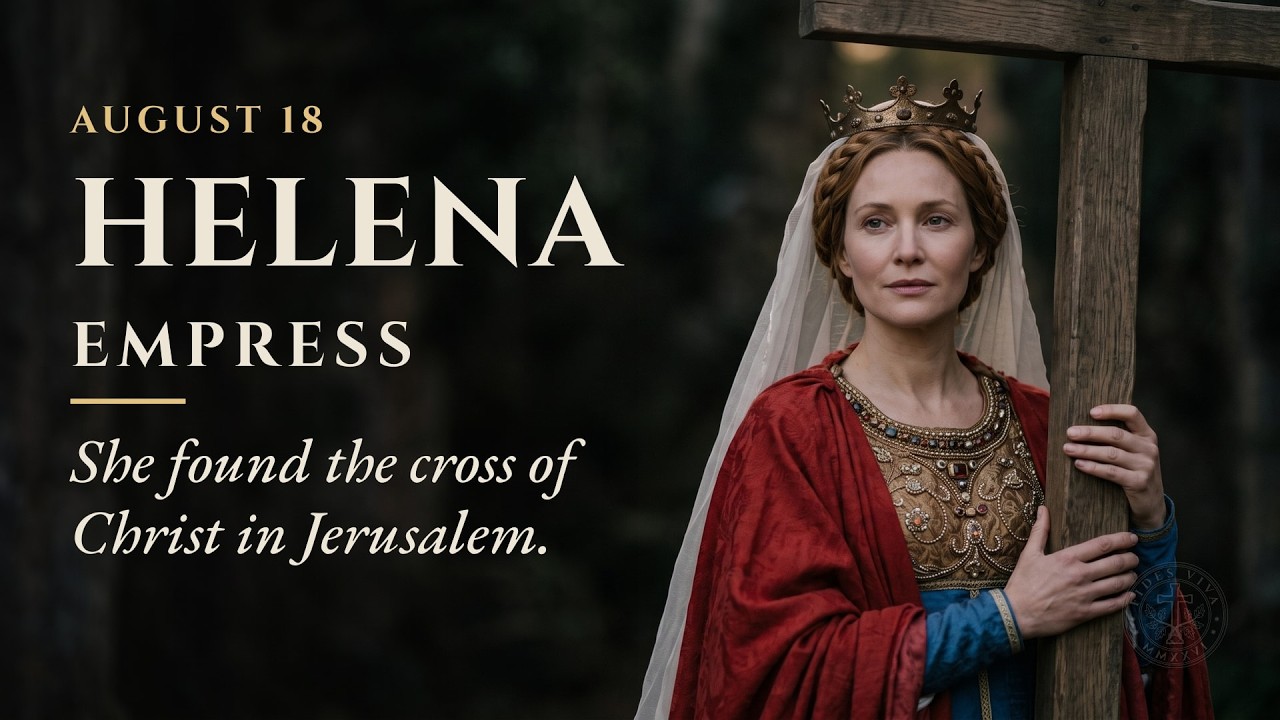
An old woman moves among the scaffolding, in a city that is not her own. Dust whitens her veil. The stonecutters stop chiseling the stone as she passes. Someone offers her an arm; she waves it off gently. She kneels in the turned earth and sinks her hands into it. Rough, broad hands—a servant's hands. They are the hands of the mother of the emperor of Rome.
She was nearly eighty years old. She could be in a palace, surrounded by silk and pearls: her face was stamped on coins across the entire Empire. Instead she had crossed the sea to a province in the East. There, by imperial decree, a pagan temple was being torn down and the earth beneath it cleared away, stone by stone, because they believed that somewhere in that ground lay the living memory of Jesus Christ.
She was not always powerful. She served tables and poured wine in a roadside inn. She was the woman a man on the rise cast aside for convenience. For twenty years, no chronicle wrote her name.
And now, at the end of her life, she was here as the earth opened. She was not searching for gold. She was not searching for glory. She was searching for the places where the Lord had once walked.
Her name was Flavia Iulia Helena. The Church remembers her as Saint Helena.
To understand how a servant came to be empress—and why an empress chose to kneel again in the dust—we must go back to an inn beside a road, in a forgotten corner of the Empire.
The Beginning in Shadow
Drepano was hardly anything: a landing place on the coast of Bithynia, at the far end of the gulf of Nicomedia, in the northwest of Asia Minor. Fishing boats, warehouses of amphoras, whitewashed houses with flat roofs, and beyond them, hills of olives. Along the front ran the road that led toward great Nicomedia. And with it came everything else: merchants, imperial couriers, soldiers with their recent pay, travelers who needed a bed, hot wine, and a stable for their mules.
In one of those inns a girl was born, around the year 250—the ancient sources argue between that date and a couple of years before; we will follow this one. She grew up in a roadside inn. We do not know so much as her parents' names; of her, we kept only this one: Helena.
She was born into a sick century. The Empire was bleeding itself dry in civil wars: in fifty years, dozens of emperors came and went, nearly all of them dead by the sword. Plague moved through the provinces and the coin lost value year by year. Now and then, power discharged its fear upon an obstinate minority that refused to worship the gods of the State: the Christians. None of that, not yet, had anything to do with the innkeeper's daughter.
She grew up working. She carried water from the well, changed the hay for the beasts, lit the oil lamps as evening fell, served earthenware jars to men who did not look at her twice. In Rome's social order, a girl from an inn occupied one of the lowest rungs: people in service, with no family name to defend, no dowry to offer. By sixteen, her hands were cracked and her arms were strong from carrying jars. No one wrote about girls like that.
A bishop, a century and a half later, would name her with two words: "good innkeeper." And he would not say them with contempt. He would say them almost with tenderness, as one who points out, still astonished, the exact spot on the map where God chose to begin something very great.
Around the year 270, in that constant coming and going of uniforms and dust, an officer of the army entered her life: Constantius. An Illyrian from the Danube provinces, made in the camps, ambitious, with a career ahead of him. Was she a lawful wife or a companion of lesser rank? The ancients already debated the exact name of the bond, and the debate has never been settled. What no one disputes is that she followed him. She left the gulf, the smell of salt and hay, her father's inn, and departed with him toward the garrisons in the north, where the Empire stood guard on the bank of an immense river.
She was about twenty years old and had no written future. No lineage, no illustrious city to back her, not a single chronicler watching her steps: no one in the port she was leaving would have risked a coin on her fate. And yet, far from the sea, in a garrison of gray stone called Naissus, something was waiting for her that would split her life in two. In the mud, the smoke of the forges, and the footsteps of sentries marking the hours, she would soon become a mother.
The Loss and the Silence
Naissus was another life: walls of gray stone, mud, winters that cut the face, the smoke of military forges rising into the sky before dawn. There, on the twenty-seventh of February, around the year 272, she gave birth to her only son. A healthy boy. They named him Constantine.
In a garrison on the Danube, a newborn changed nothing: the reliefs continued, the trumpets sounded at the same hours. But for the innkeeper's daughter, that child was everything. She led him by the hand through parade grounds, taught him to speak among soldiers, watched him grow sturdy, with something of herself in his eyes. In the years that followed, that was her home: the army, the transfers, a life lived in the shadow of an officer who was rising.
Because Constantius was rising. He was disciplined, capable, respected by his men, and in that crumbling empire, men like that were worth gold. His name began to sound in higher and higher offices, until it reached the ears of Maximian, Augustus of the West. And power, when it calls, sets conditions.
The condition had a woman's name: Theodora, stepdaughter of Maximian himself. A dynastic marriage that would tie the Illyrian officer to the imperial family and open the path to the purple for him. Only one detail stood in the way: the woman who had followed him from an inn in Bithynia. Around the year 289, Constantius set her aside. A few years later he wore the purple of Caesar. She did not even have the consolation of a scandal: it was a state operation, clean, silent, of the kind that leaves no records.
She was about forty years old. No title to claim, no court before which to protest, no powerful family to demand redress. They replaced her, simply, as one replaces a piece. No one recorded the day she left through the door, or where she went. And in those same years she lost her son as well: Constantine grew up in the courts of the Tetrarchy, an honored guest and discreet hostage, living guarantee of his father's loyalty.
Then the sources fell silent entirely: not a line, not a date, not a certain place. The historians of that time, so attentive to every gesture of the powerful, wasted no ink on a woman cast aside. Where she lived, what she lived on, who was with her: we do not know. Probably in the East, near the roads where news ran. It would reach her in pieces, with months of delay: that Constantius governed Gaul; that her son served in the courts of the Tetrarchy; that he was growing, that he was fighting, that he was living.
Silence, sometimes, is also a life. While the world forgot her, she kept rising each morning, growing old without witnesses, holding the memory of a child she could no longer embrace. Outside, the century remained cruel: power was divided and betrayed, and the harshest persecution Rome had ever known fell upon the Christians. Not a single complaint of hers survives from those years. No letter of reproach, no attempt to return. Only the waiting, learned day by day, as one learns a trade.
Until one day, from the far end of the world, a rumor began to run along the roads of the Empire: an entire army had struck their shields and acclaimed a new Augustus. The couriers, from post to post, repeated a name. And the name was her son's.
The Return and the Weight of Power
The rumor had a date and a place. The twenty-fifth of July, the year 306: Eboracum, a military post in the far north of Britannia. There Constantius Chlorus had died, in the midst of a campaign, and there, beside his body still warm, the soldiers decided for themselves who should succeed him. The man who had set her aside for reasons of State no longer existed. And the child she had led by the hand through the courtyards of Naissus now ruled Britannia, Gaul, and Hispania.
Constantine established his court in Augusta Treverorum — present-day Trier — the great imperial city beside the forests of the Moselle. And among the first changes the new ruler made was one that no chronicler bothered to explain, because it needed no explanation: his mother returned to the palace.
She was nearing fifty-six when she began, little by little, to cross palace doors again. Seventeen years before she had left one with a letter rolled in her hand and no title; now the guards stood at attention at her passing and officials bowed their heads. The sources do not record the reunion between mother and son, and perhaps that is for the best: there are embraces words cannot hold. What is certain is that from that moment on, she never returned to the shadows again.
Because six years later, the world turned. In October of 312, beside the Milvian Bridge, at the gates of Rome, her son won the battle that decided the rule of the West. And the following year, from Mediolanum, an edict granted to the Christians what three centuries of empire had denied them: the freedom to worship Jesus Christ in the light of day. Churches reopened. The exiled returned. The faith she had seen persecuted in blood during her hidden years came, too, out of its hiding place.
And at some point in those years, the woman from Bithynia embraced that faith. Eusebius of Caesarea, who saw her up close, writes that it was her own son who won her for the Gospel, and that the conversion, come so late, became total: "She became so devoted a servant of God that one might believe she had been a disciple of the Redeemer of mankind from her earliest childhood." She had no visions. She wrote no treatises. She believed as she had always lived: without noise, and through her works.
Around the year 324, when Constantine became sole master of the Empire, the greatest recognition arrived: the title of Augusta, the highest dignity a woman could receive in Rome, reserved for empresses. With it came the order to strike her face on coins of bronze and gold that circulated through all the provinces, with her name engraved around the profile: Helena Augusta. (on-screen: "FL HELENA AVGVSTA")
In the markets of Syria, in the ports of Hispania, in the garrisons of the Danube, anyone could open the palm of their hand and find her: the straight nose, the firm chin, the diadem of pearls over the gathered hair. The innkeeper's daughter from Drepano, the one who had poured wine for passing soldiers, now circulated from hand to hand across the known world. And with the title came something more concrete still: the right to dispose of the imperial treasury as if it were her own.
She was about seventy-four years old. At that age, the powerful usually administer what they have conquered; she, by contrast, had conquered nothing: everything came to her all at once, at the end, when nothing could dazzle her anymore. Anyone who looked at her closely could see it: beneath the diadem, her eyes were still those of the woman who had waited twenty years in silence. The silk weighed on shoulders that knew what a full pitcher weighs.
The question, then, was not what she had received. It was what she would spend it on.
Mercy in Silk
The answer began to write itself in the worst year of her life. In 326, the imperial court stained itself with its own blood: Crispus, the eldest son of Constantine, a young and victorious Caesar, was executed in Pola, in Istria. Months later Fausta, the Empress, died as well. On the causes, the official sources fall silent; the later ones speculate without agreement, and the question remains unanswered seventeen centuries later.
Helena was about seventy-six years old, and she was that young man's grandmother. No one recorded her grief; the sorrow of grandmothers rarely enters the chronicles. Later, some historians wanted to see in the journey she undertook then a penance for the sins of her house. It is a possible reading, not a certainty. What the sources show is simpler and greater: the old woman left the palace, and not to withdraw.
Nearly eighty years old and already on the road, she undertook the longest journey of her life: through the provinces of the Eastern empire, from city to city, from port to port. They were dusty roads that a woman of her age had no obligation whatsoever to travel. And wherever she passed, the imperial treasury became something else. She distributed alms with her own hand, with no intermediaries, looking into the face of whoever received them. She clothed those who had nothing. She relieved the poor of an entire city, and then the next, as if the gold only served her while it left her hands.
She did more. She ordered prisons opened and returned prisoners to their families. She brought back the exiled, men condemned to grow old far from everything they knew. And her mercy descended to the lowest place in the Empire: the mines, where the condemned picked stone in chains, without light, until the body gave way. By her order, those doors opened. Men who had stopped hoping climbed, squinting, to the surface and saw the sun again, free by the word of an old woman they had never seen.
The Gospel she had embraced so late spoke of the hungry, the naked, prisoners visited. She took it literally, as one who still remembers what bread costs. Her mercy did not rest on theories: it rested on Jesus Christ, who by that same word waits in each of the least. Whoever saw her in those months did not see a sovereign on tour. They saw a woman in haste to give.
And in the churches along the way she astonished still more. The Augusta of the Empire did not take a throne or a tribune: she stood among the people, dressed with a simplicity no one would have expected of her. She was just an old woman among the women of the place, praying quietly. The diadem stayed locked away in a chest. Anyone who did not know her could pass by her side without suspecting that this small woman could sign decrees valid across three continents.
What drives an empress to mingle like this with those who have nothing? Perhaps memory. She had been invisible for twenty years; she knew what it is to wait while no one looks. Now that everyone looked at her, she looked at those no one looked at.
But the journey had not yet reached its destination. It pressed south, toward the province of Palaestina, and in her heart she carried not only alms: she carried a decision already made. Before her, beyond the olive-covered hills, waited a land where the memory of Christ had lain buried under rubble for two centuries.
The Search Beneath the Rubble
Bethlehem was barely a village of limestone and olive terraces, a few hours' journey from the ancient Jerusalem. Beneath one of its hills lay a cave that Christians in the region had pointed out for generations: there Jesus was born. The Augusta descended into the grotto slowly and knelt on the bare ground. The girl who had served in a roadside inn arrived, at the end of her life, at another stable: the manger of the Lord.
And she did not stop at prayer. Over that cave she ordered a basilica built: an octagon of stone with an opening at its center, so the pilgrim could lean in and see the cave by the light of lamps. The masons measured, cut, raised columns brought from far away. For the first time, the place of Christ's birth would have a roof.
Then she climbed to the Mount of Olives, the slope that looks toward the city from the east, above the Kidron Valley. There another cave awaited her, the one that held the memory of Jesus teaching his disciples. Over it she gave the same order: a second basilica, the Eleona, with its crypt carved into the rock, facing the dawn.
The workers learned quickly to recognize her. A small figure, veiled, who appeared among ropes and blocks at any hour, who asked about the foundations, who touched the freshly cut stone with her broad hands, that had once served. She refused the arm offered to her. She was nearly eighty years old and moved through the works like someone who had finally found her true calling: to found.
Between the years 326 and 328, the works advanced on several fronts at once. An old woman oversaw, in a foreign land, work rising in several holy places at once: she was not raising palaces or walls. She was raising memory.
The hardest part remained. The ancient Jerusalem no longer existed by that name: two centuries before, after leveling it, Rome had built a new colony over its ruins, Aelia Capitolina, with colonnaded streets and marble gods. And over the most sacred point of all—the rock of Golgotha and the tomb where Christ was buried—the engineers had thrown an embankment and planted a temple to Venus above it. They meant to drown that memory under pagan earth. Without knowing it, they sealed it: the embankment and the temple kept that place as a sealed letter.
The order came from the highest place. The emperor wrote to Macarius, the bishop of the city, announcing the work; his mother was there to see it done. And the demolition began. The columns of the temple fell, the idols fell, the foundations were torn up. Then, cart after cart, the entire embankment was hauled away, and the earth was carried far. The picks went down day after day, layer after layer, until living rock appeared. And in the rock, against all hope, a tomb came into view, carved and untouched: the sepulchre.
Eusebius tells it as the return of something given up as lost forever. Over that rock the complex of the Holy Sepulchre would rise: the rotunda enclosing the tomb, the great basilica beside it, the porticoed courtyard.
In those months, faith took the shape of a tool. Spade, plumb line, baskets of earth carried on the shoulder. To believe was to dig: to wager that beneath two centuries of rubble something still remained that could be touched. Rarely has a conviction been so literal.
The witnesses' account ends here. What follows is preserved in the Church's memory, which began telling it two generations later and has not stopped telling it since: among the earth stirred at Golgotha appeared three pieces of wood. Three crosses, thrown centuries before into a ditch, as one throws away the tool of an execution once it has done its work. And beside them, a tablet with an inscription.
They brought the tablet to the Augusta. On the worn wood could still be read the sentence Pilate ordered nailed above the head of the condemned: Jesus of Nazareth, King of the Jews. By that title she recognized the Cross of Christ among the three. And the old woman who had crossed the world knelt once more in the open earth, and embraced the wood as one embraces someone who has returned.
The nails found beside the Cross were sent to Constantine. One ended up in his helmet — others say in his diadem — another, in his horse's bridle. So that the most powerful man on earth would always carry, at his brow and on his reins, the iron that pierced his Lord.
What remains of a life when the work is already standing? In Helena's case, the work itself remains. The basilicas outlived the empires: even now one descends by worn steps into the grotto of Bethlehem, even now one enters the rotunda that encloses the empty tomb. Seventeen centuries of pilgrims have walked where she walked, many without knowing the name of the old woman who ordered the digging. The bells that ring each morning above those roofs are, in a way, the echo of what she left burning.
For her, though, little time remained. The work was founded; the body, spent by the roads. The hour of the final journey had come.
The Final Hour: Death and Burial
Around the year 330, at nearly eighty years old, she faded. The sources do not say in which city death found her; they say something that matters more: who was in the room. Her son. The master of the Roman world left audiences, generals, and frontiers, and stayed at his mother's bedside and would not leave her.
The image that stayed from those days is simple and enormous at once. The emperor on his knees beside an old woman in a white tunic, her hair loose on the pillow, her hands in his. In that room there was no Augustus and no Augusta. There was a son and a mother. Everything that reason of state had torn apart forty years before came together at last, without calculation, in the low light of the lamps. She died there, nearly eighty years old, like someone finishing a job well done. She had served, had lost, had received, had given. Nothing remained for her to do in this world.
The body was given the honors of an emperor. It was laid out with a mantle of purple spread over the white tunic and the diadem placed at her side, not upon her head: even in death, the crown rested near her without pressing her brow. Then a cortege carried it to Rome, to a mausoleum built beside the Via Labicana, on the outskirts of the city, next to the catacombs where the martyrs Marcellinus and Peter rested. It was a rotunda of brick with a dome lightened by embedded amphorae, built to endure centuries.
Inside waited the sarcophagus. Red porphyry from Egypt, the stone reserved for the imperial family: a mass nearly two and a half meters high, carved in high relief with Roman horsemen riding over conquered barbarians. A stone of war and triumph, conceived almost certainly for an emperor—perhaps for Constantine himself—and yielded at the end to his mother. In that box of conquerors they laid a woman who had spent her final years opening prisons and clothing the poor. She had sought, the Church remembers, Christ beneath the rubble of a foreign city.
Between the packed earth floor of an inn in Bithynia and the porphyry reserved for emperors lies a whole life. Rome bid her farewell with the best it had: stone, purple, solemnity. It was Rome's way of honoring her, and it was also its limit, because power knows only how to give things. She seemed to have understood that well: that is why she spent the treasure on alms, the rank on the freedom of others, and the final years on raising roofs over the memory of Jesus. What the world gave her at the end fit in a tomb. What she gave no longer fits anywhere.
The door of the mausoleum was sealed and the rotunda fell into shadow, its lamps going out one by one. And yet that was not an ending. Tombs hold bodies; they do not know how to hold memories. Her memory, the vault barely closed, began to do what she herself had done all her life: to walk. From mouth to mouth, from altar to altar, toward centuries not yet born.
The Memory That Does Not Die
The first step was taken by her own son. Constantine turned his eyes toward that small harbor in Bithynia where no one had wagered anything on the daughter of an innkeeper, and he refounded it with a new name: Helenopolis, the city of Helena. The map itself of the Empire learned to pronounce it. Where there had been an inn with a floor of earth, there was from then on a city that carried her memory written at its gate.
Twenty years after her death, around the year 351, the bishop of Jerusalem, Cyril, wrote a letter to the emperor Constantius II. In it he spoke of the saving wood of the cross, found in Jerusalem in the time of Constantine, whose fragments were already being distributed throughout the entire world. It is the oldest testimony that survives of that relic. And there is a detail that moves by what it does not say: he does not name Helena. Not yet. The old woman who had dug without asking for anything did not claim, from beyond the grave, the credit for her work.
Thirty years later, between 381 and 384, a pilgrim named Egeria walked those places and wrote it all down. She saw the liturgy of the Holy Sepulchre, the lamps of Bethlehem, the songs at dawn on the Mount of Olives. The basilicas that an Augusta of nearly eighty years had ordered raised were alive, filled with people come from the ends of the world. Christian pilgrimage, as it is still practiced today, had been born.
And in the year 395, in Milan, memory at last spoke her name. The bishop Ambrose, before the body of the emperor Theodosius, pronounced his funeral oration and, in tracing back the lineage of his faith, paused at an old woman two generations before. He was the first to record in writing that Helena found the Cross and that she recognized it by the title that appeared at its side. And he called her, with a tenderness that crosses the centuries, a good innkeeper: the woman of the stable who sought with such diligence the manger of the Lord. From that day on, the discovery and her name remained joined forever. A few years later, others continued the account and added the miracle to it: the true wood, which the Church's memory recalls distinguished from the other two by restoring health to a dying woman. Thus grew, layer upon layer, the inheritance of the Finding of the Cross, as grows all that a community loves and repeats.
In Rome, her own palace became a church: Santa Croce in Gerusalemme, raised over the halls where she lived, with earth brought from Calvary beneath the pavement. A small walnut tablet is kept there, with three incised lines: the first almost worn away. In the other two, written backwards in Greek and in Latin, one reads: Jesus of Nazareth, King of the Jews. It reappeared on the first of February, 1492, in some construction work: a leaden casket sealed behind a plaque that said "here is the title of the true cross." In 2002, a radiocarbon analysis dated that wood between the tenth and twelfth centuries, many centuries after Helena. A medieval copy of a lost original, or a later piece with nothing more behind it? Science posed the question and did not close it. The tablet remains there, displayed, silent, like a question that also knows how to wait.
What has never waited is her feast. Every August 18th, the Latin Church remembers her; every May 21st, the Churches of the East celebrate her together with her son with an immense title: Equal-to-the-Apostles. And every September 14th, the Exaltation of the Holy Cross lifts before the world the wood that she sought beneath the rubble. Archaeologists hold her as their patroness; so do those who search for what seems lost. In Bethlehem and in Jerusalem, lamps still burn, seventeen centuries later, like those Egeria saw kindled.
An empty tomb of porphyry remains in a museum room. A lamp, in contrast, still burns above a cave.
When the Lost Returns to Light
At the beginning there was a question. An old woman on her knees in the dust of a city that was not hers, holding a work rope among bewildered stonemasons. Why would someone who had everything choose to bend down and search for what the world had given up for lost?
Her life answered with deeds. She opened the prisons and the mines. She emptied an imperial treasury into the hands of prisoners, beggars, and exiles. She raised roofs over the caves where the memory of Jesus Christ had lain buried under pagan stone for two centuries. And church memory holds that she ordered a terrace removed because she believed something still waited beneath it. She dug because she knew, from her own life, that what has been cast aside is not dead. She herself had been: set apart by reason of state, erased from the chronicles for twenty years. When at last she held power, she did not use it to settle accounts or to rest. She used it to give back: freedom to the condemned, bread to the poor, stone to memory.
She began her greatest work at an age when almost everyone else is only waiting. Perhaps that is the quietest and greatest fact of her life: she proved it is never too late. Not to believe, not to begin, not to give.
We too know the rubble. A job that dissolves overnight, a diagnosis spoken in a hallway. A house that suddenly falls silent, the age at which everyone around assumes we will start nothing more. Beneath the dust of routine, what have we given up for lost without even checking whether it is still there?
Helena believed it was worth checking. In her seventies, as the Church remembers her, she chose to dig.
And what was born of that choice still stands. Seventeen centuries later, pilgrims still descend into the cave of Bethlehem and climb, at dawn, the Mount of Olives. They walk a path that an old woman leaning on a staff opened for them. Her whole life fits between two stables: the one in Drepano, where as a young woman she served nameless travelers, and the one in Bethlehem, where as an old woman she had a roof raised over the cave of the Nativity. Between one and the other passed love, rejection, silence, the throne. None of it defined her as much as the final gesture of giving. The empire that crowned her crumbled long ago; the faith she served crossed the centuries. She who was cast aside founded what endures.
Saint Helena, founder of Christian memory, mother of pilgrims, patroness of archaeologists and of those who seek what is lost, pray for us.