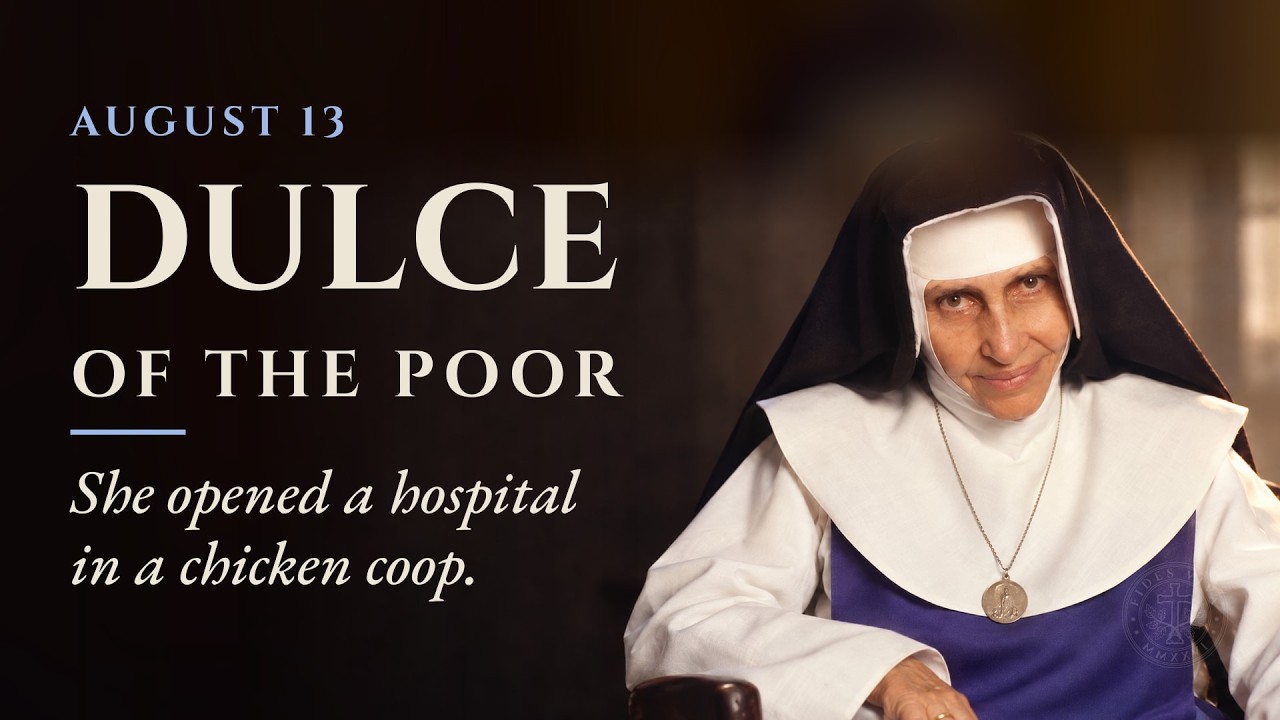
A small woman, an apron over her habit, sweeps out a henhouse. She carries the hens away one by one. She whitewashes the walls, seals the gaps, sets iron beds where the roosts used to be. Then she goes out and comes back with seventy sick people walking behind her.
A chicken coop, to everyone else. To her, a roof.
It was 1949, in Salvador de Bahia. That nun had spent a whole decade with no place of her own: she would find a space, fill it with the sick, and within months be turned out. They had even driven her off a mud islet in the middle of the bay.
She had no money, no building, nobody to vouch for her. She had the sick, a rosary, and a quiet stubbornness.
And a promise nobody could see. For her sister's health she had sworn never to lie down again, and she slept sitting in a wooden chair for close to thirty years.
That henhouse is today one of the largest hospitals in Brazil. And she is the first saint born in that country.
Her name was Dulce. Sister Dulce.
To understand where such stubbornness came from, we have to go back to a yard in Barbalho, where a girl of thirteen was already tending the ones nobody would touch.
Infancy in Barbalho: The Seed and the Wound
Salvador, Bahia, in the early twentieth century. A city of steep hills, of baroque churches golden inside, and houses in colors that the sun slowly fades. At the port, Africa and Portugal mix together; in the streets, vendors call out, bells ring, processions pass, and Christ has an altar at every corner. And below, almost invisible, live the others: the sick with tuberculosis, the lepers, the beggars who sleep where nightfall finds them. For them there are barely any doctors, barely any beds. Whoever falls sick without money falls to the street.
On one of those hills, on Rua São José de Baixo, number thirty-six, in the neighborhood of Barbalho, a girl is born on May 26, 1914. They call her Maria Rita de Sousa Brito Lopes Pontes. She is the second child of Augusto, a dentist and professor at the university — a learned man and a believer. Her mother is Dulce Maria, a young woman whom the family remembers praying. The house is bright, with a courtyard of packed earth at the back and mango trees that give shade. There the rosary is said in the afternoons, and there is always a plate left over for whoever arrives.
The small girl grows up quick and joyful. She plays with rag dolls, flies paper kites on the slopes of the neighborhood, chases a ball like any street child. She cheers for Ypiranga, a club of workers and people who count for nothing; already then, without knowing it, she has chosen a side. And she learns something more. The family remembers it was her mother who taught her to look at the poor who knock at the door not as a nuisance, but as visitors. In that house, whoever asks for bread is given it.
It is told in Salvador that the joy of that house broke early. Maria Rita was six or seven when her mother, Dulce Maria, died. From one day to the next, the sweetest name in the house became silence. The girl who flew kites learned mourning before she learned to write it. Her father's dark suit, the low voices, the empty place at the table where there had always been a plate left over.
Some sorrows shrink a person; others open them. Hers opened her. From then on she recognized suffering in others from a distance, with the precision that only comes from having tasted it herself. She would stand watching the beggars climbing the hill, the sick whom no one would take in, and something in her could not pass by. She was still only a girl with a doll in her lap. But she looked at the street as one looks at an unfinished task.
No one taught her a method for it. She had no bandages, no basin, no idea of what would come. She had only what she had received and what she had lost: a faith learned on her knees in that house, and an emptiness that bore her name. With less than that, many people close themselves off. She did not.
The door of that house would remain, in the memory of the neighborhood, always half-open, as if waiting for someone else. Behind that opening grew a girl who had learned too early what it means to lose. It remained to be seen what she would do with that wound — when the suffering of others, the suffering of the street, the suffering no one gathers up, came at last and knocked at her door.
The Open Courtyard: Compassion Becomes a Craft
The answer came around 1927, without announcement and without a plan, the way things come that later change a city. Maria Rita was about thirteen. She began with those she saw as she passed: men lying on the pavement, burning with fever, whom people skirted around like a puddle. She would stop, crouch down, speak to them, help them to their feet. And then she did what no one in Salvador did: she took them to her own house.
It was not the gesture of a single day. The next day there was another, and another after that. Beggars with open sores, sick old people, wounded people whom no one else would gather up from the street. She would go out looking for them on the slopes of the neighborhood and come back with them leaning on her small shoulder. The courtyard of the house began to fill with mats.
She learned the work with whatever was at hand: a glazed earthenware basin with clean water, a bottle of iodine, scissors, cotton bandages that she would wash and use again. She cleaned wounds that others could not bear to look at, held heads steady to give them water, spoke softly as she worked. Her hands grew red from so much washing. She asked no one where they came from or what they had done. In every broken body she saw what her faith had taught her to see: the face of Jesus Christ, present in the poorest.
Augusto could have forbidden it with a single word. He was a respected professional, with a middle-class home that suddenly smelled of iodine and filled with strangers. He watched his daughter kneeling in the dirt before a stranger's sore feet, and he said yes. Not only did he permit it: he supported her, and helped as he could in those first treatments his daughter gave. Father and daughter understood, without needing many words, that that house was no longer entirely theirs.
The neighbors did not know what to think. The dentist's daughter, a girl of good family, was on her knees before beggars, washing sores with her own hands. Some shook their heads; others peered in with a mixture of astonishment and bewilderment. In time, half joking and half serious, they began to call the house of the Lopes Pontes "the shelter." The name told more truth than they themselves knew.
Because word spread. Among the poor of Salvador the news passed from corner to corner: in Barbalho there was a house that did not close its door. And more came. Each week more sick, more hunger, more wounds to tend. The courtyard grew too small, the bandages ran out, and the arms of one girl alone could not keep up. The need of an entire city could not fit in the back of a single house.
What does a young woman do when the house is no longer enough?
Calling and Obedience: The Habit, the Name, and the Rule
The answer was to seek something larger than the house: a form, a rule, a family dedicated entirely to what she was already doing alone. In 1933, at barely nineteen years old, she left Salvador and traveled north, to São Cristóvão, a colonial town in Sergipe with baroque churches and streets of silence. There the Missionary Sisters of the Immaculate Conception of the Mother of God were waiting for her—a congregation of the Franciscan family, born from the spirit of that poor man of Assisi who had kissed the lepers.
At the convent she received the habit: the long, pale tunic of the sisters, with the scapular—that piece of cloth that falls from shoulder to foot, a sign of service—and the veil that from then on would cover her hair forever. With the new clothes came a new name too, because whoever consecrates herself leaves behind even what she was called. Maria Rita chose to call herself Dulce.
Dulce, like her mother.
The name of the woman she had lost as a child came back now upon herself, like a mantle. Each time someone called her, they would be naming both: the mother who had gone too soon and the daughter who turned that wound into a path. The deepest loss of her childhood became her identity, and her identity became her mission.
As the congregation still remembers it, on the fifteenth of August, 1934, the feast of the Assumption of Mary, she pronounced her vows: poverty, chastity, and obedience, for all her life. A promise spoken in a low voice in a whitewashed chapel in Sergipe, binding her to Jesus Christ with no turning back. She was twenty years old and had just given everything away.
Back in Salvador, Sister Dulce soon discovered that the habit did not take her away from the streets: it sent her back to them with greater force. The city she found was still the one she had left, with its poorly paid workers, its families without schooling, its sick with no door open to them. And she began to organize. In 1936 she founded the Workers' Union of Saint Francis, the first Catholic workers' movement in Bahia. Workers in patched shirts and straw hats had, for the first time, a place to gather, to learn, and to defend themselves together. Shortly after, she opened a school for them, because she understood that hunger for bread and hunger for learning came from the same poverty.
But inside her something pulled in two directions. The rule demanded schedules, silence, enclosure; the poor demanded the opposite: the street, urgency, the night. To obey and to serve, to serve and to obey. Could both fit into a life so small?
Some afternoons she would stand looking at the city from the convent: the red roofs, the slopes, the smoke rising from poor kitchens. Out there was her people. And still she did not know how to reach them without letting go of her obedience.
The City Without a Roof: Expulsion and the Wandering Years
In 1939 she took the step. She was twenty-five years old and possessed a certainty that would not let her rest: the sick she gathered from the streets needed more than bandages and iodine. They needed a roof. No one would give them one, so she took one. Across from Salvador, in the waters of the Bay of All Saints, lay a low-lying island called Ilha dos Ratos. Wooden and mud shacks on the marshland, canoes drawn up on the shore, the smell of low tide. Five of those houses stood empty. She occupied them one by one and filled them with her people: those wasting from tuberculosis, the old with no one, men with festering legs that no one wanted to touch.
She is remembered crossing the bay with food, clean water, and bandages; sweeping floors, arranging cots, tending wounds while the salt air came through the cracks. For the first time, her sick slept under a roof, with someone who answered for them. And on the mud of a forgotten island, Sister Dulce raised, without knowing it, the first sketch of her hospital.
It lasted little. The order came to leave, and they were expelled with all she had gathered: the cots dismantled, the sick back out in the open, the refuge undone in a morning. The city that let those men die on its streets could not bear to see them gathered under a roof. There was no appeal possible. They had to go.
At dawn, through streets still sleeping, a small nun with an apron over her habit led a slow line of sick with nowhere to turn. That was the portrait of the years that followed.
Nearly ten years. A borrowed place, a few months of peace, and then the search began again. One move after another, from one corner of the city to another, carrying mattresses, pots, and bodies that could barely walk. Each door that closed forced her to start over: find the space, clean it, set it up, tend the wounds; and when life seemed to settle, gather everything and return to the street. Anyone else would have called that journey a failure. She could not call it that: in every despised sick person she saw the face of Christ, and Christ is not left lying on a curb.
She had no money, no building of her own, no sure supports. She had a line of sick, a rosary in her hand, and a meek stubbornness that refused to accept no as a final answer. She asked the shopkeepers, asked the wealthy, asked whoever passed, without shame, because she was not asking for herself. And her chest, fragile since her earliest years in the convent, began to exact the price of that life in the open.
Ten years fit into a sentence, but you must imagine them night by night: the heat, the rain, the new sick who appears just when there is not a single mat left. And her, every morning, on her feet again. Charity had hands, had names, had a woman willing to spend herself entirely. The one thing it did not have was a place. What does it take for a city to open, at last, a door?
The Swept Henhouse: A Work Is Born
The door opened in 1949, and it was not a door: it was a henhouse.
Next to the Convento Santo Antônio, on the Largo de Roma, there stood a henhouse: a low gable of wood and tile. She had looked at it many times from the courtyard. Where anyone else saw a coop, she saw a roof, walls, space for beds. One day she made up her mind, found her superior, and asked permission to occupy it with her sick. She did not demand anything, did not present anyone with a fait accompli. She asked, as one asks who has learned obedience. And the superior said yes.
That yes, spoken quietly in a convent in Salvador, changed the history of Bahia. After ten years of closed doors, the one that finally opened was inside her own religious house. Obedience, which so often had seemed a brake, turned out to be a hinge: what the cloister seemed to forbid, a superior's permission made possible. The work was not born in spite of the Church; it was born within her, with a borrowed key and a blessing.
What followed was work, pure and simple. She drove out the hens, swept the floor until it was clean as a house, whitewashed the walls inside, stopped up the gaps. Then she went to gather her people. She brought them on foot, in a line, as so many times before; only this time no one would throw them out. Seventy sick entered that henhouse: old people alone, people without a home, men and women the city had been letting fall. She found iron beds and lined them up in rows; where beds would not fit, she hung hammocks. A bare bulb lit that unlikely dormitory at night. It was poor, it was cramped, it still smelled of a coop. And it was, at last, a place.
No one who entered then would have called it a hospital. They would have seen enameled basins, bandages laid out to dry, a small nun moving from cot to cot with quick, short steps. But inside that poverty was meticulous order: each sick with a bed, each wound with its dressing, each expense written in a notebook. And there was something more, which no notebook records: the certainty with which she knelt before each ravaged body. In each one of them she served Jesus Christ himself. You do not serve Him any way at all. For food and medicine she went out asking, door to door, from shopkeepers, from ladies, from politicians, and she rarely accepted no as an answer.
The days had a fixed rhythm. Before dawn, the chapel: Mass, the rosary, the stretch of silence that was her breathing room. After that, the henhouse: wash, feed, change bandages, listen. Many of those sick had gone years without anyone asking their name; here they got it back, along with a bed and a warm plate. The city had counted them as a problem. She counted them one by one, as you count your children.
Those were also the years when the body began to truly fail. The cough became a constant companion; the chest, a tired bellows. She worked the same, from first light to last, and still kept strength for what no one saw.
So Salvador remembers it: around 1955 or 1956, her sister by blood—Dulce, the one who bore the name of their mother—went through a pregnancy of high risk. The nun made then a promise: if her sister lived, she would sleep sitting in a wooden chair. Her sister lived. And the promise was kept night after night, for about thirty years. A chair with a straight back, in a corner. A woman exhausted, refusing herself even the rest of lying down. Behind the work everyone saw were nights that no one saw.
Meanwhile, the henhouse was growing too small again, because Salvador's need did not fit into seventy beds. She was not frightened: she expanded, reorganized, asked again. And through the city began to run a story that people told with an incredulous smile: that on the Largo de Roma a nun was raising a hospital where hens had once slept. The neighbors said it half in jest. They did not yet know they were watching be born, bed by bed, what all of Bahia would end up calling a miracle.
From Henhouse to Hospital: Charity Takes Shape
The rumor became paper on May 26, 1959. That day—the very day she turned forty-five—the Obras Sociais Irmã Dulce Association was formally established. Some statutes, some signatures, a name written in official ink. It sounded like paperwork, and it was far more: what had begun with a basin in the courtyard of a house now existed before the law. The charity of a single woman was becoming a work with its own name, capable of receiving aid, managing beds, answering for her poor.
The structure had its logic. A work sustained by one woman alone could collapse with her; an association would have a board, clear accounts, continuity. It was not a monument: it was a roof that had to stand beyond the one who had raised it. And she, with lungs already tired, signed her name.
A year later came the proof that this was serious. In 1960 the Santo Antônio Shelter opened, with one hundred fifty beds, on the same grounds where the henhouse had stood. Solid walls instead of planks, tiled hallways, ceiling fans moving the hot air of Salvador. The iron beds lined up in rows again, but now under a roof built to last. Where eleven years before hens had slept, there was a real shelter, with an infirmary, a kitchen, and a crucifix on the wall.
The first residents were always the same: old people without family, people with tuberculosis, those picked up from the streets. Only now each one received a bed with sheets, a sure plate, and a place in the sister's notebooks. For her nothing essential had changed: in each ravaged body she still served the same Christ she had found as a child in the courtyard of Barbalho. What changed was the scale. From seventy to one hundred fifty; from a borrowed gable to an institution with open doors.
And she remained unchanged. The same worn habit, the same quick, short step, the same hand outstretched from door to door asking for her people. The work grew, but its foundress did not grow with it: she still slept in that chair, as Bahia tells it; she ate little, coughed more. Each year her breath grew a bit shorter, and each year the beds grew more numerous, as if the body and the work had made a silent trade.
With growth came questions too, but not from the street—from within. It is remembered that in her own congregation some voices began to stir with unease. So much street, so many papers, so many hours outside the regular rhythm of the convent: could all of that fit in the life of a nun? No one said it aloud yet. But while the shelter filled with grateful sick, around the woman who had raised it a new silence was slowly forming.
Obedience Tested: Exclaustration and Faithfulness
The memory of the city holds also years of silence and distance. Around 1965, that unease took shape: part of her congregation judged that Sister Dulce had strayed too far from the rhythms of the cloister. There came then a period of exclaustration—the suspension of regular community life, the stepping back from the common table, from the choir, from the shared rhythm of the sisters. It lasted about ten years.
There was no scandal, no rupture. There was something quieter and perhaps harder: the house that had been hers becoming foreign. The woman who had always obeyed—who had waited for permission even to occupy a henhouse—found herself now at the margin of the life she had chosen. She had been barely eighteen or nineteen when she made that choice. And yet no one heard her complain. No one saw her remove the habit.
She went on with her work. Each morning, the round of beds. Each afternoon, the notebooks, the receipts, the hand outstretched. The sick knew nothing of those distances or of the disciplines within walls; they knew only that the sister arrived, as always, with her short quick step and her broad smile. She did not defend her cause in a loud voice or seek allies against anyone. She understood that obedience was not the price of her work: it was part of it, and that obedience included this new poverty too—the poverty of not being understood in her own house.
Around 1975 that time closed, as quietly as it had begun, and she returned to regular community life without a word of reproach. Ten years set apart, not a single day of resistance. What sustains someone when even her own house seems to turn its back? She had her answer in every bed of the shelter. But the body was beginning to exact its price: the air came to her more and more in gasps, just as the world was about to learn her name.
Recognition: From the Altar to the Bedside
The world learned her name on a day in July of 1980. John Paul II was setting foot in Brazil for the first time, and the entire country poured into the streets to watch him pass. In the midst of that tide of flags and singing, on July 7th, they invited a small nun of sixty-six years to come forward to the altar to receive a special blessing. She climbed the steps in the same clear habit she had always worn, nothing to set her apart from any sister in any convent anywhere.
Then the pope reached into his pocket. He drew out a rosary and placed it in her hand, and spoke words that Brazil would not forget: "Continue, Sister Dulce, continue." He asked something of her too, almost as a father would: that she take better care of her health. She received the rosary as she had received her mother's name half a century before—something small, placed in her hand, that held everything. Forty-seven years of giving all, and now the Church entire, in the figure of that man clothed in white, was telling her to go on.
And she went on. In 1983, Santo Antônio Hospital opened its doors, with capacity for about a thousand beds, on the same ground where thirty-four years before she had swept a henhouse. Where once seventy sick had fit among displaced chickens, there now stood pavilions, operating theaters, white coats. The city that had once driven her from an island now owed her its largest hospital.
The body, though, was exacting its price with growing harshness. It is said in the house that in 1985 the doctors ordered her to leave the wooden chair where she had slept sitting upright for about thirty years, and she returned to a bed. She obeyed that too. Three years later, in 1988, President José Sarney put her name forward for the Nobel Peace Prize, with the backing of Queen Silvia of Sweden. The award that year went to the United Nations peacekeepers. She appeared in the official photographs as she appeared everywhere: the unadorned habit among tailored suits and protocol, and in her eyes the same question as always—who was still waiting to be tended.
The emphysema advanced. The lungs, worn out by decades of streets, sheds, and nights sitting upright, gave her air in sips. By 1991 she scarcely left her room in the Convento Santo Antônio, with oxygen at her bedside and the pope's rosary between her fingers.
And then the pope came back. On October 20, 1991, on his second visit to Brazil, John Paul II broke the protocol of his schedule. He did not summon her to any altar: he walked to her. He entered that narrow convent room, with the window open to Salvador's heat and a crucifix on the wall. He sat beside the bed of the woman to whom eleven years before he had said to continue. Two lives spent for Christ, one beside the other, in the quiet of a poor room.
When he left, there remained only the sound of the city drifting through the window, and that shallow breath that counted time like a tired clock. Outside, the work kept growing: a thousand beds, schools, shelters. Inside, a body of ninety pounds that could barely breathe. Everything she had built with her hands remained standing; her hands, though, were beginning to let go. Salvador had five months left with its Good Angel.
Consummation: The Final Gift and the Passage Into Memory
Those five months wore away as everything else had worn away: without sound. The last days unfolded between the Portuguese Hospital, an intensive care unit, and her room in the Convento Santo Antônio. On March 13, 1992, at four forty-five in the afternoon, that breath which had for decades counted time in sips came to a stop. She was seventy-seven years old. She died as she had lived: small, without fanfare, with lungs spent by decades of service and the entire city hanging on her breath. Sixty-five years after that first basin in the courtyard of Barbalho, the body surrendered what little remained to the Christ she had bathed, healed, and laid down in each nameless sick.
Bahia poured out to bid her farewell. The city that once had no place for her sick stood still to say goodbye. Rich and poor alike, doctors and the forsaken—all had passed through her hands at some point.
But the farewell was not an ending. On June 9, 2010, her body was moved to the Capela das Relíquias, in the sanctuary raised on the Largo de Roma—a few steps from the ground where the henhouse had stood. There she sleeps now, in a circular room of soft light, surrounded by candles, by votive offerings, by photographs that the poor leave beside the tomb as one visits a mother.
Every day pilgrims arrive. They come from the high neighborhoods and from towns in the interior, bringing sickness, debts, children, gratitude. The question that hung in those lines in 1992 still floats among the candles: if charity dies with the one who practices it, why does this chapel never go dark? The founder had departed. The work, and something more than the work, was only beginning to show itself.
Miracles and Canonization: The Work That Continues to Heal
The first sign came nine years later, far from Salvador. January 2001, Itabaiana, in the interior of Sergipe—the same land where a young Maria Rita had received the habit. Cláudia Cristina dos Santos had just given birth to her second child when a hemorrhage brought her to the edge of death. Nearly twenty-eight hours like that, bleeding out, with the doctors offering nothing more. The family, without hope, turned to a priest devoted to Sister Dulce, and entrusted themselves to her intercession. The hemorrhage stopped. Suddenly, without medical intervention, without explanation. The Church examined the case for years, with doctors and theologians, and recognized it as a miracle.
Thus, on May 22, 2011, in Salvador, before a multitude of Bahian faithful numbering in the tens of thousands, Cardinal Geraldo Majella Agnelo proclaimed her Blessed Dulce of the Poor: the city heard the title as one hears something confirmed that it already knew.
The second sign touched the eyes. In 2014, the maestro José Maurício Bragança Moreira, a Bahian orchestra director, had been blind for fourteen years from aggressive glaucoma. One night, in the grip of a pain crisis, he took a small image of Sister Dulce into his hands and prayed. The next day he could see. Completely. Specialists from Brazil and Rome studied the case and found no medical explanation. In May of 2019, Pope Francis recognized the miracle, and the path lay open.
On October 13, 2019, across the face of St. Peter's Basilica, an enormous tapestry unfurled bearing her photograph: the elderly nun, the clear veil, the smile intact. Below, a sea of Brazilian flags. Francis spoke her name among five new saints, and the girl from Barbalho became Saint Dulce of the Poor, the first saint born in Brazil, with a feast day each August 13. The girl who healed festering feet in the courtyard of Barbalho was inscribed in the catalog of saints of the universal Church.
Her homeland also claimed her: in 2023, by law, her name entered the Livro dos Heróis e Heroínas da Pátria, alongside the founders and liberators of Brazil. But her true monument breathes. The hospital on the Largo de Roma continues to serve free of charge, with nearly a thousand beds, the sick without means. Her relics travel today through the parishes of the interior of Bahia amid candles and processions, and each August the feast day fills the sanctuary.
From the Roman plaza, the gaze descends again toward Salvador, toward its steep streets and its people. There, where it all began, charity continues to begin each morning.
Contemplate: Charity That Does Not End
At the beginning there was only an adolescent kneeling on packed earth, washing with water and iodine the feet of a man whom no one looked at. The question hung suspended over that basin: what can be born from a gesture of compassion repeated each day. Her entire life was the answer. From that courtyard came a swept henhouse with seventy iron beds; from the henhouse, a shelter; from the shelter, a hospital of a thousand beds that still heals the poor of Bahia free of charge.
None of it was spectacular while it was happening. It was a basin, some bandages, and that wooden chair that Bahia remembers, where no one saw her pass the night. She did not wait to have the means: she began with what she had and with whoever stood before her. In each nameless sick person she recognized the face of Christ, and to that face she gave her whole life—a small body and two ruined lungs.
We too meet that suffering: the man sleeping in a doorway on the way to work, the neighbor who is ill and whose door we pass without stopping, the message from someone in pain that we have left unanswered for days. What do we do with the suffering that crosses our path?
Each of us answers that in the silence of our own home. We know hers. She knelt, and from that gesture she never rose again in all her life.
In Salvador, the light of evening still enters through open doors like the one in Barbalho. The nights spent sitting, the prayer, the worn rosary, sustained what the whole world now admires. A swept henhouse was the beginning of a hospital, and a life spent without fanfare became light for her people.
Saint Dulce of the Poor, mother of the forsaken, comfort of the sick, hope of Bahia and of the poor, pray for us.