A man crosses the courtyard of a royal residence. He brings no letter, no gift—only two objects wrapped in cloth, which he sets down on a table before an old woman who was once a queen. She pulls back the fabric with her own hands.
A naked sword.
And a pair of shears.
Among the Franks, that long hair is no ornament—it is the right to reign. To cut it is a sentence. The sword means something else. The two objects are a question asked without words, and an old woman must answer for three children playing in rooms nearby: her grandsons.
No answer could save all three. Two of those children she would never see alive again. The third disappears.
And there begins the strange part. Years later, that third child—now a man, with his father's kingdom still his to claim—finds himself facing shears once more. No one forces him. No one threatens him. This time he takes them himself. And what he does with them is exactly what his uncles had tried to impose by force.
He had the blood. He had the right. He had every reason for revenge. He did not claim the throne. He did not raise an army. He chose to vanish.
What makes the heir to everything decide to be no one?
The Inheritance of Blood and Power
Four young men divide a kingdom over their father's grave. It is the year 511, and the father is Clovis, the first king of the Franks to bend his knee before Christ at baptism. His inheritance is vast, won by the sword; and among the Franks, an inheritance does not stay whole—it is divided, as a farm or a flock is divided. Theuderic takes the east. Childebert takes Paris. Clotaire takes Soissons. Chlodomer takes the city of Orléans, on the Loire. Four crowns from a single line. Four brothers who watch each other.
In the court of Orléans, around the year 522—the most likely date—the third son of King Chlodomer and Queen Gondioque is born: a boy they call Clodoald. Before him had come Theodobald and Gunthar. Three boys with uncut hair from birth, the same long locks that would one day decide their fate.
The child is barely a year old when his father rides to war against Burgundy. The campaign begins with a victory and a crime: the Burgundian king Sigismund falls prisoner and is executed in Orléans with his wife and his sons. A year later, on the twenty-fifth of June, 524, in the damp plain of Vézeronce, the Burgundians answer in kind. They know the battle cry of Chlodomer and mimic it in the fog: come here, come here, we are your own. The king rides forward alone. They surround him. They cut off his head and raise it on a pike.
The Franks do not break when they see it raised. They rally and lay waste to the land. Blood answering blood—the justice of that age. But in Orléans the victory brings nothing back: there remain a young widow and three orphans who do not yet know that word.
What follows is the cold arithmetic of power. Clotaire, one of the uncles, takes the widow Gondioque as his wife—his own brother's widow—and with her a share of her standing. Then a woman intervenes who has already lost nearly everything: Clotilde, the grandmother, the widow of Clovis, the queen who had brought her husband and her people to the faith of Jesus Christ. After the mourning passes, she gathers the three children and takes them with her to Paris.
In that house, prayer preceded command. The memory of the Franks preserved the image of the old queen teaching her grandsons the psalms, raising churches, distributing bread to the poor. The woman who had seen an entire kingdom ask for baptism now watched over three heads of fair hair, long, never touched by iron. And the whole court understood what that hair meant: as long as they wore it, these children were kings in waiting. And a king in waiting is, to whoever already reigns, a threat that grows a little each day.
On the other side, in Paris and in Soissons, two kings looked toward their mother's house. They were the children's uncles. They saw three heads of hair growing, and with them three claims to the kingdom of Orléans, which both wanted to divide between themselves. The boys played in courtyards by the Seine; the kings calculated. No one had yet told the three brothers that their hair was a matter of state, or what it usually cost among the Franks to stand in the way of a throne.
The Shears and the Sword: A Night Without Exit
Around the year 531, the eyes of Paris and Soissons had come to agreement. Childebert and Clotaire resolved that the kingdom of Orléans would not wait for three boys to grow. Only one thing remained: to clear the way. And for that they did not send an army. They sent a question.
The man who carried it had a name and a lineage: Arcadius, a Gallo-Roman aristocrat, grandson of Sidonius Apollinaris—the poet and bishop who had sung of Gaul in the century before. A learned man with careful hands, chosen for the filthiest errand of his generation. Before the old queen he laid down the shears and the naked sword. From the two kings he brought a single question: what did she prefer for her grandsons—the iron that cuts hair or the iron that cuts life.
Clotilde had buried her husband. She had received word from Burgundy of her son's beheading. She had raised those three boys under her roof, psalm by psalm, watching the hair grow before her eyes—the very hair that now condemned them. And there was no way out: shorn, they would live without a name, dead to the throne; with the sword, they would not live at all. From that hour came a sentence that is still debated: "I would rather see them dead than tonsured." Perhaps she spoke it that way, with the full pride of a daughter of kings. Perhaps grief spoke for her and no one wished to understand her. The only certainty is what came after.
It did not last long. Clotaire took the eldest by the arm. Theodobald was ten years old. Gunthar, seven, managed to break free and ran toward the other uncle, clinging to his knees, begging not to be killed. He was not heard. Both died, and with them their tutors and their servants—all who had watched over that childhood. Then Clotaire mounted his horse and rode away unmoved, like a man closing a file.
Paris then saw a procession that would take centuries to forget. The grandmother had the two small bodies placed on a litter and accompanied them through the city to the Basilica of Saint Peter, where Clovis rested. There were no cries, no oaths of vengeance. There were psalms: the chants with which the Church commends her dead to Christ, sustained by the voice of an old woman who could sustain nothing else. The woman who had brought a king to baptism now buried two grandsons beneath the oil lamps, beside the tombs of kings.
And the third. They could not catch the third. Some warriors got him away in time—brave men, says the only line that remembers them; not a name, not a face, not a reward. He was nine years old. He crossed the night on the back of a horse, clinging to a stranger's shoulders, his tunic torn and a rough brown cloak too large for him. Beneath the hood, tangled and matted, his hair traveled intact: the only thing his uncles had wanted from him, and the only thing they could not take.
Behind him lay two brothers dead, a grandmother on her knees, and a throne with his name written on it. Ahead lay nothing that could be called a future: roads, hiding places, silence. That night, anonymous hands gave him a life that no longer belonged to him. No one wrote where they took him or who sheltered him in the years that followed. Only this remained, hanging over all of Gaul: a question. What would that boy do, when he grew, with a life that was not his to live.
Silence and Renunciation: Cutting the Hair
Around the year 542, in some corner of Frankish Gaul, that boy was now a man of some twenty years. The hair had grown with him. It fell across his shoulders, untouched since the night of flight: twenty years of uncut hair, eleven years of a living claim since that night. The kingdom of Orléans still had a rightful heir, and his uncles knew it, and he knew it. Every strand was a title. Every hand's breadth of hair was a banner waiting to be raised.
He had the blood, he had the grievance, and in his world that was enough to raise an army. Among the Franks, those three things together raised armies. A Merovingian of twenty with two brothers slain would not have had to convince anyone: he would have needed only to appear. Vengeance was what his entire world expected of him.
What he did was something else.
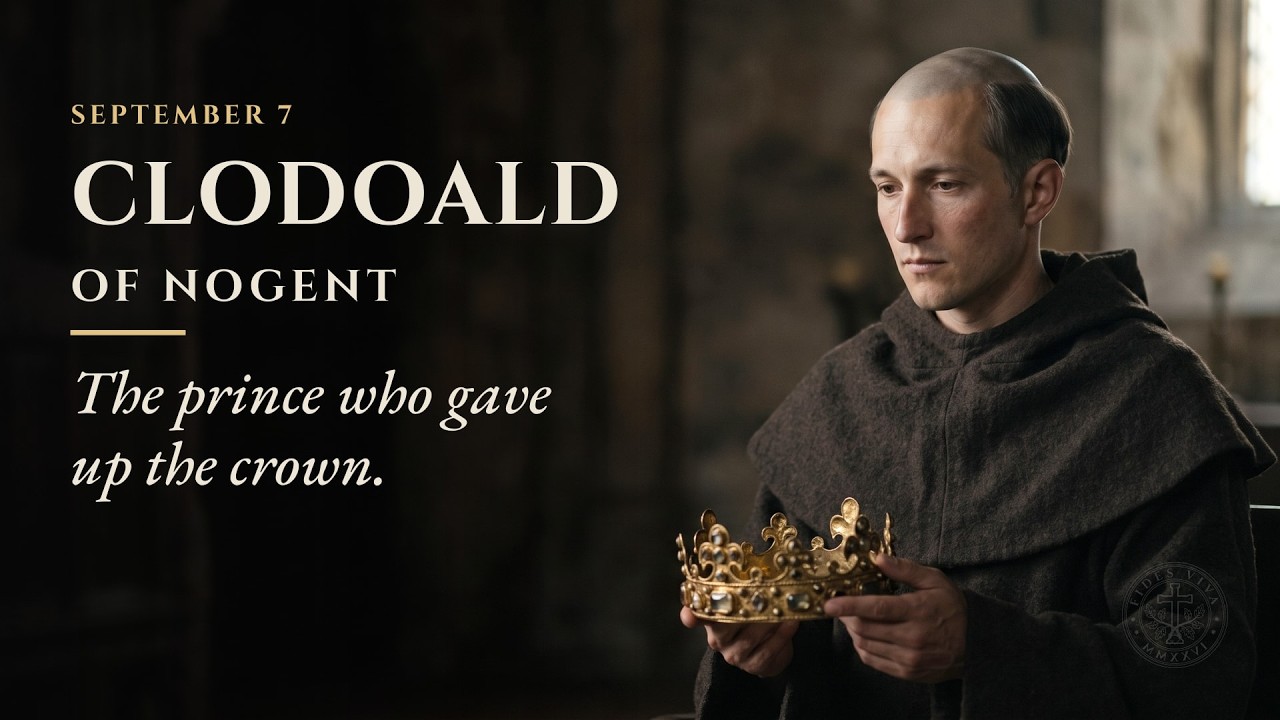
One morning without a date, without witnesses who would leave their names, he took the forces—the Frankish shears of iron, a single piece with a spring that held them open. The same iron that an envoy had once placed, in other hands, on a table before his grandmother. He lifted a strand. He cut. The hair gave way without sound. Another strand. Another cut. The fair hair fell to the ground, lock after lock, around his feet. When he lowered the shears, his head was cut unevenly, the work of his own hand. Then he shed the mantle. The brooch of garnets struck the ground with a small sound.
He did not bend to pick it up.
Under the law of the Franks, that gesture was a death. A Merovingian shorn did not reign: he had just signed the most complete renunciation his world knew. His uncles had sent that iron as a threat. He grasped it as freedom—and by choosing what they had tried to force upon him, he took it from their hands forever. There was nothing left to take from him.
A generation later, a bishop named Gregory of Tours gathered the memory of the Frankish kings into writing. To this prince he gave barely a few lines; his entire life fits within them: "Despising an earthly kingdom, he consecrated himself to God and, having cut his hair with his own hand, was made a cleric. He persevered in good works and died a priest." With his own hand. The bishop noted it as one who underscores the unheard-of: no one tonsured him; he tonsured himself. Centuries later, some images would prefer to paint him kneeling before the bishop of Paris, the whole court as witness: a ceremony worthy of a prince. The older memory is harsher, and greater. He alone, and the iron.
He was made a cleric: the tonsured crown of the Church's servant took the place of the heir's long hair. And he completed the stripping by distributing among churches and the poor whatever wealth his uncles had not been able to seize from him. No document preserves the moment when Jesus Christ crossed into that broken life: no vision, no word, no name of who taught him to pray. Only the effect remained—a man with a claim to everything who wanted nothing, except to be Christ's. Perhaps the seed had come from far away, from the faith that breathed in his grandmother's house. That silence, too, belongs to him.
To renounce a blood-right—an inheritance, a debt unpaid, a wrong uncollected—weighs as few things weigh. That morning, the line of Chlodomer lost its last heir. And where does a prince go when he is no one? He set out toward the gates of Paris, head shorn and hands empty, seeking someone who could teach him to live another way.
Learning to Disappear: The Hermit and the Disciple
At the gates of Paris, beside an old Roman road, there lived a man whom many called holy. Severin. A recluse, Gallo-Roman, old and bent, who had exchanged the world for a cell of dry stone and adobe, with a roof of thatch, a wooden cross driven into the earth, and a garden of cabbages. He had no lineage, no lands, no authority but that of his own life. What the memory of Novigentum kept is this: that one day at that low doorway there stopped a young man with a freshly shorn head, and he knelt on the threshold, and asked to be received.
A grandson of Clovis, on his knees in the mud, before an old man without a name. In the court of his uncles, men bowed before blood; here blood bowed before a poor man. Severin raised him and clothed him: a tunic of undyed wool, the color of the sheep, cinched with a cord, and over his shoulders the cowl, the short hood of the monks of Gaul. It was the whole of his investiture.
The years that followed left barely a trace, and perhaps that was the intention. Prayer at the fixed hours, when it was still night and when evening fell. The Psalms spelled out in a rough codex of parchment, until he knew them as one knows a mother tongue. The work of the garden, the meager bread, the fasting that sharpened his cheekbones. He learned what no court had taught: to be silent, to wait, to let himself be commanded. He who had been born to give orders found the strange rest of receiving them from a poor man. And in that silence took root the one thing no one could take from him, which was Christ—the inheritance that no uncle coveted, the only one worth keeping.
But a secret like that cannot stay long in a cell at the gates of a city. Someone recognized the survivor. The news ran from mouth to mouth: the heir of Orléans, the child who had escaped the slaughter, lived dressed in rough wool beside the road. Visitors began to come. The curious, the devout, and perhaps an eye or two sent to see if that monk was still a danger. He did what he already knew how to do. One morning, the cell woke without its disciple: he had gone south, toward the Midi, into Provence, where no one knew his face or his story.
He had renounced the crown. Now he renounced something finer, harder to let go: admiration. Because the fame of a saint, too, can become a throne, with its court of gazes and its weight of expectation, and he had learned to distrust all thrones. In the Midi he spent several years as a stranger: one more monk beneath the sun and among the stones, his skin growing ever more weathered, his tunic ever more worn, content to be no one.
The piety of those lands told afterward that it was heaven itself that gave him away: that through his hands came healings and favors, and that the wonders did what no messenger had managed—point out exactly where he was hiding. The man who fled from being someone could not stop being one. Around him grew again what he had left behind in Paris: people who came, asked, waited at his door.
What was he fleeing from, exactly? Not from people. He fled from becoming a title again: prince, saint—two different ways of ceasing to be a man before God.
And yet, on the banks of the Seine, no one had forgotten him. In Paris the story was still told of the young man who had chosen the edge of shears over the edge of a sword, and that memory was ripening into a petition. When the people learned where to find him, they did not ask him to reign. They asked something else, the only thing he did not know how to refuse: that he come back to serve. From admiration one can flee without guilt. From those who need, one cannot. The man who had spent half his life learning to disappear came back to where they sought him—this time, to let himself be found.
Service and Forgiveness: Priest and Founder
What the account of his life, set down in writing many generations later, remembers of what followed is this. It was not he who knocked at the doors of Paris: the city came looking for him. The people who for twenty years had kept his story did not ask him to reign or to judge disputes. They asked something else of the bishop of the city, Eusebius: that this monk in a worn tunic be ordained a priest. It was the year 551.
In a church of Paris, Eusebius laid his hands upon the shorn head. Over the rough wool they vested him in the alb of linen, without a single ornament; the stole, crossed upon his chest; and over it the chasuble, the ample and closed vestment of that time, falling in folds to his wrists. Twenty years before, two kings had decided that this child should not exist. Now his hands consecrated the bread and wine, and a city drew near to receive from them the Body of Christ.
The survivor had become a shepherd.
And then came what no one would have dared to ask for. Childebert, the king of Paris, was already going gray. He was the same one who had sent a messenger one day with shears and a sword; the same one at whose feet a seven-year-old boy had pleaded in vain. With the years he would become a founder of churches: basilicas raised, altars endowed, and that contradiction walked with him. What passed between uncle and nephew, if they ever looked each other in the eye, if any word crossed that silence of two decades, no one wrote it down. What remained was the fact, bare: Childebert gave his nephew the lordship of Novigentum, a wooded hill on a bend of the Seine, two leagues downstream from Paris. With it came the fields, the riverbanks, and all the lands attached to it.
He could have refused it. That land came from the hands that had decided the ruin of his house, and to accept it was much more than to accept a gift: it was to close the account, to renounce forever the right to collect it. He accepted.
And forgiveness, which had been ripening in silence, became something one could stand on: earth, riverbank, hill beside the water.
He climbed the hill with nothing but what he wore. Below, the Seine bent its course slowly; on the bank, fishermen's cabins, nets spread in the sun, flat-bottomed boats drawn up in the mud. There he raised a small church, of stone and timber, with a straight apse and narrow windows. He dedicated it to Saint Martin of Tours, the soldier of Gaul who two centuries before had cut his cloak in two for a poor man. The work grew slowly, at the pace of the river people: stone gathered from the banks, timber from the forests of the hill, local hands raising what would become their home. Around it grew cells of wood. Men came who wanted to live as he lived, and when it came time to choose a father for the community, they chose him. No one imposed the office on him: free men chose him, with no swords involved.
The years that followed took the shape of days. He taught the fishermen and the farmers of the countryside; he opened the Psalms to them as one opens a door, spoke to them of the Lord Jesus in words a child could understand. He divided what remained of his inheritance—the goods his uncles had not been able to seize—among the churches and the poor. The keys to the granary passed from hand to hand until they were no longer his. When fever came into the cabins, they climbed to find him; he came down with what there was: bread, oil, a word. He seated at his table whoever came hungry, and the house of the community became the door at which the whole valley knew to knock.
Over the hill, among the smoke of the hearths and the lap of water against the boats, a question was taking shape that he never spoke aloud: what remains of a life given when the one who gave it is no longer there. The answer was building itself stone upon stone, though no one could see it yet. Nine years were left to him on that hill. He spent them the same way he had spent everything else: giving.
The Last Alms and the Peaceful Death
Of those final years, the people of the valley kept one scene above all, and they told it so often that centuries later it ended up painted on the altars. One cold morning, a beggar climbed the slope to the monastery and asked for alms. The abbot had nothing left to give: the keys to the granary were in other hands, the inheritance was distributed, the table was for all. But he would not let the man leave empty-handed. He took off the cowl—the hood of wool that covered his shoulders, the only thing he wore besides the tunic—and put it on the poor man's back. The beggar went down the slope covered against the cold. The monk stayed at the top, his shoulders bare to the wind off the river.
He had given a kingdom. Then an inheritance. At the end, the very clothes that covered him.
On the seventh of September in the year 560, at thirty-eight years of age, he passed away in his cell at Novigentum. The devotion of the centuries that followed added that he himself had announced the day, with the calm of one who awaits a visitor. No sword sought him out this time. He died on a bed of straw, his face drawn thin and his hands crossed upon his chest, in the community that had chosen him as superior. Below, on the bank, the boats struck the water as they did every day. He died as he had lived since the morning of the shears: poor, hidden, and Christ's.
They buried him in the church that he himself had built, under the patronage of Saint Martin, the soldier who split his cloak. The man of the given cowl rested in the house of the man of the half-cloak.
And then what began to happen was what he had spent his whole life avoiding. The tomb did not stay alone. It was told in the valley that beside that stone the sick were healed, and the news ran up and down the river. Pilgrims came from the countryside, then from farther away. They lit candles on the stone, prayed to Jesus Christ for their children and their fevers, and returned to their villages telling what they had seen. The memory of the region holds that, around the year 592, his name was written among the saints, in the ancient way: without process or tribunal, a bishop and a people recognizing aloud what they already venerated on their knees.
The community remained standing beside the tomb, generation after generation, and in its shadow the fishing settlement grew until it became a village. And one day the place itself changed its name. Around the year 811, as was told among the fishermen of the place, the name written was no longer Novigentum, but Sanctus Clodoaldus. The land that a murderous uncle had given as one closes a debt now carried, written for all time, the name of the survivor. The man who fled twice from fame could not flee from this: the map itself had become his memory. And that memory was only beginning to travel.
A Name in the Earth: Legacy and Memory
The first journey was a flight. In the year 885, when Norse boats came up the Seine burning all they found, the bones of the saint were carried to the cathedral of Paris, sheltered behind the walls. Five years later they returned home in procession, downriver, by the same road on which he had arrived one day seeking to hide. The hill awaited them.
And the centuries went on piling dates around that tomb. On the twentieth of April in 1376, the flow of pilgrims had grown so great that the bishop Aimery de Magnac opened the sarcophagus. He moved the bones solemnly to the choir of the upper church, beside the high altar; from then on, each eighth of May the feast of that translation was celebrated. In 1394, a bone of the arm that had been stolen was restored, and the bishop Pierre d'Orgemont ordered a silver reliquary carved for it. Each generation returned to touch that memory with its own hands.
The devotion of the people, meanwhile, invented its own paths, simple and almost domestic. A small bone of the finger, set in crystal on a silver stand, was dipped in a spring on the Orleans road: it was the water of Saint Cloud, which the people used against inflammations of the neck, the cold swellings, and the abscesses of the skin. And the nailmakers of France adopted him as their patron, not for anything he had done, but for a play on words: in French, Cloud sounds like clou, nail. Naive piety, if you will; but behind the wordplay lay something true: working people of humble craft seeking a saint who had labored, as they did, with empty hands.
Then came the fire. In 1793, at the height of the Revolution, most of his remains were thrown into the flames. Of that body which had crossed twelve centuries, one bone of the forearm was saved. Only one. The arm of a man whose entire biography fits in the gesture of an arm: the one that took up the shears, the one that distributed the inheritance, the one that held out the cowl.
Over the ruins of the old collegiate church, between 1861 and 1878, the present church of Saint-Clodoald rose, paid for in large part by Napoleon III. In its choir, five painted scenes still tell the life of the founder: his ordination, the building of the monastery, the healing of the sick. And in September of 2022, fifteen hundred years after his birth, the entire city celebrated a jubilee year: a holy door authorized by Pope Francis, opened by Matthieu Rougé, bishop of Nanterre, and the silver reliquary, newly restored, carried in procession through the streets that bear his name.
Because the name kept traveling. It crossed even the ocean: in Minnesota, in the United States, an entire city and diocese are called Saint Cloud, and they have him as their patron on the far side of the Atlantic, far from the Seine.
Fifteen centuries of translations, thefts, fires, and processions, and in the end the reckoning is simple: the kingdoms of his uncles vanished, their palaces no longer stand, and the boy who fled one night from Paris gives his name today to two cities on two continents. He wanted no one to know it.
The world answered by writing it on the map.
The Echo of a Renunciation: Contemplation and Being Questioned
At the beginning there were two objects on a table, and a question hanging in the air: why does the heir of a kingdom cut with his own hands what makes him king. He never answered it with words. He left not a single word written: no letters, no rules, no decrees. He answered it with what he did. He had seen as a child what a crown cost—the lives of two brothers—and he chose the kingdom of Jesus Christ, which is not inherited by the sword. He cut, he gave away, he forgave, he built. That was his whole answer.
Against the logic of his age—whoever can collect a debt, collects it—he answered with another logic entirely: without a word, he accepted the land of the uncle who had ordered the killing, and made it a refuge for the poor.
We too carry some sign of power that is hard to let go. The reason that is ours in a family quarrel. The unpaid debt it would be fair to collect. The message we did not answer, because to answer would be to yield. What would we be willing to cut, if the hour came one ordinary morning?
He already answered. He took the shears.
The strands fell to the ground somewhere in the Frankish realm, and of that gesture only the record of his own hand remained. From that stripping, Novigentum remembers, a cell was born; from the cell, a church; from the church, a community that outlived him. The crown he left on the ground was taken by others, and was lost with them. What he released did not perish: it became the name of a city that still carries it.
Saint Clodoald, the crownless prince, founder of Novigentum, father of the poor and confessor of the faith, pray for us.