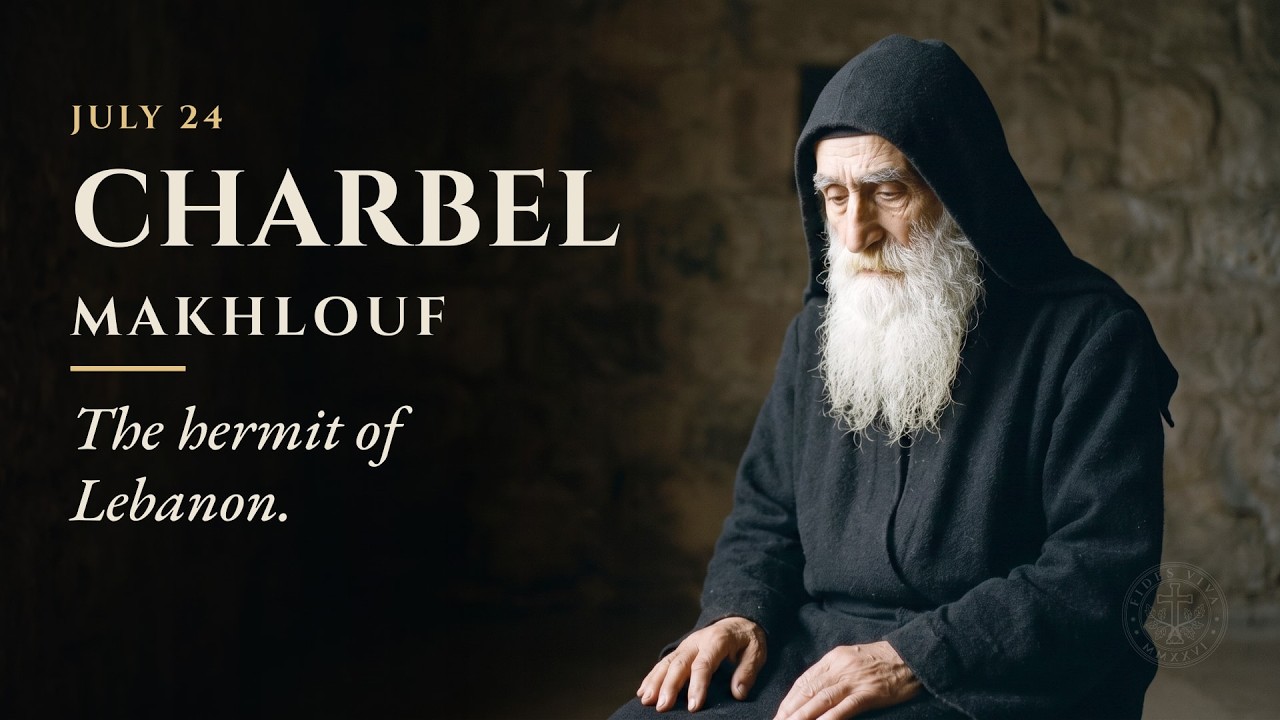
He wrote not a single line. He founded nothing. For twenty-three years almost no one saw him. And today millions climb a mountain to kneel before his tomb. How did a man who spent his life disappearing reach the whole world?
The Child of the Highest Mountain
In the nineteenth century, Mount Lebanon was a land both beautiful and wounded. It belonged to the Ottoman Empire, and the empire took its share: taxes, soldiers, sons. Conscription officers came down to the villages and carried the men off to wars no one had asked for. Around the middle of the century, the violence against Christians would leave thousands dead across the mountain. And still, those people stayed. Their root was the Maronite faith: Eastern Catholics of Lebanon, in union with Rome, who prayed in Syriac, a sister tongue to the one Jesus spoke. Their true temple was the mountain itself: stone, snow, and cedars.
At the highest point of that mountain, some sixteen hundred meters up, Bekaa Kafra clings to the slope — the highest village in Lebanon. There, on the eighth of May, 1828, a boy named Youssef Antoun Makhlouf was born, the fifth child of Antoun and Brigitta. A peasant family, poor and believing, the kind that measures the year by snowfall and harvest. Around the house, terraced fields climbed in steps; on the horizon stood the Cedars of God; above it all, a hard sky of the heights.
Youssef was three years old when the empire called his father. Antoun was taken for a levy of the Ottoman army, and he died on the road home. There was no farewell. A widow remained with five children and a plot of land in the highest village of the country. Brigitta did not break. She worked the land, she held the home together, and in time she married again, a devout man bound to the service of the Church. To her children she gave the one thing she had to spare: prayer. In that house they prayed morning and evening, as naturally as one lights a fire.
Like so many boys, his task was to mind the family's small flock. He would go out with his staff along the slopes, among the wind and the bleating of the sheep, and pass hours seeing no one. His village remembers that he had found a cave in the hills, and that he had placed there a small image of the Virgin. While the flock grazed, the little shepherd would step inside, kneel, and pray. Alone. In silence. One day after another.
No one taught him that from any book. He learned it the way deep things are learned: by doing them. Before he could explain who Christ was, he already knew how to stay quiet in his presence. Solitude, which weighs on others, gathered him within. With a knotted-cord rosary between his fingers, that orphan discovered that silence was not empty: it was inhabited.
So he grew: between the work, the snow, and that cave that was his first church. The village, meanwhile, imagined for him the usual things: a wedding, a piece of land, a life like everyone else's. But something was beginning to call him up the mountain. And that call, with the years, would ask him for everything.
He Climbed and Did Not Return
Youssef became a man working the land. By twenty he was a lean, sinewy farmer with calloused hands, who plowed the family terraces and served in the parish when he was needed: he lit the lamps, he prepared the altar, he cared for the house of God as one cares for one's own.
His family had plans for him. He was steady, healthy, a good worker: the ideal son to marry, build a home, and hold the Makhlouf land. In the village that was the good life, and no one looked down on it. But he carried something else within. Two of his mother's brothers lived as hermits, monks withdrawn into solitude to pray without ceasing. Their example told him another road existed: to leave everything and be alone with Jesus Christ. The more he thought of them, the smaller the cave of his childhood grew.
For years he carried that tension without speaking it: the warm home that begged him to stay, and the horizon that begged him to go. In 1851, at twenty-three, he made his choice. Before dawn one morning he took the path that led down from the village and walked toward the monastery of Our Lady of Mayfouq. He said no goodbyes. He carried almost nothing. He knew that if he looked back his heart would break in two; so he did not look.
At Mayfouq he knocked on the door and asked to be received as a novice of the Lebanese Maronite Order. And there the second stripping happened, deeper than the first: he gave up his own name. Youssef Antoun Makhlouf vanished on that threshold. In his place was born Brother Charbel, named for a martyr of Edessa from the second century, a man who had died for confessing Christ. In Lebanon they say that ancient name means "story of God." New name, new life: he no longer belonged to himself.
Below, in Bekaa Kafra, Brigitta remained. She had lost her husband on a road; now she lost her son on a mountain. In Lebanon they remember that, when she understood he would not return, she did not hold him back nor mourn him as one mourns the dead: she blessed him. She would rather know him a good religious than see him come home. Faith did not spare that mother her pain; it turned it into an offering. There are blessings that cost a whole lifetime, and hers was one of these.
He had given up the house, marriage, the land, even his name. It seemed the end of every renunciation. It was not. Within that call slept another call, deeper still, that would take years to wake. For now, the black habit fell over his shoulders, the hood covered his head, and the monastery walls closed around a faithfulness no one would see.
The Monk of the Lamp
Two years later, the novitiate lay behind him. On the first of November, 1853, in the monastery of Saint Maron at Annaya, Brother Charbel consecrated himself forever: poverty, chastity, and obedience, the three vows that stripped him of all a man can call his own. He was twenty-five. In the church of ochre stone the monks chanted the hours in Syriac, the ancient tongue of the Maronite liturgy, sister to the Aramaic that Jesus spoke. An oil lamp lit the altar. No one could have known it then, but that monastery would be his home until death. And far beyond death.
Soon after, his superiors sent him to Kfifan, the order's house of studies, a monastery of golden stone set among olive groves. Six years of philosophy and theology, of Syriac manuscripts and bare cells. And a teacher worth more than all the books: Father Nimatullah Al-Hardini, a spare monk with a grizzled beard. The whole mountain knew him for his love of the Eucharist and his resolve to live hidden in God. The young student watched him in silence, and something of that fire stayed inside him for good. Years later the Church would raise them both to the altars: the master and the disciple, formed in the same classrooms.
On the twenty-third of July, 1859, he was ordained a priest, and from that day he held the body of Christ in his hands every morning. He returned to Annaya. And there began the part of his life that almost no one could tell, because nothing happened. Sixteen years of nothing, in the eyes of the world: working the vines and the terraces, obeying without question, eating whatever he was served, speaking only what was needed. He was the first to come to prayer and the last to leave. The brothers grew used to that figure with lowered eyes and hands folded in his sleeves, so silent he seemed part of the walls. The black beard slowly grayed, year after year, beneath the hood.
He celebrated Mass with a plain chalice and paten, vested in the sober garments of the Maronite rite. Then he went back to the fields. Hoe, vine, stone. In his hands, the same care for the host as for the soil: all was service, all was prayer. Nothing in him asked to be seen.
The monks of Annaya remembered one episode from those years they never forgot. One evening some companions wanted to put him to the test: they emptied his lamp and, in place of oil, filled it with water. As night fell, Charbel lit it to pray, as he always did.
And the lamp burned. It burned with water as though it were oil, with a steady flame, before men who no longer knew whether to laugh or to kneel. Perhaps that flame said, in miniature, what his whole life repeated under his breath: that when a man believes and obeys, God kindles what cannot burn.
He was, in everyone's eyes, a monk beyond reproach. And yet something in him kept asking for more: more silence, more stripping away, more solitude with God. Up the hill, above the monastery, stood a tiny hermitage dedicated to Saints Peter and Paul: four walls of stone, a bare little chapel, mist and wind. Each time he looked at it, that old thirst to be alone with the Lord grew instead of fading. Sixteen years of faithfulness had taught him to wait. But one day, his beard already gray, he would gather the courage to ask the unthinkable: to leave even the common life, and disappear altogether.
Twenty-Three Years of Silence
In 1875 he asked. He was forty-seven and had spent more than two decades in the order. He came before the abbot with the strangest request a monk can make: to leave the community, not to return to the world, but to draw even farther from it. The abbot knew him well. He knew that in this silent man there was no whim and no flight, but a call within the call. And he granted it. Charbel climbed the hill with nothing but the clothes on his back, crossed the threshold of the Hermitage of Saints Peter and Paul, and never lived among men again. Twenty-three years waited for him up there. The last twenty-three of his life.
The hermitage was almost nothing. A chapel the size of a room, a bare cell, a terraced garden scratched from the slope, at thirteen hundred and fifty meters of altitude. In winter the snow hemmed it in for weeks; the rest of the year, mist and wind. Inside, a straw pallet with a wooden log for a pillow. That was his bed for twenty-three years. He ate once a day, the poorest food there was: vegetables from the garden, scraps from the monastery. Beneath his tunic he wore a cilice, a coarse cloth of penance that chafes the skin without rest. He worked the soil, prayed on his knees over the stone, slept little. Seen from without, he looked like a man punishing himself. Seen from within, he was a man emptying himself, so that God alone might fill the space.
Because the center of that life was not the fasting. It was an altar. His whole day turned around a single Mass, which he celebrated toward midday. The morning was the preparation: hours of prayer before the tabernacle, making himself ready for what he was about to celebrate. The afternoon was the thanksgiving: hours of silence for the gift received. A single sacred act, and a full day to dwell within it. There, in that chapel lit by one candle, the hermit held Jesus Christ in the host each day between his gnarled hands. And around that instant he ordered everything else: sleep, work, hunger, the years.
And yet this man who had withdrawn from the world closed his door to no one. When someone climbed the slope — a sick man, a farmer with a sorrow, a mother with her child — he received them, listened to them, blessed them. He did not ask where they came from or what they believed. Christians and Muslims from the neighboring villages knocked at that door, and all found the same charity. He had hidden himself from men, and men, without knowing how, found him closer than ever.
So the winters passed. The gray beard turned wholly white; the back bent a little further; the hands hardened with the hoe and the rosary. Twenty-three years of snow, mist, and stone, without a single event the world could point to. His whole life had narrowed to one thing: the Eucharist.
And it was there, at the altar, that the silence came to claim him fully. One December morning, with the host raised high, the prayer broke on his lips.
The Unfinished Prayer
The sixteenth of December, 1898, dawned cold over the mountain. In the chapel of the hermitage, one candle lit the altar, and an old man of seventy vested himself, as every day, in the plain garments of the Maronite rite. He had spent the morning making himself ready, kneeling before the tabernacle. Toward midday the Mass began. The elevation came. The gnarled hands raised the host and the chalice. His lips began the prayer the Syriac liturgy sets in the priest's mouth at that moment; not words of his own: the prayer of the Church. "Father of Truth, behold Your Son, a sacrifice pleasing to You…". He could not finish it. A stroke struck him at the very elevation, the Body of Christ held high. He fell beside the altar, the host and the chalice still in his hands.
They found him so and carried him to his cell. On the straw pallet where he had slept through so many winters, the body began to fail; the lips did not. Eight days the agony lasted. Eight days of snow against the wall. Eight days of a voice ever fainter repeating the same broken prayer: Father of Truth, behold Your Son. What the stroke had cut off at the altar, he went on offering from the bed. He did not complain of the pain. He asked for nothing. Those who tended him heard from his mouth only the prayer. To the end he was what he had always been: a man turned wholly toward God, with no word of his own to leave behind.
Outside, the villages of the mountain were lighting their candles for Christmas. Inside, in the dimness of the cell, another flame was burning down without a sound. The prayer of his last Mass had become the prayer of his last week. On those spent lips, the whole Church went on offering her Lord.
On the twenty-fourth of December, 1898, on Christmas Eve itself, while the churches of Mount Lebanon prepared to sing the birth of Jesus Christ, the flame of Father Charbel's life went out. He died on the night the sky opens over the earth, within the mystery he had guarded all his life. The prayer stayed unfinished at the altar; he would finish it elsewhere.
The next day they brought him down from the hill to the monastery of Saint Maron. They shrouded him in his priestly vestments and, according to the rule of the order, buried him without a coffin in the monks' cemetery. No special stone, no eulogy. The Christmas Eve snow fell over a grave like all the rest. He had wished to disappear; now he disappeared entirely beneath the soil of Lebanon. The brothers went back to their cells; the mountain, to its silence. Everything, to all appearances, was over.
They buried him like any monk, and like any monk he was to be forgotten. And yet that same winter, on the darkest nights, something began to be seen over the snow-covered grave. Something that no one, in the monastery or in the villages, could explain.
The Light Over the Tomb
The memory of Annaya holds that the glow returned night after night, for weeks. A gentle light over the grave, visible from the houses on the slope, like a lamp burning where no lamp had been set. The villagers climbed to watch from a distance, wrapped in their woolen blankets; the monks saw it from the monastery windows and did not know what to say. The man who had spent twenty-three years hiding from the world had lain a few weeks beneath the earth, and the whole mountain was pointing to his grave.
People began to come. First the neighbors from the nearby villages, then those from farther off; some carried away a handful of earth from the grave, the way one keeps a relic. Faced with that silent tide, the superiors decided to open the tomb. It was April of 1899, four months after his death. The monastery records set down what they found: the grave flooded by the rains, turned to mud. Over the mud, floating, lay the body of the hermit: supple, whole, as if newly asleep, giving off a bloodlike fluid no one could name. They carried it inside the monastery and clothed it again in the priestly vestments. They would have to renew them many times over: the fluid did not stop.
Half a century passed. The devotion stayed alight on the mountain, quiet like the man himself, until in 1950 the fluid seeped from the tomb and worked its way through the wall. This time they called the doctors. They examined the body, drew up records, searched for an explanation. And while the physicians wrote, the whole of Lebanon set out on the road. That year hundreds of healings were declared. The sick climbed the slope of Annaya in endless lines: on donkeys, on the shoulders of their children, dragging legs that would not answer. Many walked back down. At the monastery door the crutches began to be left behind, hung on the walls like sheaves of a new harvest. And all of them came up: Christians and Muslims, together, before the tomb of the monk who in life had opened his door to all alike. In that hidden hermit an entire people recognized the grace of Jesus Christ, whom he had served without a sound through a lifetime spent out of sight.
That same year, the mountain received another gift. They tell in Annaya that on the eighth of May, 1950, some priests were photographed before the monastery wall. When the image was developed, among them appeared a figure none of them had seen when they posed: an old monk with his eyes cast down, a black hood drawn low, a full white beard. The oldest monks, the ones who had known him, recognized him without hesitation: it was Father Charbel, just as he was in his last years. No one had portrayed him in life. From that image came all his likenesses: the face of the man without a face reached the world fifty-two years after his death.
The people of Lebanon already knew. The mountain knew, the crutches hung on the wall knew. What remained was for Rome and the whole world to know. And what Annaya kept in secret at last crossed the sea, all the way to Saint Peter's.
The Hermit Who Reached the World
Rome walks slowly, and perhaps it must. Years earlier his cause had opened: Pius XII had already recognized the heroic degree of his virtues. And on the fifth of December, 1965, at the close of the Second Vatican Council — bishops from the whole world gathered in Saint Peter's — Paul VI declared him blessed. It was no ordinary gesture. In the very hour when the Church was asking how to speak to modern man, before them all, she held up a monk who had barely spoken. A man with no visible works, no writings, no disciples, set forward as an answer.
Twelve years later came the full consecration. On the ninth of October, 1977, Paul VI canonized him, and called him "a worthy representative of the Eastern Churches and their lofty monastic tradition"; and that same day he described him as "a very humble mountain flower." Saint Charbel Makhlouf: the first saint of Lebanon, a son of the Syriac tradition raised to the altars by the Bishop of Rome. The bridge he never meant to build now stood between East and West, stone to stone, like the arches of his monastery.
And the current did not stop. The shrine's register holds the case of Nohad El Chami, a Lebanese mother laid low by hemiplegia, the paralysis of half the body. On the night of the twenty-second of January, 1993, she dreamed two monks operating on her; she woke healed, two scars on her neck she would carry the rest of her life. She told how the saint asked her to climb to Annaya on the twenty-second of every month, in thanksgiving. From that request was born the pilgrimage that, every month to this day, fills the mountain with thousands of people carrying lit candles. Nohad climbed faithfully, showing her scars to whoever cared to see them, until her death in 2025.
More than thirty thousand recorded healings are kept today in the archives of Annaya. Each year, some four million people climb to the tomb: Christians and Muslims, together, as in the days when the hermit opened his door to all alike. In a country battered by war and crisis, that silent monk has become a place where all of Lebanon can meet. No one asks anyone their religion before that iron grille. They ask, they weep, they give thanks.
And on the first of December, 2025, the circle closed. Leo XIV, on his first apostolic journey, walked the road up to Annaya and knelt before the tomb: the first pope in history to pray at that grave. He called his intercession "a river of mercy," and named the four attitudes that had upheld that life: prayer, silence, humility, poverty. Weeks later, in January of 2026, the monastery recorded two new healings attributed to the saint: a woman in the United States, another in Lebanon. A hundred and twenty-seven years after the Christmas Eve of his death, the river runs on.
The successor of Peter knelt before the hermit who did not want to be seen. The shepherd of the universal Church bowed before the man who spent twenty-three years hidden with Christ on a hillside. One question hangs in the air, the first of them all. And to hear its answer, one must return to where it all began: to the silence.
What Remains When Everything Falls Silent
In the Hermitage of Saints Peter and Paul, today, a candle burns in the dim light. The cell is still bare; the altar where he fell still stands. Outside, the snow falls on the stone as it fell back then, and the wind passes through, finding no one.
He never wrote a single line. He founded nothing. For twenty-three years almost no one saw him. How did a man who spent his life disappearing reach the whole world? His life itself gave the answer, without speaking it. He buried himself like the grain of wheat that hides to bear fruit: he left his name, his home, his own will, and stayed alone with Christ on a hillside in Lebanon. And what was sown in that silence never stopped growing. A lamp filled with water burned in his hands. A glow watched over his tomb through the winter nights. Thousands of the sick came down healed from his mountain, and they come down still.
We too keep a part of our lives that no one sees. The sick tended with no witness, with no reward but the silence itself. Charbel laid on those unseen hours the whole weight of his existence, and and those were the hours that reached the farthest. The question he left open is still warm; it has not aged. What we cultivate when no one is watching is an answer only God hears, and each of us knows our own.
On the mountain of Lebanon, a lamp is still burning. What burns in secret before God, He kindles in its hour for the world.
Saint Charbel Makhlouf, hermit of Mount Lebanon, father of silence and the hidden life in God, heavenly physician of the sick, pray for us.