Es de madrugada y un anciano ya no puede levantarse de la cama. En la pared, frente a él, alguien ha clavado unas hojas de pergamino: salmos copiados a mano y sujetos a la pared, para que pueda leerlos sin sostener el libro. Los lee despacio, moviendo apenas los labios. Lleva días así.
Y llora.
Outside the window, smoke rises from a besieged city. It is the summer of the year 430, on the coast of North Africa, and this man is the bishop of that city. An army has camped before its walls for three months now.
In his lifetime he wrote more than almost anyone of his century: books, letters, sermons that are still read today. And to die, he did not choose any of his own words. He asked for borrowed ones: the psalms of repentance. One of the most powerful minds in the Christian West fades away asking for forgiveness.
As a young man he deceived his mother and fled from her on a ship, in the night. He lived fifteen years with a woman whose name he never wanted to write. He asked God for purity… but not yet.
And everything—the flight, the search, the tears of this ending—began far from this bed and these walls, in a corner of countryside deep in Africa.
The Restless Heart: Tagaste and the First Wound
In the middle of the fourth century, Roman Africa lived with its back turned to fear. Its plains of wheat and olive groves fed Rome; its cities had forums, baths, and schools. The emperors were now Christian and favored the Church, but the old temples still stood open and the ancient gods still received incense. In many houses the two faiths lived under the same roof. No one imagined that world, so solid in appearance, had its days numbered.
In Tagaste, a town of hillside streets among the hills of Numidia, on November 13, 354, a child was born. They named him Aurelius Augustine. His father, Patricius, was a small landowner of pagan faith, a member of the town council, with more ambition than money. He dreamed that this son, quick of mind, would go far by the path of words. His mother, Monica, was Christian, and taught him from infancy the name of Jesus Christ. She enrolled him as a catechumen—that is, as one preparing for baptism—but did not baptize him: in those days many put off that step for later. That "later" would last thirty-two years.
The boy learned early that words were power. He studied his first letters in Tagaste and then was sent to Madaura, a learned city, proudly pagan, to train in grammar and rhetoric. There he discovered the poets, wept at the misfortunes of heroes, and won applause reciting. He came home with prizes. He came home too with something he could not name: an impatience, a hollow place.
At sixteen, the money ran out. His family could not stretch to Carthage, the great center of learning, and meanwhile the boy spent a whole year idle in his town. He had no teacher and no task: only all the strength of adolescence and nothing to spend it on.
One night of that year he went out with a gang of friends. Near the family vineyard stood a pear tree heavy with fruit. They were not hungry. The pears were not even good. They emptied the whole tree, loaded themselves with armfuls of fruit, and threw them to the pigs. Decades later, now a bishop, he still turned it over in his mind: he had not stolen out of desire for the pears. He had stolen for the pleasure of the forbidden, because the others laughed, because it was wrong. And beneath the laughter, he wrote, there was nothing. That was the first face of the restlessness that would follow him all his life: to do evil and gain nothing by it, to seek something without knowing what.
Soon after, Patricius died. He had been baptized at the end, won over by his wife's quiet patience, and left the family with just enough. It was a wealthy neighbor, Romanianus, who made up what was lacking. Around the year 371, the son of Tagaste took at last the road to Carthage, carrying with him his grief, his gift, and that hunger with no name.
Something in him still had no place to rest. He did not know it yet. Carthage was going to offer him, first, all the wrong answers.
Carthage: Desire, Love, and the Fire of Intelligence
Carthage received him with a roar. The great port city of Roman Africa churned with life: the circular harbor where grain ships docked, the baths beside the sea, theaters packed to the edges, the shouts of merchants, the smell of fish, incense, and crowd. For a boy from the countryside seventeen years old and freshly grieving, that was the whole world at once. Years later he would remember that he arrived without loving anyone yet, but in love with the idea of love itself. He was searching for something to embrace. And in Carthage everything let itself be embraced.
He gave himself to his studies with a gift that left his classmates behind, and to the city's pleasures with the same intensity. The theater held him captive: he paid to weep over others' sorrows, feigned, while he dodged his own. And soon he found someone real. A woman about whom we know almost nothing, except what little he chose to tell, entered his life. They did not marry: marriage, for a man with his ambitions, was a piece to be played higher on the board. But he lived with her, and with no one else, for fifteen years. Their son was born in 372, when he was barely seventeen. They named him Adeodatus: "given by God." They had not sought him; the name they gave him says what they did with him.
A year later, in 373, something happened to him that no pleasure had made him feel. The curriculum put into his hands a book by Cicero: the Hortensius, an exhortation to philosophy. Today it is lost, and survives only in fragments and in what he told of it. He opened it expecting to polish his style, since that was how a future orator earned his living. And the book pierced him through. Those pages did not praise any teacher or any school: they called to love wisdom itself, wherever it might be found. Suddenly all his hopes of applause and career became small. At nineteen, in the noise of Carthage, an ambitious young man discovered that what he wanted was not to shine. It was the truth.
One thing alone was missing from that book, and he noticed it at once: the name of Christ did not appear, that name he had drunk in with his mother's milk. So he went to look for it where it belonged: he opened Scripture. And he stumbled headlong into them. He came from Cicero, from the most polished Latin in the world, and those pages seemed to him rough, humble, unworthy of a mind like his. He did not understand that he had to stoop to enter by that low door. He closed them, disappointed, and kept searching elsewhere.
Elsewhere had a name: the Manichaeans. An elegant and hidden religion that promised exactly what he wanted to hear: truth without faith, pure reason, no mysteries to swallow. They explained evil as a substance, an eternal kingdom of darkness at war with light; so the evil that one did was not entirely one's own fault. For a man with an uneasy conscience and a hungry mind, the offer was almost irresistible. He became a "Hearer," the lower grade of the sect, and drew several friends with him. He was going to remain there nearly nine years.
Those were years of ordered double life: by day he taught rhetoric, first in Tagaste and then in Carthage, gathering students and a name; by night he debated cosmologies of light and darkness, certain he had left behind his mother's simple faith. She, meanwhile, wept for him and prayed without limit. A bishop to whom she came, worn out by her pleas, sent her away with a phrase she held as a promise: it is impossible that the son of so many tears should perish.
But inside the dutiful Hearer, questions piled up without answers. The Manichaean explanations of heaven and the stars did not square with what astronomers measured. His teachers asked for patience: when Faustus came, the great bishop of the sect, everything would become clear. He waited years for that visit. The mind had found nourishment, but the heart still hungered. And a hunger like that, sooner or later, drives a man to cross the sea.
Flight and Disillusionment: Rome and the Loneliness of the Seeker
Faustus of Mileve came to Carthage at last in the year 383. For years, every doubt had received the same answer: wait for Faustus. And Faustus turned out to be charming. He spoke with a grace that wrapped around you, chose his words like someone picking ripe fruit. Augustine listened to him for weeks and sought him out alone. He laid before him his objections about the stars and the seasons, those calculations of the heavens that Manichaean doctrine could not reconcile. And that kind man did something no other teacher of the sect had done: he admitted, simply, that he did not know how to answer. He was honest. And his honesty brought everything down.
There was no scandal, no door slammed. The break was silent, interior: he understood that eloquence is not truth, that one can speak beautifully what one does not know. Nine years of commitment dissolved in a few courteous conversations. On the surface he still moved among the Manichaeans; inside he was already a man without a home. He decided to leave for Rome: there, they said, the students were more disciplined and the career of a rhetorician could rise higher. Monica learned of it and did not hesitate: she would go with him, or he would not go at all.
The night of departure he went down to the harbor with her. He told her he was only going to see a friend off, and that she should wait. She would not leave: she withdrew to pray at a shrine beside the sea, built in memory of the martyr Cyprian, and spent the night asking God to prevent that voyage. While she prayed, the ship sailed with her son on board. By dawn the dock was empty. She cried out before a sea that had taken him from her. Years later, he would write it with a clarity that still wounds: God did not hear what his mother asked that night, so that he might grant what she had been asking all her life.
Rome received him with fever. Newly arrived, he fell so ill he was near death, unbaptized, in a stranger's house, while his mother—who knew nothing—continued to pray to Christ for him on the other side of the sea. He recovered, opened his school, and learned the trap of the City: students who listened to the whole course and vanished as a group just before paying. The bigger world he had dreamed of turned out to be narrow and cold. Streets cramped between tall brick buildings, smoke from braziers, and the exact loneliness of the foreigner who no longer believes what he believed and has found nothing to put in its place. In those months he even toyed with the thought that truth, simply, could not be reached. Neither reason had sufficed for him, nor affection: he had left his mother deceived on a beach, and in exchange his hands were empty.
The way out came through a competition. Milan, the seat of the imperial court, was looking for a public professor of rhetoric, and the prefect Symmachus, after hearing him declaim, recommended him. In 384, at thirty years old, he crossed the northern plain toward the city where the imperial court of the West resided. And there, out of professional curiosity, he went to hear the man everyone was talking about: Ambrose, the bishop. He was not seeking God; he was going to judge another master's eloquence the way one professional sizes up another. But Ambrose received him with a father's kindness, and he began to love him before he believed a single word he said.
Every Sunday he came back, attentive to the form. And the form began to open cracks through which the content started to seep in. In Milan, restlessness found new questions, and for the first time in many years, a door that was not quite closed.
Milan: Between the Wound and Grace
The crack widened into a breach. Sunday after Sunday, Ambrose took the passages from the Old Testament that the Manichaeans ridiculed—the harsh stories, the carnal images—and opened them from within. He showed that beneath the letter lay spirit, that those texts did not ask to be read as flat chronicle but as figure. One after another, the walls that for so many years had kept Augustine from Scripture came down. Faith no longer seemed unworthy of a thinking man. He still did not believe; but he could no longer mock.
He wanted to speak with the bishop alone, to put his questions to him. He never managed it. Ambrose lived besieged by a crowd of people with troubles, and in the few free hours he did something that in that world was strange: he read in silence, moving his eyes alone across the page, without moving his lips. The visitor would stand watching him for a time, not daring to interrupt, and would leave with his questions untouched. The answer would have to come another way.
Meanwhile, Monica had crossed the sea. She found him in Milan, no longer Manichaean, not yet Christian, and took up her work as a mother again with her usual patience. She wanted to secure his future and arranged an advantageous marriage for him with a young woman of good family. For that future, one person was in the way: the woman he had lived with for fifteen years, the mother of his son. They sent her back to Africa. She left swearing she would know no other man; the boy stayed with his father. He confessed afterward that they had torn her from his side, and the wound bled for a long time without closing. He never named her. And he could not wait as she had: while he waited for the promised bride, he took another woman. He left it written without excuse, so that no one could tell his story cleaner than it was.
That was his true knot. Understanding had nearly arrived; the will still stood divided in two. He knew what he wanted to become and could not want it fully. From those years he kept a prayer that portrays him without mercy: "Grant me chastity and continence, but not yet." He was afraid God would listen too soon. The habit, he said, had become a chain; and he himself had forged the chain, link by link, each time he said tomorrow.
In the summer of 386 the knot pulled tight and snapped. One day a visitor came: Ponticianus, a court official from Africa, a Christian. On the table in the room he saw a book, opened it expecting some manual of rhetoric, and found instead the letters of Paul. Surprised, he began to speak of his faith, and told a story Augustine did not know: that of Anthony, an Egyptian who had left everything for the Gospel. He told also of two imperial agents in Trier who read his life by chance and decided, in a single hour, to change their whole lives. Men without letters rose up and took heaven by storm, while he, with all his learning, still wallowed in doubt. Each word of that account turned his face back toward himself, and what he saw he could not bear.
When Ponticianus left, something broke. He went out to the garden of the house with Alypius, his friend from the years in Carthage, unable to speak. He tore at his hair, struck his forehead; the body obeyed each gesture of the tumult and the will could not take the one step that mattered. He drew apart from his friend, let himself fall beneath a fig tree, and at last released the tears, in torrents. How long, tomorrow and tomorrow? Why not now, why not put an end, in this hour, to his shame?
And then he heard it. From a neighboring house, a child's voice—or was it a girl's? he never knew—singing over and over: "Take and read, take and read." He stopped. He tried to remember some children's game with that refrain and found none. He understood it was a command. He rose, ran to where he had left the book of Paul, opened it where it fell, and read in silence the first passage his eyes found: nothing of gluttony or drunkenness, nothing of lust or lewdness; rather, put on the Lord Jesus Christ. He did not want to read more. There was no need. In the instant he finished the sentence, a light of certainty poured into his heart and all the darkness of doubt scattered.
It was not a new argument: he already had all the arguments. It was the will, at last, whole. Alypius asked to see the text, read the verse that followed—welcome the one who is weak in faith—and applied it to himself: he would go with him. Together they went to find Monica and told her. She leaped for joy and blessed God, who can do far more than we ask: she had spent nearly her whole son's life asking for exactly this.
The world that afternoon did not change: Milan remained Milan, the lectern awaited him, the body was the same. But the man who walked back into the house no longer fought with himself. What remained was to give shape to what had been born beneath the fig tree: to leave the lectern, to withdraw with his own, and to walk toward the water.
Baptism, Loss, and the Window at Ostia
He pleaded poor health, which was true: the chest weak, the voice worn. When the course ended he left the lectern without scandal, and a friend, Verecundus, lent him a country estate near Milan, at Cassiciacum. There he spent the autumn and winter with his own: his mother, his son Adeodatus, Alypius, a few pupils. It was not yet a monastery; it was something simpler and stranger: a house where a handful of friends sought God by talking.
They spoke in the meadow, on the portico, by the fire, and a scribe took notes. From those conversations came his first books: Against the Academics, On the Happy Life, On Order, the Soliloquies. Monica took part, and more than once her word—a woman without letters—cut deeper than the roundabout arguments of philosophers. The man who had earned his living teaching people to speak was learning, slowly, to listen. And he waited for spring, because in spring came Easter, and in Easter came the water.
He returned to Milan and gave his name among those asking for baptism. And in the night of April 24 to 25 of the year 387, in the Easter Vigil, he went down the steps into the baptismal pool of Milan. With him went Adeodatus, who was fifteen years old, and Alypius, his friend from all the years in Carthage. The man who baptized them was Ambrose. The teacher who had come to judge his style now received from his hands, in the name of Christ, a life that no style could give. They came up dressed in white, their hair still wet, and he wrote afterward what happened to him that night while the church sang: he wept at the hymns and canticles, and truth poured slowly into his heart. Thirty-two years of walking fit into those tears. The restlessness of a whole life remained, not quenched, but at last aimed true.
There was nothing left to do in Milan. The group took the road to Africa: they wanted to return to Tagaste and live there, together, this new life. At the port of Ostia, waiting for the ship, they stopped in a house by the Tiber. And one afternoon, mother and son were left alone, leaning on a window that opened into an inner garden, resting from the journey. They began to speak of eternal life: what that life would be like, which no eye has seen nor ear heard. And speaking they climbed, as if by steps: from bodies to heaven, from heaven to the soul, from the soul upward. For a moment—he wrote it with trembling—they touched together, with the whole beat of one heart, eternal Wisdom. Only a moment. Then they sighed, and returned to the noise of words.
Then she said to him something that was a testament: "Son, as for me, nothing in this life delights me now." She no longer knew, she said, why she was still here, now that the one hope that had held her — to see her son a Catholic before she died — was fulfilled. God had granted it to her abundantly.
Five days later she came down with a fever. After nine days of illness, at fifty-six years old, she died. All her life she had prepared her burial place in Africa, beside her husband; in the last moment it mattered to her no longer. "Put this body anywhere," she asked; "do not trouble yourselves about its care. I only beg you to remember me at the altar of the Lord, wherever you may be." The woman who had crossed the sea after her son needed no earth.
He closed his mother's eyes and forbade himself to weep in front of others: it seemed to him that her death did not deserve tears of defeat. He bore the whole funeral with his chest clenched tight. Only afterward, alone, did he let go, and let the tears run as they wished for the woman who had wept for him so many years. He was not ashamed to write it: let whoever wishes weep on reading it, he said, and let no one mock.
The return to Africa had to wait in Rome nearly a year. In 388 he set foot in Tagaste at last, the city of his childhood. He sold what he had inherited, distributed the money, and turned the family house into something else: a small community of laymen who prayed, studied, and held all things in common. The boy who had stolen pears a few steps from there was coming home to the same earth without wanting to possess anything of it.
There the other blow reached him. Shortly after, around 389 or 390, Adeodatus died. He was seventeen or eighteen years old, and an intelligence that frightened his own father: he had been his interlocutor in an entire dialogue, The Teacher, and Augustine swore that all those ideas truly came from the boy. He wrote of him that his genius left him in awe, and that nothing about that son belonged to him except the sin. Of his death he told almost nothing. There are wounds that are written in silence.
In a few years he had lost the mother who waited thirty years and the son who bore the name of a gift from God. What remained to him were friends, books, and the longing for a hidden life. He sought only silence. But on the coast, a few days' journey away, there was a city with a harbor, olive groves, and a church governed by an aging bishop, who was waiting for him without knowing it.
Hippo: The Unexpected Pastor
He traveled to Hippo in the year 391, taking a precaution that today sounds touching: he made sure first that the city had a bishop. His fame was already running through the region—the orator turned believer, the man who had left the chair at Milan for a life of prayer. He knew that communities without a shepherd would seize on celebrated men without asking. That is why he avoided vacant sees. Hippo was safe: it was governed by Valerius, an old man of Greek origin. He came seeking something else: a place to plant his monastery, and a man he hoped to win for Christ. He entered the basilica like anyone else, to pray among the people.
he had not counted on being recognized. Someone recognized him, and the name ran from bench to bench like fire through dry straw. That morning, besides, Valerius was speaking to his people about exactly that: he was old, the burden grew, he needed a presbyter to help him. The people did not hesitate a moment. They surrounded the stranger, held him fast, carried him almost bodily to the apse and placed him before the bishop, crying out that he ordain him. The Church of Africa knew those acclamations: the voice of the people chose, and the chosen could almost never refuse. Ambrose himself had come to his see that way, years before, in Milan.
Augustine wept. And those who saw him weep understood it exactly backward: they thought it pained him to receive only the presbyterate, being a man of such renown, and they comforted him, assuring him that the episcopate would come. He wept for the opposite. He wept for the silence slipping from his hands, for the hidden life he had planned with his friends and which was unraveling in the midst of the shouts, for the weight he already felt coming. Years later he would recall it before his own people, without ornament: he had arrived confident, certain because the see already had a bishop, and they seized him. Valerius ordained him presbyter. He was in his thirty-seventh year.
The old bishop understood quickly who he had received. He granted him something no one expected: the garden of the church, so that he could build the monastery there that he had come to seek. Beside the basilica a house of whitewashed walls was born, where a handful of men lived according to the form he had dreamed of in Tagaste. Without private property, with prayer, work, and books held in common; dressed in undyed wool, shod with worn sandals. The dream of Tagaste had not died; it had simply taken root in new soil. And that garden would bear fruit for decades: from its discipline would come nearly ten bishops for the churches of Africa.
Valerius did more still. His mother tongue was Greek, and Latin was a struggle for him in the pulpit. Against the custom of Africa, which reserved preaching to the bishop, he asked his new presbyter to preach before him. Some in neighboring sees were scandalized. The old man did not move: he knew what he had. And the voice trained for years in theaters and at court began to wear itself out in another task: explaining the Gospel of Jesus Christ to longshoremen, farmers, mothers with sleeping children in their arms. He learned to speak plainly, with images drawn from the street and the harbor, so that the last bench in the basilica might understand.
He spent five years like that, between the garden and the pulpit. Around 395 or 396, Valerius, already quite frail, wished to secure the succession: he had his presbyter consecrated bishop alongside him, and at his death Augustine was left at the head of Hippo. He was little more than forty years old, and ahead of him, though he did not know it, thirty-five years of teaching, lawsuits, and ink. On an anniversary of that consecration he summed up before his people what the office meant to him: "For you I am a bishop; with you I am a Christian." The first named a duty he feared; the second, a grace he shared.
He moved the common life to the episcopal house: to the end he would live surrounded by his clergy, with nothing of his own, a monk with a city placed on his shoulders. He never chose that calling. He received it as one receives rain or mourning, without anyone asking him, and he decided to inhabit it wholly, day by day, until it wore him out. And he discovered over the years that serving had not taken his word from him: it had deepened it and multiplied it. At night, when the city fell silent and only his lamp burned on, he took up the pen. What he was going to write by that lamp would outlive the empire itself.
The Doctor of Grace: Word, Table, and City
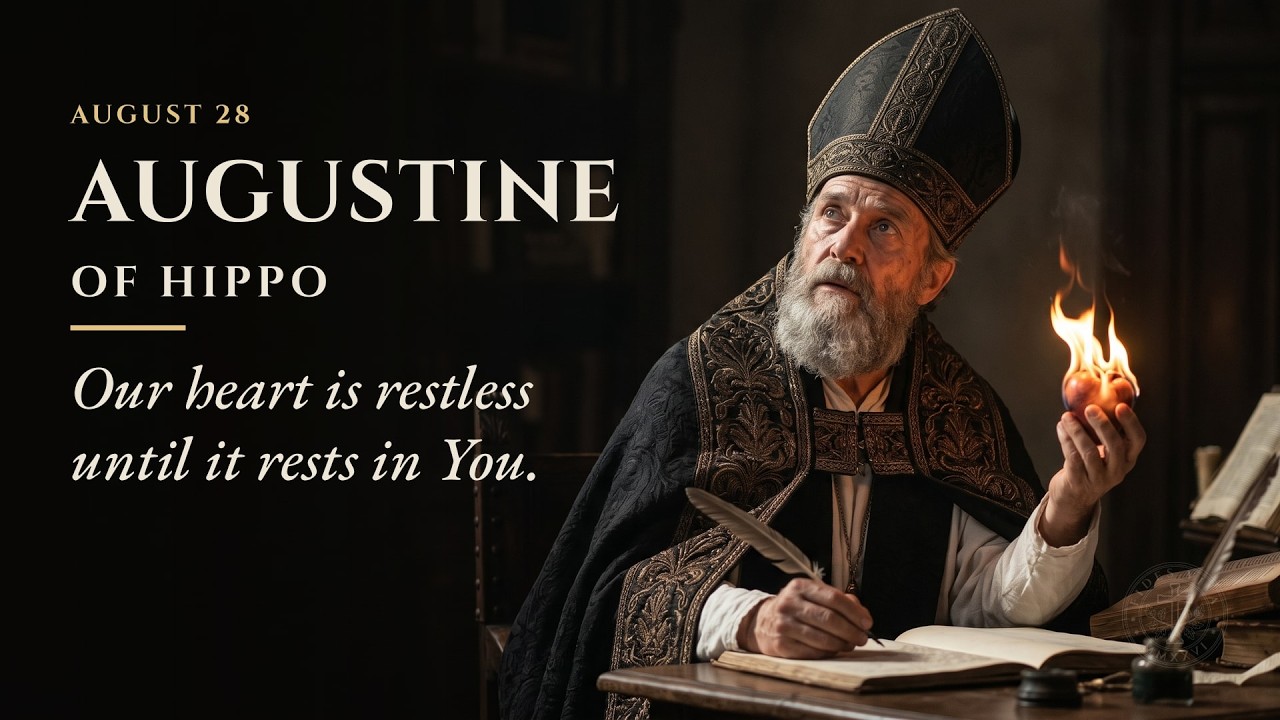
Around the year 397, little more than forty years old and his episcopal consecration still fresh, he began a book unlike anything being written then. It was not a treatise or a defense: it was a prayer of hundreds of pages, addressed to God from beginning to end, where a bishop in office recounted his own sins knowing that half of Africa would read it. The pears stolen in Tagaste, the Manichaean years, the lie at the harbor, the woman without a name, the weeping under the fig tree: he set it all down, hiding nothing and putting on no show. He called them the Confessions, because he confessed at once his own misery and the mercy received. And on the first page he left the sentence that summed his whole life and that he had carried within long before he knew how to write it: "You made us for yourself, Lord, and our heart is restless until it rests in you."
Few men of his time had laid themselves bare like that in public. Bishops wrote to teach or to conquer; he wrote to give thanks, and in doing so taught more than anyone. Whoever read those pages found not a saint of marble, but a man who had delayed, doubted, and fled—and who for that very reason could speak of grace with authority, because he had needed it all his life.
Writing was night work, because the day was not his own. He preached almost daily, sometimes twice, with a voice worn from so many years of speaking. Beside the apse, some stenographers took down his words as he spoke, and thanks to those quick hands hundreds of his sermons are preserved today just as they left his mouth, with the interruptions and the applause of the people. From one of them, preaching on the First Letter of John, leapt the boldest and most quoted line of his preaching: "Love, and do what you will." It was not a license: it was the confidence that whoever truly loves no longer wants to do harm. Between sermon and sermon he was slowly writing, over twenty years, the deepest treatise of his life: De Trinitate, fifteen books on the mystery of a God who is one and is three, built stone by stone between 399 and 419.
And there were the lawsuits. Roman law allowed civil disputes to be brought to the bishop's tribunal, and the people of Hippo did so without rest: inheritances, boundaries, debts, broken marriages. He spent whole mornings listening to neighbors at odds, seeking justice case by case. The task weighed on him—he confessed as much to his own people more than once—but he never let it go: that too was tending the flock. At table, the rule was the same sobriety as always: vegetables, a little meat only for guests, and carved on the wood a verse that all could read: whoever loves to slander the absent should know this table is not for them. In that house no one spoke ill of anyone. Nor did any woman live there, not even his widowed sister: the bishop would not have the least shadow touch his clergy.
In the year 410, news crossed the sea like a tremor: Rome had fallen. Alaric and his Goths sacked for several days a city that had not seen an enemy within its walls in eight centuries. To the ports of Africa came shattered refugees, senators ruined, entire families with what they carried. And with them came the accusation: the pagans said Rome had fallen by abandoning its gods, that the fault lay with Christ and his own. The question demanded an answer equal to it, and Augustine took thirteen years to give it in full: twenty-two books, written between 413 and 426, which he titled The City of God. His heart fits in a single sentence: "Two loves built two cities: love of self even to contempt of God built the earthly; and love of God even to contempt of self built the heavenly." Rome was not eternal; no imperial stone is. But within history, woven through it, journeys as a pilgrim another city that cannot be sacked.
One last gesture remained for him as a writer, and it was the humblest. Between 426 and 427, past seventy now, he reread one by one all his works—dozens of books, a whole life of ink—and published the Retractationes: a catalog of his own errors, corrected by his own hand. The master of the West ended his work amending himself in public, like an honest student.
Thus he held up his people while the world cracked around them: with the word spoken each morning, patient justice, a table clean of poison, and the pen burning until dawn. But that mind, the keenest of his century, knew one thing that he repeated without tiring: there was a limit where thought must kneel. And the devotion of centuries to come would guard, beside the sea of Hippo, a scene that says it better than any treatise.
The Shell and the Mystery: Beyond Reason
The scene is not in any of his letters or his sermons. It was born centuries later, in the devotion of simple people, and perhaps for that reason it says, better than many treatises, what he himself taught about the limits of reason.
He walked along the beach near Hippo, turning over in his mind the mystery he had spent years and years writing about: how the God that Jesus Christ revealed could be one alone and be three at once. He moved slowly, his feet in the wet sand, when he saw a child kneeling by the shore. The child had dug a hole in the sand and, with a shell, went back and forth from the sea, pouring water into the hole, one trip after another, with all the seriousness in the world.
He stopped and asked what he was doing. The child said he was emptying the sea into that hole. Augustine smiled: that is impossible; the whole sea cannot fit in a hole in the sand. Then the child looked up. "Even more impossible," he said, "is locking the mystery of God inside your mind." And he vanished.
He stood alone facing the water, with the hole at his feet and the sea to the horizon.
Legend, yes. But a legend that understood him well. He who had raised his whole treatise on the Trinity closed it knowing that no page exhausts God, that the mind, when it is honest, does not end in conquest but in wonder. And that was not defeat: it was rest. There are truths that are not possessed; they are adored. That trust—the trust of one who knows himself to be small before what he loves—would soon be needed. Because while the old man corrected his last pages, on the other side of the sea an army was already on the march.
The Siege and the Psalms: Fidelity to the End
In the year 429 the threat took a name. Genseric, king of the Vandals, crossed from Hispania into Africa with his entire people: warriors, women, children, carts, livestock. He advanced eastward laying waste the provinces that for centuries had sent grain and oil to Rome. They were Arians: they denied that Jesus Christ was true God, and they treated the Catholic churches as enemies. In their wake, basilicas burned and communities scattered; bishops fell or fled.
Those who managed to escape ran toward Hippo. Along the roads of Numidia columns of smoke rose into the sky, and the routes filled with carts, dust, and fear. The walled city by the sea swelled with refugees: bishops without sees, priests without altars, entire families with only what they carried. The old man received them all. He opened the episcopal house, shared the frugal table as always, and some of those exiled bishops stayed at his side until the end. To those who asked him between tears what to ask God in the face of such ruin, he answered what he himself asked: at least the strength to bear it.
That year of 430 the Vandals pitched their camp before the walls. Hippo would hold out for about fourteen months; its bishop would not see the end. In the third month of the siege he fell with fever, and understood that this bed was his last. Then he asked for something no one expected of the master of the West.
He had the penitential psalms copied, the psalms of repentance, the ones the Church has prayed since ancient times when a believer asks forgiveness. He ordered them fixed to the wall facing his bed, at the height of his eyes, so he could read them without having to hold a book his arms could no longer carry. Words a thousand years old, where a guilty king begs mercy, begs to be washed, begs for a new heart. And he read them. He read them weeping, without rest, day after day, as though he had just been converted.
He used to tell his people a conviction he now kept to the letter: "However praised his life may have been, a Christian should not die without doing penance." He had spent forty years teaching that grace precedes all things, that no one saves himself by his own merit. Now he taught it one last time, without pen and without a chair: the Doctor of Grace died asking Christ's forgiveness like a beginner.
Twenty years before, when Rome fell, he had answered the catastrophe with twenty-two books. Now the catastrophe camped beneath his window, and he did not answer with arguments. He answered with tears, which was his oldest tongue.
He asked also that no one enter the room except the physicians and whoever brought him food. It was not a rejection of those who loved him. It was a greed of another kind: he did not want to lose even an hour of the time left to him for prayer. Outside, the dull sound of the siege, voices on the walls; inside, a lamp burning, pages on the wall, and an old man alone with God.
It is said that in those days someone brought him a sick man, and the man begged him to lay hands on him to heal. He answered, with the mild irony he had always kept, that if he had such power he would have used it on himself already. But the sick man pressed, the bishop gave way, stretched his trembling hands over him, and the man rose healed.
On August 28 of the year 430, while his monks and his clergy prayed around the bed, he died. He was seventy-six years old. He kept until the last moment his sight, his hearing, and his mind entire: he entered death with his eyes open, as he had lived. The restlessness that had followed him since Tagaste came at last to its rest.
He left no will. Not from neglect: the poor of Christ had nothing to leave in one. No lands, no money, no house of his own. He left to the Church three inheritances: his clergy, formed over nearly forty years in the common life; a short rule for life in community — the oldest in the West still in use: Augustinians, Dominicans, Premonstratensians and countless communities live under it to this day —; and his library. Hundreds of codices: the Confessions, the twenty-two books of The City of God, the fifteen on the Trinity. Also the sermons the stenographers had caught on the wing, and the letters that had crossed the sea in all directions. A century later, Isidore of Seville measured that ocean in a single sentence: whoever claims to have read all of him is lying.
Not long after his death, Hippo fell. The Vandals entered, and there was fire in the city. The memory of that church kept hold of a detail that sounds like a parable: that the flames did not touch the library, and that the codices were saved.
A warrior king took the city, and of his kingdom barely the name remains today. An old man died in it without possessing anything, and his word has burned bright for nearly sixteen hundred years. That is what a man leaves when he dies poor: everything that cannot be sacked. His body was buried in the broken city, but it was not going to stay there. For his bones, as for his heart, rest too would be a long journey.
The Journey of Memory: Relics, Devotion, and Echo in the Present
The journey began at sea. The African Church kept the memory of bishops driven into exile by those same Arian Vandals who had besieged Hippo: as they departed, as that memory has it, they carried with them the body of their master, so it would not remain in hostile ground. They placed it in Cagliari, on the island of Sardinia. There it rested for centuries, while the ancient world finished fading away.
Around the year 720, as Pavia remembers it, a king crossed paths with the dead man's destiny. Liutprand, king of the Lombards, paid for those relics and carried them north to Italy: to the basilica of San Pietro in Ciel d'Oro, Saint Peter in the Golden Sky. They remain there still. The African who had come home never to leave it again has rested for thirteen hundred years beneath Lombard brick.
In 1298 the Church proclaimed him a Doctor of the Church, master of all, alongside three other Latin masters. Gregory the Great, who would be born a century after his death; Jerome, with whom he exchanged sharp letters and then fraternal ones; and Ambrose, the bishop who had baptized him one Easter night.
In October of 1695, workers laboring in the basilica came upon a marble box holding human bones, and among them part of a skull. Was it him? Pavia remembers that two religious communities argued for years over the authenticity of the find, until the pope commissioned the judgment from the bishop of the city. Since 1739, the Gothic Ark has stood above an altar brought from Rome.
And his land reclaimed him. At some point in the nineteenth century, tradition says that a relic of his arm returned to Africa. In 1881 a basilica of pale stone was raised on the hill of Annaba, the ancient Hippo, looking out at the sea and the ruins. Pope Benedict XVI made pilgrimage to the Ark of Pavia in 2007; sixteen years later, in 2023, the city celebrated thirteen hundred years of the arrival of the relics and displayed the remains for the veneration of the people.
The echo reaches us today. On May 8, 2025, an Augustinian friar was elected pope, Robert Francis Prevost: Leo XIV, the first Augustinian pope in history, the first of Augustine's Order to hold the seat of Peter. Eleven months later he walked beneath torrential rain among the truncated columns of Hippo. He prayed in silence where his spiritual father—as he called him—had preached and died, and he repeated before the faithful a phrase of the master: peace is the end of our good. In June he visited Pavia, stood before the Ark, and left word that sounded like a tender warning: Augustine is not ours; he belongs to the Church.
Pilgrims from many lands still arrive at those two shores: at the marble of Pavia, at the hill of Annaba. They come to see the bones of a man who died without possessing anything, and they remain in silence longer than they expected. Perhaps because what he knew how to name has not stopped aching: sixteen centuries later, the heart is still restless, and still seeking where to find its rest.
Reflection: Restlessness and Rest
The question hung open in the small hours, before sheets of parchment pinned to a wall: what does a heart seek that will not settle, even when it has found everything? His entire life was the answer. He sought it in the applause of Carthage, in a religion that promised reason without faith, in a teaching post beside imperial power. And what he found at the end of the road was not an idea. It was Someone. It was Christ.
And finding was not arriving. It was learning to walk a different way. Thirty-five years serving a city he had not chosen; one book after another; the disputes of others each morning; the refugees of a crumbling empire; and at last, penitential psalms read through tears. One of his laments holds his whole life entire: "Late have I loved you, beauty so ancient and so new, late have I loved you." Late, but not too late. The restlessness was never his sickness. It was his compass: the sign that he was made for something greater than all he kept finding.
We know that ache too. It appears on an ordinary morning, when everything is in order and yet something is missing; in the work that comes undone from one day to the next; in the message we have been putting off for weeks. If so many things promise to fill that hollow and none of them does, toward what are we walking with it?
Augustine walked with his until his last day. He did not hide it or lull it to sleep: he turned it into prayer. His answer was not a theory but a life—that of a man who wanted a hidden monastery and received an entire people instead, and who stayed at his post while everything fell away. To his own he left a way of walking that is still repeated: sing and keep moving.
At the beginning of his Confessions stands the sentence that would echo afterward in so many tongues: "You made us for yourself, Lord, and our heart is restless until it rests in you." He spoke it as a man who had tried everything, and who only stopped seeking when he let himself be found. His heart, at last, rests.
Saint Augustine, Doctor of Grace, father of the Latin Church, shepherd of the restless, pray for us.