An old man holds a newborn in his arms. His hands tremble, and yet he lifts him up like someone raising something he has waited for all his life. Beside him, a slight young woman, her veil drawn low over her brows, looks at the child and not at the old man. Then he lowers his gaze toward her.
And he tells her of a sword.
Not a crown. Not a throne for her son. A sword that will pierce her soul.
It has been only a few weeks since she gave birth. She has come to fulfill what the Law requires, with the offering of those who cannot afford a lamb. No one knows her among the pilgrims: she is a peasant from a village that does not appear on any map of the empire.
She does not answer. She does not ask what it means. She takes the child, keeps the words inside, and returns home with them.
That sword will come again. In a flight by night, with the child tied to her chest. In three days of searching for him through a city in celebration. On a hill outside the walls, and in a tomb that is not hers. Seven times. And each time she will do what she does now: she will not leave.
What does a mother do when she is told, while her son is still in swaddling clothes, that her whole life will be pierced by a wound she did not choose?
The World and the Girl of Nazareth
It is early, and the millstone is already turning. A girl pushes it with both hands in the courtyard of a house of dark stone and whitewashed adobe, and the smell of ground wheat mixes with smoke from a clay oven. Around it stood a few dozen houses pressed together on the slope, with terraces of olive and fig trees and cisterns cut into the rock. This is Nazareth, in Galilee: a small village, of no importance to anyone beyond it.
Beyond the hills, the world belongs to Rome. In Jerusalem, King Herod raises a Temple of golden stone that leaves pilgrims breathless, and he rules by the grace of the emperor and by force of spies. Along the roads pass tax collectors and soldiers. Beside the highways, now and then, a post with a man nailed to it: that is how Rome punishes slaves and rebels. Galilee is the land of farmers who pay the king, the Temple, and Caesar, and who wait in silence for God to remember his people.
The girl at the mill is called Miriam; Mary, as the world will learn to say it. An ancient account, written long afterward, recalls her as the daughter of Joachim and Anne, born some twenty, or perhaps sixteen, years before Christ. The place does not agree: some place her birth here, in Nazareth; others in Jerusalem, by the pool where the sick waited. Nothing was written about her face; what we know is what the women of her land looked like. A young woman of olive skin, tanned by the sun; hair almost black, parted in the middle and gathered under her veil; dark eyes that lower when someone speaks to her. She barely reaches five feet. Her hands are small and already hardened: they grind grain, carry water from the well, move the shuttle on the loom of the house. She is promised to a craftsman of the village, a just man and a man of few words called Joseph.
One day like any other in that life, the Gospel of Luke says, an angel came to where she was. There was no thunder, no crowd. There was a greeting, a fear, and a message: she would conceive and bear a son, and she would name him Jesus. She asked what any girl would have asked: "How will this be?" She listened to the answer. And then she spoke six words: "Let it be to me according to your word."
She did not know the price. She said yes to a son, not to suffering, and so her yes was clean, without calculation. What would come was not a bargain signed with eyes open: it was fidelity to a word given when everything was light. Whoever has said yes to someone—to a child, to a house, to a person—without knowing what time would bring, knows something of that morning in Nazareth.
And yet, in the same Gospel, there is already a small shadow. Twice, later on, it will be said of her that she kept all these things in her heart. The joy in that house was real. But it was a joy that was guarded, the way one guards something fragile.
The months passed. Her son was born far away, in Bethlehem in Judea. And when the time came to take him to the Temple, Joseph led the way ahead, Mary wrapped the child in strips of linen, and the three of them climbed toward Jerusalem. At the end of that road an old man was waiting for her.
The Sword Announced: The First Sorrow
The Temple is visible from far away, before the city itself. Walls of stone blocks golden in the sun, so high that a man at their base looks like a child. Porticos of columns, and smoke from sacrifices that rises and hangs over the courtyards. We are, roughly speaking, in the year five before Christ, and the child by whose birth the years would one day be counted is not yet two months old. The time set by the Law has passed: forty days since birth for the mother to present herself, offer her sacrifice, and be purified. And the son, being the firstborn, must be redeemed with five shekels of silver, as every firstborn of Israel.
Joseph carries the coins. Mary carries two turtledoves in a wicker basket, the offering Leviticus permits those who cannot afford a lamb. No one in the Court of the Women turns to look at her: another peasant, with a newborn, among hundreds of pilgrims. She stops, like so many mothers, near the great bronze gate they call the Gate of Nicanor, beyond which women do not pass.
Then someone approaches. An old man of about eighty, bent, his skin olive-pale and wrinkled like parchment, his hair and beard white as ash. He is not a priest. He wears no vestments. The Gospel of Luke calls him simply just, and says that he was waiting for the consolation of Israel: the Spirit had promised him that he would not die before he saw the Anointed of the Lord. His name is Simeon. He has come to the Temple that day because something drew him, and among so many mothers with their children, he sees this one.
He reaches out his arms. She gives him the child.
Simeon lifts him with his gnarled hands and blesses God. He says he can now die in peace, because his eyes have seen what they were waiting for; that this child is a light for the nations and glory for Israel. They are words of song, and they became a hymn: the Church prays them every night, before sleep, in the last office of the day. Joseph and Mary listen and marvel. A stranger is saying of their son what they have kept silent about for months.
Then he stops singing, turns his eyes toward the girl who entrusted him with the child, and speaks to her.
"Behold, this child is set for the fall and rising of many in Israel, and for a sign that is spoken against—and a sword will pierce your own soul too—that thoughts out of many hearts may be revealed."
A sword. Not for the son: for her. The text does not say what expression crossed Mary's face. It does not say she wept, or asked, or held the child closer. She stands there, her hands joined at her chest, and listens to the end. All that is remembered of her in that hour is the silence.
There is a witness. A very small old woman, almost doubled over, in a dark veil: Anna, daughter of Phanuel, an eighty-four-year-old widow, of the tribe of Asher, who never left the Temple and served God with fasting and prayer. She too draws near, and from that day she speaks of the child to all who were waiting for the redemption of Jerusalem. Two old people and a girl, in a corner of the courtyard, while the smoke keeps rising and the sellers of doves keep calling out their prices. The courtyard goes on its way, unaware of what has just been said.
Then ordinary life resumes. The shekels passes into the priest's hands. The doves are offered. They collect the empty basket and the waterskin, and go down the stone steps with the child, Jesus, asleep against the blue mantle. Whoever has been told that sorrow is coming, without knowing when, knows the way one walks down those stairs: the world the same, and oneself already changed.
The sword did not fall that day. It was only announced. And she kept it where she kept everything she did not understand: in her heart, beside the angel's words. From then on, every joy in that house would have a hidden edge.
There were days of calm. Very few. One night, a dream woke Joseph with an order that could not wait until morning.
Exile and Absence: The Following Sorrows
Rise. Take the child and his mother. Flee to Egypt and stay there until further word, because Herod is going to search for the child to kill him. That was all. No deadline, no route marked out, no promise of return.
Joseph does not argue. He wakes Mary in a low voice, and she does not ask either. They gather what little there is: flat bread and dates in a cloth sack, a water jug, the oil lamp of baked clay, which they do not light so no one sees them leave. She wraps a length of cloth across her chest and settles the child inside, against the warmth of her body. She is sixteen, maybe seventeen, and that night she learns what it means to flee in darkness.
Herod the Great rules Judea by grace of Rome, and a rumor about a king born in Bethlehem is enough for him. What came after in the village is still remembered: soldiers, and the boys under two years old. By then, the parents of Jesus will be far away, on the road south.
The road to Egypt cuts through the Negev Desert: days of sand and stone until the first mud-brick villages of the Nile Delta. No one knows how many days it took. They walk before dawn, rest when the sun is high, walk again as the light falls. Dust gets into the eyelashes, into the folds of the mantle, into the wrappings of the child. Her lips crack, her feet turn red, and her arms grow tense from carrying him hour after hour. A child of a few months cannot be left on a donkey.
Today that woman would have a name: refugee. A mother crossing a border at night, her son pressed against her and no destination ahead, because staying means dying. Jesus Christ left his land this way: in arms, against the chest of a girl who did not know if she would come back.
Egypt is a Roman province then. There they could lose themselves in villages of canals and date palms, with mud-brick houses and palm-thatch roofs. Christians of that land marked out centuries later, with shrines, the path they believed the family had taken: a sycamore tree, monasteries in the desert. No one ever told the details, not even how long they stayed in that place. We are told only that they remained until Herod died, around the year four before Christ, and that they went back when another dream opened the door.
Then Nazareth. Whole years of which we know almost nothing, and perhaps for that reason they were good. Water, grain ground, the loom, Joseph's saw in the yard. A son growing. The sword Simeon spoke of seemed to have stayed behind in Jerusalem.
But around the year seven or eight of the Common Era, when Jesus is twelve, the family goes up to the holy city again for Passover, as they do each spring. Jerusalem overflows with pilgrims, lambs bleating through the streets, songs on the Temple steps. When the feast ends, the caravans start back. Galileans travel in groups of relatives and neighbors; boys of twelve drift from one to another. At the end of the first day's journey, Mary and Joseph look for him among their own. He is not there.
They go back to Jerusalem. And they search for three days.
Any mother who lost sight of a child in a marketplace knows that minute: the world shrinks down to fit a face that does not appear. Here it was not a minute. It was three days: walking and rewalking the narrow streets, asking at inns, looking at every boy's back among the caravans scattering in all directions. She is nearly twenty-eight now; the first gray hairs have begun to show at her temples, and her voice grows hoarse from calling.
On the third day they find him in the Temple. Sitting among the teachers of the Law, listening and asking questions, and the scholars amazed at the answers of this boy from Galilee. He is not lost. He has not wept. He is where he belongs.
Then Mary speaks. It is the only time, through all her sorrows, that her own words are kept:
"Son, why have you treated us so? Behold, your father and I have been looking for you anxiously."
He answers with another question: why were they looking for him, if he had to be about his Father's work. And there remains a sentence that weighs more than the whole scene: they did not understand what he said to them.
They did not understand. Not the mother who had carried him in her arms through the desert, not the man who had protected him from a king. They went down with him to Nazareth, and the son obeyed them in all things, and the text says again of her the same thing it had said after his birth: that his mother kept all these things in her heart.
How can a mother hold what she does not understand? There is no answer written down. We are told only that woman, who falls silent again, and who stays.
More than twenty years pass. The boy becomes a man, leaves the house, and his name begins to spread through Galilee. She goes up to Jerusalem again for Passover. This time she will not have to search for him. The whole city will know where he is.
An old man holds a newborn in his arms. His hands tremble, and yet he lifts him up like someone raising something he has waited for all his life. Beside him, a small girl, her veil drawn low over her eyes, looks at the child and not at the old man. Then he lowers his gaze toward her.
And he announces a sword.
Not a crown. Not a throne for the son. A sword that will pierce her soul.
It has been only a few weeks since she gave birth. She has come to do what the Law requires, with the offering of those who cannot pay for a lamb. No one knows her among the pilgrims: she is a peasant from a village that does not appear on the maps of the empire.
She does not answer. She does not ask what it means. She takes the child, keeps the words inside, and goes home with them.
That sword will return. In a flight in the night, with the child tied to her chest. In three days of searching for him in a city full of celebration. On a hill outside the wall, and in a tomb that is not hers. Seven times. And each time she will do the same thing she does today: she will not leave.
What does a mother do when she is told, with her child still in swaddling clothes, that her whole life will be pierced by a wound she did not choose?
The Way to Calvary: Sorrow Without Words
It is the morning of a Friday of Passover, around the year thirty. Down the narrow streets of Jerusalem comes a procession of soldiers and shouts, and in the middle walk three condemned men; one of them carries the crossbeam of his cross. The whole city is talking about it: the Master from Galilee has been brought before Pontius Pilate, and Pilate has handed him over to crucifixion, the death Rome reserved for slaves and rebels.
Among the women who follow the rope binding the prisoners walks one of about fifty years, small, with her veil pulled tight and gray showing in her hair at the temples. Joseph is no longer at her side. She moves forward with her hands pressed against her chest, those small hands that once carried a child through the desert and that today have nothing to carry.
No gospel tells us that mother and son met on that road. But the Church, praying through the Passion step by step across the centuries, could not help but see them, and fixed the meeting forever in the fourth station of the Way of the Cross. So the memory of the faithful kept it: in a narrow street the procession stops for a moment, perhaps because the condemned man falls, and she manages to push through to the front row.
And he looks at her.
His back is open from the whips, his right eye swollen, blood clots on his forehead beneath the crown of thorns, his shoulder raw where the wood has pressed. It is the same face she searched for three days among the caravans. Now there is no question. There is not a single word. A son sees his mother, and keeps walking. And the mother turns to follow.
Outside the wall, in an abandoned quarry with openings carved into the rock, stands Golgotha. There they nail him. The soldiers divide his clothes by casting lots, and above his head hangs the placard with the charge against him. The gospels do not linger on the sound of the hammers. But the Gospel of John, instead, lingers on who was there and where:
"But standing by the cross of Jesus were his mother, and his mother's sister, Mary the wife of Clopas, and Mary Magdalene."
Standing. It is the verb of presence, upright; in the Latin that the Church would pray afterward, stabat. All around, everything collapses. The disciples have fled, Peter denied him before dawn, the crowd that shouted Hosanna five days ago now mocks him, and toward midday the light goes out over the city. The verbs of the Passion are verbs of falling, flight, abandonment. One alone remains still: they stood.
Nothing in the text says she cried out. Nothing says she fainted, as some would paint her centuries later. She is upright, in sight of her son, in the dark mantle of women in mourning and the dry wind from the south striking her veil. Mary Magdalene, whom art would always paint weeping with her hair loose at the foot of the cross. The Mother does not. Beside her, John, the youngest disciple, takes her by the elbow. She does not lean on him.
Compassion means, in its root, to suffer with. It is not to look at another's pain from the outside, and it is not to take it away, because that is not always possible. It is to not leave the place where it hurts. None of the women under that cross could do anything: neither lower him, nor give him water, nor turn away the soldiers. They could stay. And they stayed.
There are people who have stood that way: in a hallway, beside a bed, knowing their own hands no longer help and that leaving would be worse. That standing does not heal anything. But the one who suffers stops suffering alone.
From the cross, Jesus sees her. And he speaks to her. He does not call her mother: he calls her woman, as he had called her at the wedding in Cana, the day of the first sign, when she spoke the last words of hers that the gospels keep: "Do whatever he tells you." Here she says nothing. He speaks.
"Woman, behold, your son!" And to the disciple: "Behold, your mother!"
And from that hour the disciple took her to his own home.
In the worst hour of her life she does not receive comfort. She receives a charge. Another son, whom she did not bear. And behind that disciple, all who will come: the Church has read in those two sentences the birth of a motherhood wider than Nazareth. Her sorrow stops being private at the moment it becomes unbearable. And she accepts, as she accepted everything else: without a word.
The sword Simeon announced has arrived. More than thirty years after the announcement in the courtyard, it pierces a soul and not a body. No wound of her own bleeds on Golgotha, and for that reason Christians called her Queen of Martyrs, a martyr without dying. The only blood that splashes her is that of Jesus Christ.
Toward three in the afternoon, he bows his head and gives up his spirit. Nothing in the account says she moved. The afternoon advances, the city begins to prepare for the Sabbath, and at the foot of three beams a woman remains upright before a body that no longer breathes.
How does one stay on one's feet when everything around falls? And what can be born in a heart that is pierced? Golgotha does not answer. It only shows the Mother standing, with a new son at her side and the other hanging from the cross. That body still has to be taken down before nightfall. And taking it down will not be the end of the sorrow.
The Pietà and Solitude: Grief Without Answers
A rich man dares, that afternoon, to do what his own fear had prevented him from doing until then. His name is Joseph of Arimathea; he sits on the Sanhedrin and has been a secret disciple. That afternoon he goes to see Pilate and asks for the body of Jesus. Pilate grants it. With him comes Nicodemus, the Pharisee who had gone to hear the teacher one night in darkness. He brings a mixture of myrrh and aloe, a hundred pounds, as for the burial of a king. And a new linen sheet, folded over his arm.
They lean a ladder against the wood. They pull out the nails. The body, with nothing to hold it taut anymore, sags into the arms waiting for it. This is the hour when the light turns golden and falls level across the quarry, while the city behind them rushes to close its gates before the Sabbath.
The gospels say this: that Joseph of Arimathea took down the body. It was the prayer of the centuries that placed it afterward in the lap of the Mother. In the fourteenth century, German carvers began to sculpt her sitting with the dead son across her knees, so that people could pray before her as evening fell. By the end of the fifteenth century, Michelangelo, in his twenties, carved her in marble from Carrara for a basilica in Rome. The Gospel does not tell it that way. Yet no one could help but see it. And in that image the whole world recognized itself.
This is how the memory of the faithful preserved it. Sitting on the floor of the quarry, her back bent under a weight that no longer helps. In her lap, his head, with the mark of the thorns on his forehead; the crown itself, set aside on the stones. Her small, worn hands trace the wounds as they once searched for a child's fever, and they are stained. Clotted blood in her lap, on the front of her mantle, under her fingernails. And she carries it like the only thing that remains.
Her veil has fallen back and no one holds it up. Her hairline is visible: gray strands and a few loose locks the south wind presses against her face. She does not gather them. Her cheeks are furrowed with tears that have already dried, and her gaze does not turn from the face she holds. She does not cry out. She does not move. She holds.
More than thirty years before, in the courtyard of the Temple, these same hands had given an old man a newborn wrapped in cloth. Now they receive back what they then gave, and wrap it again in linen.
The sun drops fast. At dusk the Sabbath begins, and the Law does not permit leaving a body without burial: there is an hour, perhaps less. Joseph and Nicodemus wrap the body in the sheet with the spices, tie the strips, and there is no time for more. The washing, the anointing done with care, remain unfinished. The women tell themselves they will come back after the Sabbath, with what is left to do.
Nearby there is a garden, and in it a new tomb carved into the rock, where no one had ever been laid. It is Joseph's: a tomb of his own, unused, and he gives it. Even the tomb, that man had only on loan.
They carry it between them down the path, among young olive trees, and they lay it on the stone shelf. The Gospel of Mark notes a detail that seems small: Mary Magdalene and the other Mary were watching where he was laid. They were watching. As mothers watch the exact place, so they can come back.
Then, the stone. A round slab, heavy, that rolls along its groove with a sound of rock against rock and fits into the mouth of the tomb. That sound is the last sound of Friday. After that, nothing.
And they have to go back.
This is the seventh sorrow, and it is the quietest of all. There are no nails, no soldiers, no crowd. There is a path back toward the city, already dark, with clothes stained and hands empty. On Friday she had a body to hold. On Saturday she has nothing.
The Gospels say nothing of that night: neither where she spent it nor with whom. John had taken her into his home from that hour, and it is to be supposed that is where she went. But the text is silent, and that silence is the truest portrait of the Mother on Saturday: a woman sitting in a borrowed house, in the same city where she lost her son three days when he was twelve years old, and where now she has lost him altogether. The sword that an old man announced to her has entered all the way through. And she remains there. She does not go back to Nazareth. She does not curse. She keeps, as she always kept, what she does not understand.
What remains when there is nothing left to hold? The Saturday of Jerusalem does not answer. It only leaves a mother awake in the dark, with her hands stained by the blood of her Son, without having gone away.
That solitude, which she lived without witnesses, did not stay locked in that house. With the centuries, others would begin to remember it, to sing it in the streets, to dress themselves in her mourning like a sign. But that night still, no one knows it. That night, in a sleeping city, there is only a woman who has buried her son and remains.
Grief Becomes Song: The Planctus and Stabat Mater
More than a thousand years later, in the twelfth century, a monk in a white habit lifts his eyes toward the crucifix in the choir of a gray stone abbey, in Cistercian Burgundy. The Christ he looks at begins to stop being the serene king of the ancient mosaics: the arms give way, the body grows heavy, death shows in the flesh. From the end of the eleventh century on, Western prayer had begun to dwell on the suffering humanity of Jesus. And anyone who lingers over the Crucified eventually sees, at his side, the woman who stood beside him.
So the Planctus Mariae were born—the laments of Mary: poems that put into her mouth what she never said aloud, so that people could weep with her. They were sung in Holy Week, first in the abbeys and then in the squares, in Latin and afterward in the local tongue. The silent Mother of the Gospel was becoming a voice.
In the thirteenth century, in Italy, that lament found its defining form. Someone wrote a succession of short, rhymed stanzas, simple enough to learn by ear. The authorship remains in doubt. The most widespread tradition attributes it to Jacopone da Todi, a notary of Umbria who, when widowed, became a Franciscan friar and walked the roads barefoot, singing poems of penance. Others have attributed it to a pope, Innocent III, or to Saint Bonaventure. The oldest copy with music that survives was written by Dominican nuns of Bologna in their songbook. The beginning, though, no one forgets.
Stabat Mater dolorosa, iuxta crucem lacrimosa, dum pendebat Filius. The sorrowful Mother stood weeping beside the cross, while her Son hung from it.
The hymn opens with the same verb by which John saw her: stood. And all that follows is a plea to remain with her there, to make her pain their own, and to let the wounds of Christ be written on the heart of whoever sings.
Then the song left the books. In 1388, through the streets of Genoa, the processions of penitents sang it: men barefoot, their tunics open down the back, who walked the streets asking forgiveness for the sins of all. By 1399 it was already heard in Provence. They were not bishops or masters of theology. They were weavers, farmworkers, people who had seen plague and war up close, and who found in that melody a way to say what had no words. Before it entered any missal, this grief was for centuries a song of the poor in the streets.
So the mourning of a single mother became the song of many. She lived it without witnesses, in a borrowed house in Jerusalem; now thousands of voices sang it by candlelight, behind an image of hers carried on a litter. That is what they asked of her, exactly that: not that she take away the pain, but that she let them weep at her side.
But a song fades when the procession ends. There were those who wanted to keep that mourning from ever fading: to make of it an entire life, and afterward, a day of the year.
Dressing in Black: The Servants of Mary
In 1233, a century and a half before those processions, seven businessmen closed their shops in Florence. They were merchants of comfortable means in a city growing rich at full speed, and they belonged to the Laudesi, a lay confraternity that gathered at day's end to sing praises to the Virgin. That year they decided that singing was not enough. They divided their wealth among the poor, left their houses, and withdrew together to a property in the countryside, Villa Camarzia, to live in prayer and labor. The memory of the Order dates their departure to the fifteenth of August, the Feast of the Assumption.
Florence understood nothing, and yet it gave them a name. When they came down to the city to beg alms, children pointed them out on the street: the Servants of Mary. And that was the name they kept.
The city was too close. In 1234 the bishop of Florence, Ardingo, gave them land on Monte Senario, a summit of firs and chestnuts some eighteen kilometers away. There the mist lingers in the mornings. They built separate cells of stone among the forest and a chapel in the middle. There they fasted, kept silence, prayed through the night. And there they chose the center of their life: not a work or a trade, but a sorrow. The sorrow of the Mother beside the cross. They would preach the sorrows of the Passion of Christ and the sorrows of Mary, and nothing else. In 1239 the papal legate, Cardinal Goffredo Castiglioni, gave them a written rule—the Rule of Saint Augustine—so that their life would have a recognized form within the Church.
The Servants of Mary tell how the Virgin herself appeared to them on the summit on April thirteenth, 1240, and gave them the habit they would wear from then on: all in black—tunic, scapular, and cape—the color of her mourning. To dress that way was to say, without opening your mouth, that they had chosen to stand where she stood. Nearly eight hundred years later they still wear it.
From that summit came also a prayer still said on black beads: the Crown of the Seven Sorrows. Seven sets of seven Hail Marys, one for each sorrow, from the sword of Simeon to the stone of the tomb, and at the end three more in honor of the tears of the Mother. With it, the count of the sorrows, which until then had been the meditation of monks, passed into the hands of the people.
The seven grew old on the mountain. In 1304 Pope Benedict XI confirmed the Order, which Innocent IV had already approved. Six of them were ordained priests; the seventh, Alexis Falconieri, chose to be a lay brother his whole life, and was the last to die, in 1310, past a hundred years old. In 1317 a friar of the Order set down in writing the memory of those beginnings: the property, the mist, the appearance. It was nearly a century after the events, when none of the seven lived to correct it.
In 1888 Pope Leo XIII canonized all seven together, in a single act, as they had lived. And at Monte Senario they, too, rest together in a single tomb, in the church on that same summit they once climbed. Seven men who had competed in the markets of Florence ended up bound by the sorrow of a woman whom none of them ever saw: a wound of twelve hundred years before was enough to make of them a single family.
What began on a Tuscan summit did not stay in the forest. For that mourning to belong to all, it still had to enter the books of the Church.
From Mourning to Feast: The Sorrowful Mother in the Calendar
A notary dips his pen in ink in a stone hall on the banks of the Rhine. It is the spring of 1423, and outside, Cologne Cathedral still stands unfinished, with wooden scaffolding climbing higher than the walls. In the chapter room, on long benches of oak, sit bishops and clergy from across the entire ecclesiastical province. The archbishop is Dietrich von Moers, a Rhinelander with a square jaw who has led this Church for nearly ten years. Among the business of the day is one that few would have expected to hear at a synod: the sorrow of a mother.
The reason was an offense. In those years, mockery ran through the Rhineland against images of the Sorrowful Mother: the woman in dark mantle and heart pierced served as a target for the jeers of some. The fathers of the council decided to answer not with punishment, but with a feast. On the twenty-second of April, 1423, they instituted for the entire province a commemoration of the anguish and sorrow of the Blessed Virgin Mary. A reparation: where some had laughed, an entire province would now pray.
For the first time, that grief of nearly fourteen hundred years before had a date, its own prayers, and a page in the liturgical books. What the penitents sang on the roads and the friars meditated on their mountain, was now required by decree.
From Cologne the feast spread slowly, diocese by diocese, under different names from place to place. In 1482 it entered a missal under a title that said more than any other: Our Lady of Compassion. Compassion, in the most literal sense of the word: to suffer with. They named her not for what she had done, but for having remained.
The Servants of Mary, meanwhile, kept their own date: the Seven Sorrows in September, recognized by Rome in 1668. There were two memorials of the same sorrow, and over time one became tied to Lent—the Friday of Sorrows, the eve of Palm Sunday—and the other to the end of summer. For centuries they coexisted without troubling each other.
In 1727 Pope Benedict XIII took the greater step. The feast of the Sorrowful Mother, until then a matter of regions and orders, became mandated for the entire Church. And with it entered the Missal the song that, three centuries before, the penitents had carried through the streets of Genoa: the Stabat Mater. It became a sequence, the hymn sung at Mass before the acclamation of the Gospel. The Roman liturgy preserves today only four sequences in the whole year, and one is the song of the Mother standing beside the cross. A poem from the thirteenth century, sung by barefoot people, ended up beside the altar, at the side of the Word of God.
Then came a pope who knew sorrow from close at hand. Pius VII had spent years a prisoner of Napoleon, far from Rome. He returned to the city in 1814, at seventy-two years old and with his body already bowed. And that same year he extended to all Christendom the feast of September, the Servants of Mary's feast. An old man coming back from captivity gave the whole Church the memory of a mother who had come home without her son.
It remained to fix the day. In 1913 Saint Pius X set it on the fifteenth of September. And in 1969 the reform of the calendar, to avoid celebrating the same thing twice, suppressed the feast of the Friday of Sorrows and left a single memorial in the year.
The date is not by chance. On the fourteenth of September the Church celebrates the Exaltation of the Holy Cross: the cross of Jesus Christ lifted up over the world and venerated. And the next day, it celebrates the one who stood beside it. First the Cross. Then the heart pierced. The calendar preaches what the Gospel of John said in a single line: that beside the cross of Jesus stood his mother. No one separates the two feasts, because no one could separate the Mother from the Cross then.
Each fifteenth of September, in cathedrals and in neighborhood chapels, someone sings again that the Mother stood. Those who have buried a son sing it, and those who have lost nothing yet. Six hundred years of decrees are not enough to explain that constancy. Why does the whole world keep returning to this woman precisely in sorrow, and not in glory?
The feast now belonged to all. But a day on the calendar does not contain a grief. Long before Rome's decrees, the Sorrowful Mother had crossed the ocean on ships, and was entering the everyday life of entire peoples.
Pain and Comfort: The Mother on the Roads of the World
A dining hall in Quito, on the twentieth of April, 1906. The boarders are at table: earthenware plates, the murmur of boys tired after a day of classes. The Jesuits of Colegio San Gabriel have hung on the wall, as in so many houses in the city, a picture of the Sorrowful Mother. Dark mantle, heart pierced, tears. It was part of the wall, like the door or the windows.
In Quito it is still told that that night several students looked up and saw the eyes of that picture move. Eyes that until then had been still on the wall, suddenly turned toward the dining hall. The news left the school and ran through the city, and Church authorities opened an investigation. From that dining hall came a devotion that today runs through all of Ecuador, with its own feast and pilgrimages. It was the mother of Calvary, looking at children as they ate.
This is what the Sorrowful Mother did in the Hispanic world and in the Portuguese-speaking world: she entered homes. In Mexico, on the sixth Friday of Lent, families set up an altar of Sorrows in the living room: sprouted wheat in clay pots, purple tissue paper cut in patterns, bitter oranges, glass spheres that tremble in the light of candles. An entire town in that country bears her name, Dolores. In Natá de los Caballeros, in Panama, and in Brazil, which calls her Nossa Senhora das Dores, sorrow wears the same face.
In Andalusia they wait for her at night. Through the narrow streets of Seville, among penitents with candles, the platform moves forward with its silver poles and curled wax. In Granada, the whole city has as its patroness Our Lady of Anguish. And in the early morning of Holy Saturday comes Our Lady of Solitude: a woman in mourning, with hands clasped, behind an empty cross from which hangs a shroud. The sculptors gave her tears of glass on her cheeks and a lace handkerchief in her hand, the same cloth any neighbor would carry at a wake. No one recognizes her by her glory. They recognize her by her sorrow.
Far from there, in the heart of Europe, an entire people made her their own. On the twenty-second of April, 1927, Pope Pius XI proclaimed Our Lady of the Seven Sorrows patroness of Slovakia. Her sanctuary stands in Šaštín, and on the high altar there is not a Sorrowful Mother standing, but a Pieta: the Mother seated, with the body of Jesus Christ in her lap. Each fifteenth of September the esplanade fills with pilgrims carrying flags and scarves, and the day is a feast throughout the country.
Almost no one has watched a child die. But almost everyone has stood once before a pain they could not prevent. A hospital hallway, a call at three in the morning, a border crossed with a child in arms. Before her come the mothers of the disappeared, those who emigrate, the sick, those who wait for news that does not come. She explains nothing to them. She promises nothing. She stays with them, as she stayed that Friday, and that is enough. No one has ever fully said what so many eyes search for, at that hour of night, in a tear of glass.
While the peoples carried her in procession through their streets, in Rome another task remained open, quieter still. The task was to say in exact words who this mother is for those who believe in her Son, and how far the gift she received at the foot of the cross extends.
A Wound That Does Not Close: The Mother Today
That task began, in a way, at the end. In the Kidron Valley, beside the garden of Gethsemane, a broad flight of stone steps descends toward a crypt in shadow. Below, among dozens of oil lamps hanging from the ceiling, there is a small chamber carved into the rock and, inside it, a burial bench faced with marble. It is empty. Pilgrims touch it with their hands and leave without having seen a body. From ancient times the Church venerated there the tomb of Mary—another old memory, also ancient, places it in Ephesus—and held that this woman did not know the corruption of the grave. On the first of November, nineteen hundred fifty, Pope Pius XII defined it as dogma: Mary was taken up into heaven in body and soul. The mother who left her Son in a tomb not her own did not remain in hers.
Fourteen years later, on the twenty-first of November, nineteen sixty-four, the Second Vatican Council searched for words for what she had lived at the foot of the cross. And it wrote that she stood there "suffered deeply with her only begotten Son and associated herself with His sacrifice in her mother's heart." No verb of collapse this time either. Ten years later, in nineteen seventy-four, Paul VI insisted that this devotion always be guided by the liturgy and the Gospel; and in nineteen eighty-four, writing about the meaning of human suffering, John Paul II looked back at her on Calvary. The pain that is joined to the cross of Christ ceases to be a weight without a name.
On the fourth of November, twenty twenty-five, with the approval of Pope Leo XIV, the Dicastery for the Doctrine of the Faith published a doctrinal note. Its title already says much: Mother of the Faithful People. There it recalls that there is one Redeemer, Jesus Christ, and that the cooperation of his mother is real, but subordinate and received from him. For this reason "the use of the title Co-Redemptrix to define the cooperation of Mary is always inappropriate." Nothing is taken from her. She is given her proper place: beside the cross, not upon it.
That place is what any person occupies today who stays beside a bed unable to do anything. Two thousand years of theology have added no new verb to the Gospel of John. It remains the same as that Friday: they stood. On any night of this century, that verb still suffices.
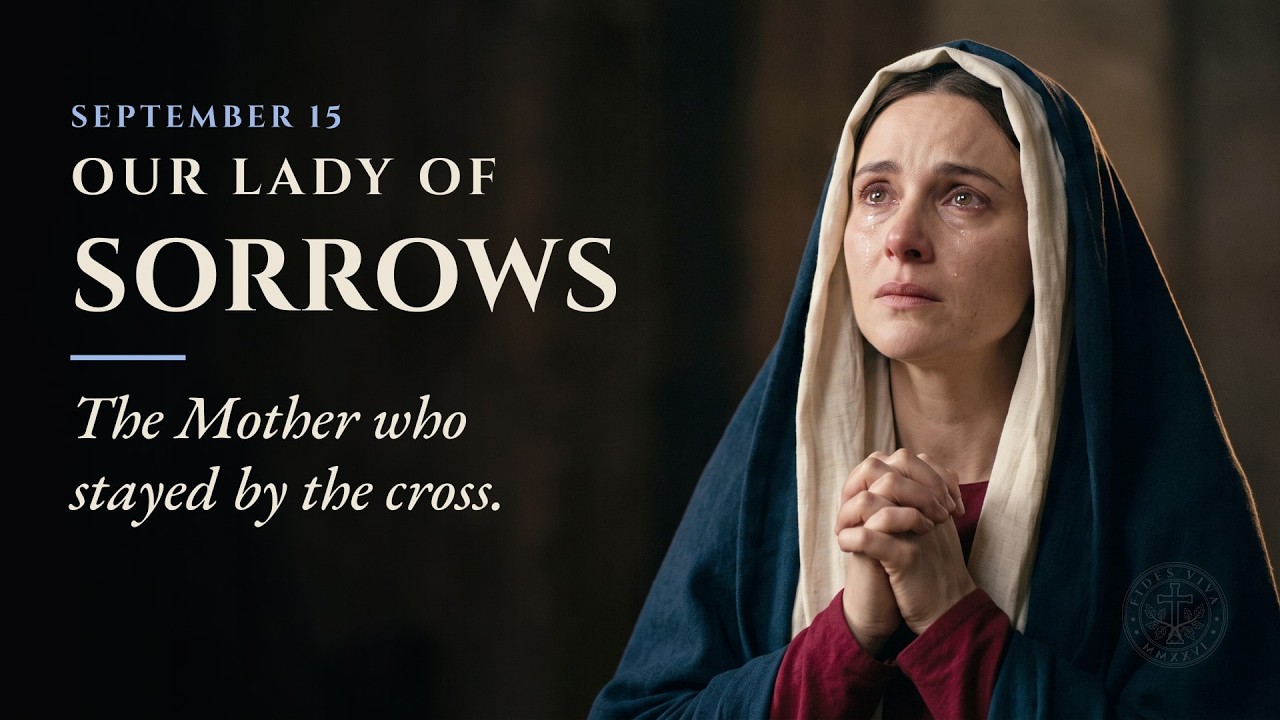
What began with a sword announced in the courtyard of the Temple remains alive in the memory and prayer of those who suffer: they pray to the Mother every September 15, and every night when it is needed.
Contemplate the Wound, Find Companionship
In a church somewhere tonight, a row of candles burns in front of an image dressed in black. It has a single tear stopped on its cheek and a silver sword driven into its chest. No one explains it. Those who approach do not come to understand anything; they come to not be alone.
An old man announced the sword when her Son was forty days old, and she did not ask when or how. She carried the child through the night across the desert. She searched for him three days among the caravans. They nailed Jesus to a wooden beam outside the walls. Almost everyone who had promised to die with him stepped away. She did not move from there. She did not say it—she lived it, standing.
We know that sword too, though it arrives by another name. A phone call at three in the morning. A diagnosis spoken in a hallway. A son who does not come home again. And then the question sits down with whoever hears it: what do we do with the pain of someone we love, when it is not in our power to change it?
She remained beside him, and received there, from the lips of her Son, a new son, and with him all who would come after.
For this reason the oldest image, the one that has come down to us, is not of a mother who has collapsed. It is of a woman standing upright beside the cross of her Son, with her heart pierced and her eyes fixed on him, to the end. What Simeon announced in the Temple was fulfilled in full. And the Mother who did not turn away from Calvary has not turned away, from that hour forward, from anyone who suffers.
Holy Mary, Our Lady of Sorrows, Mother of compassion, comfort of the afflicted, our Mother, pray for us.