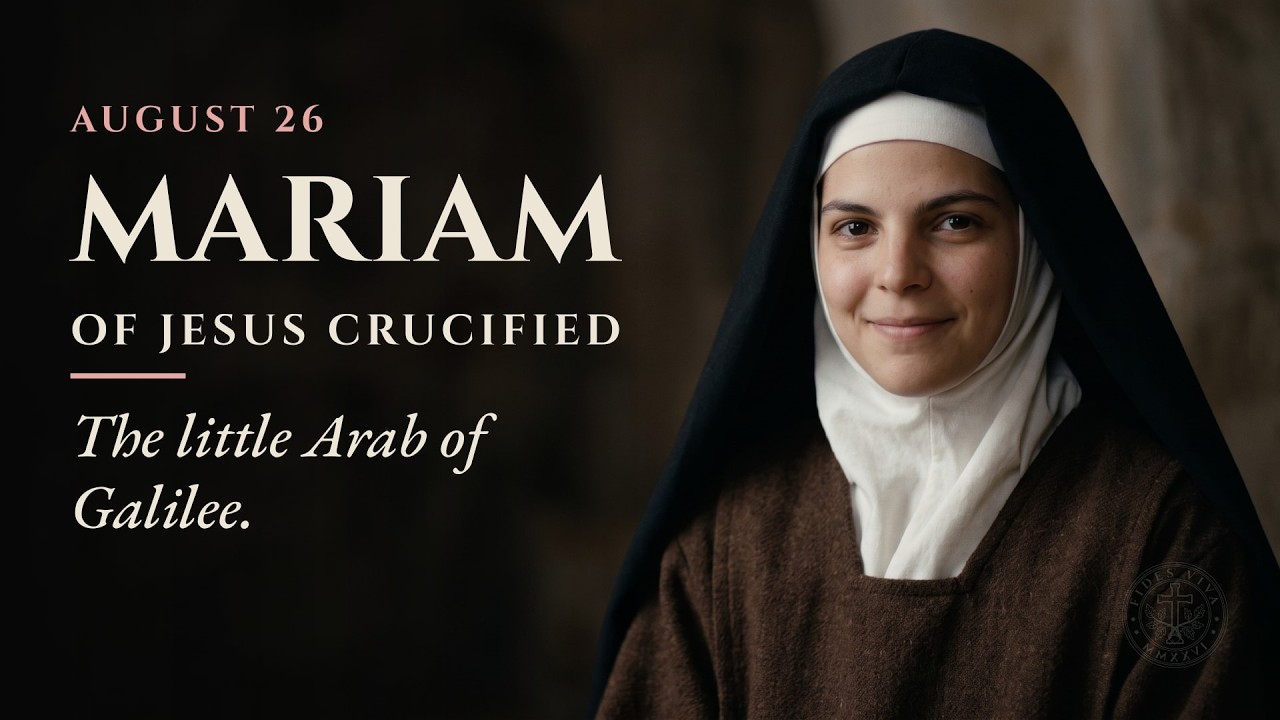
Dawn breaks over a hill of golden stone. Among wooden scaffolding and half-dressed limestone blocks, a small woman in a brown habit and white veil climbs the slope carrying a water jug for the masons. She walks quickly, bent forward, as though she had learned early not to take up space. She bends to pour the water, and her headdress shifts for a moment.
A scar runs across her throat.
Nearly ten centimeters of flesh sealed by a knife. When she speaks, her voice comes out hoarse, veiled, as if filtered through cloth.
It is 1878, and the hill stands in Bethlehem. The building rising around her will become the first Carmel of the Holy Land. The ground plan, the shape of the walls, the place of each door—all of it came from her. And she cannot read or write.
The scar has its own date. A knife opened it when she was thirteen, the night she refused to turn away from Jesus Christ.
Orphaned at three. Raised as a servant in other people's homes. A stranger in Europe. Not a single line written by her own hand. Yet she founded two monasteries: one in India, another in Bethlehem. In 2015, the Church declared her a saint—one of only two modern saints born in the Holy Land.
Her village called her Mariam—Mariam Baouardy; Carmel would come to call her Mary of Jesus Crucified.
Long before that morning, another road brought to Bethlehem a man and a woman with empty hands.
Promised in Bethlehem, Born in Galilee
Along the dusty roads of Ottoman Galilee, in the middle of the nineteenth century, tax collectors and caravans passed. Stone and adobe villages among olive and fig trees; bell towers and minarets beneath the same sky. Arab Christians lived there, tolerated but on the lowest rung: their faith was carried with care, with silences, and sometimes with fear. And within that minority was another, even smaller: the Greek Melkite Catholics, worshipers of the Byzantine rite united to Rome, who sang the liturgy of their grandparents in Arabic before icons with golden backgrounds.
In one of those villages, Ibillin, halfway between Nazareth and Haifa, there lived Giries Baouardy and his wife, Mariam Chahine. They were poor farmers and believers. And they carried a sorrow almost beyond words: they had borne twelve children, and all twelve had died as children. Twelve cradles. Twelve graves.
The family always told the story of what that husband and wife did next. They made a pilgrimage to Bethlehem, to the place where Jesus was born, and there, on their knees, they asked the Lord for a daughter. Just one. And they promised to call her Mariam, the name of the Mother of God.
The child was born on January fifth, 1846, on the eve of Epiphany, when the Christian East prepared to celebrate the Magi who came to Bethlehem following a star. They kept their promise: they called her Mariam. A year later her brother was born—Boulos, Paul—and for the first time in that house there were two living children beneath the same roof.
Those were a few years of ordinary life: the stone threshold, the fig trees in the courtyard, the women going down to the spring with the water jug on their hip, the smell of bread and oil. A childhood like any other, in a house that at last echoed with children's voices.
It did not last. Before the little girl turned three, her father died. Days later, her mother. The village buried them nearly together, and the whole house fell silent without time enough to pass between one loss and the other.
The orphans were divided, as was done then. Boulos was taken in by an aunt. Mariam by a paternal uncle. Two houses, two paths. The brother and sister who had been born a year apart would not grow up together again.
The uncle was a prosperous Melkite merchant. He took the child in with affection, clothed her well, seated her at his table. Soon his business drew him far from Galilee: he moved with his entire household to Egypt, to Alexandria, the great port city where languages, merchandise, and creeds from half the world crossed paths. Stitched into her memory, and traveling with her, was the faith of her parents: the golden icons, the chants in Arabic, the name of the Virgin.
For a village girl, everything was new and everything was foreign. The voices of the market in languages she did not understand, the masts of the harbor, the whitewashed courtyards with wooden screens. In Ibillin, two graves remained, and a brother she would not watch grow up. From Galilee she carried what truly belonged to her alone: a name promised in Bethlehem.
The Refusal and the Wound
In her uncle's house, the orphan grew to girlhood. When she turned thirteen, her world had prepared a single path for her: marriage. Her uncle arranged everything according to custom: he chose the suitor, set the date by custom, and ordered the festive clothes prepared for the day of betrothal. It was what was done with daughters of that age, and she, besides, owed him roof and bread. No one asked if she wanted it. It was taken for granted that she would obey.
But that quiet girl carried within her a certainty that no one had taught her in words: she would not be any man's wife. She wanted to keep her whole life for Jesus Christ, though she still did not know how to say it except in prayer. She prayed that night as one who asks for strength for something that will cost dearly. And alone, she made the choice that in her world had no turning back: she took a razor and cut her hair. Lock by lock, until it lay short and uneven. Among the families of her land, a bride without braids was an answer that needed no translation: there would be no wedding.
Her uncle's fury fell on her without restraint. Shouts, blows, confinement. Nothing bent her. Then came the punishment devised to humiliate her: the niece who had sat at the family table went down to the kitchen. Reduced to a servant in her own house, she scrubbed the floors, carried the water, served the dishes to those who had been nearly her equals. She ate apart, with the servants. She worked from sunrise to sunset and slept little. And in that lower place, without anyone suspecting it, the girl was learning the work she would never set down in all her life: to serve in silence, and to pray while her hands labor.
The months passed and loneliness weighed more than the work. In all the earth, she had only one blood relation left: Boulos, the brother from Galilee, whom she had not seen since childhood. She could not write, but she managed to send word to him. She trusted the letter to a young Muslim servant, hoping it would reach Galilee.
The boy knew her situation and saw her sorrow. And he offered her a way out: to leave that house that mistreated her, to marry him, to embrace Islam. All the scorn could end with a single yes. She said no. She was Christian; she would not turn from Jesus Christ, no matter what it cost. He insisted. She refused again. The boy's fury erupted in an instant. A knife. A slash across the throat. A body left in a dark alley. It was a September night in 1858.
What happened afterward, she would tell many years later, as her memory held it. A nun dressed in blue found her in the alley. She brought her to a grotto, stitched the wound with her own hands, and cared for her over weeks, keeping vigil and giving her food. When she was healed, the woman let her go. Mariam recognized in that figure the Virgin Mary. She searched afterward for that grotto, and she could never find it again.
From that night two marks remained that anyone could see. A wide horizontal scar on the left side of her neck, about ten centimeters long, which a French doctor would measure years later. And a voice changed forever: hoarse, veiled, as if she spoke at half strength. With that voice she would tell everything that followed.
She was thirteen and alone. Orphaned twice: first of her parents, and now of the house that had taken her in. Without a dowry, without braids, without a whole voice. What could a girl marked like that do, a stranger in an enormous city? What she knew how to do. She tied a scarf around her neck to cover the scar, adjusted the cloth over her short hair, and when she had recovered, she went to knock on the door of a stranger's house, ready to serve.
The Path of the Servant
The doors of Alexandria opened to her, one after another. Houses of merchants, foreign kitchens, courtyards to sweep before the masters woke. She earned little and worked much. She lit the fire before dawn, kneaded bread, carried water from the well, washed clothes for families that barely knew her name. No one asked about her story, and she did not tell it: the scarf around the scar and the cloth over her short hair kept the secret. Inside, meanwhile, prayer never stopped. She had discovered that you can speak to God with your hands in dirty water, and that no work is too low when it is done for love.
Service carried her from city to city. She served in Jerusalem, and there she could do what she had dreamed of since childhood: make pilgrimage to the Holy Sepulchre. She knelt before the empty tomb of Jesus Christ and sealed there what the razor had announced at thirteen: a vow of virginity. She would be Christ's, His alone, forever. A servant kneeling among pilgrims, a moment like any other. And yet that morning decided the whole shape of her life.
Then came Beirut, with its arched houses open to the sea. More years of brooms, of buckets, of staircases scrubbed on her knees. The girl grew without taking root anywhere: she served well, with a simple joy that puzzled people, and when the house changed, she changed houses. But the vow from the Sepulchre worked within her. More and more it became clear to her that her place was not in the world, though the world had not yet found a place for someone like her.
In 1863, an Arab Christian family she served took her with them to France. Marseille received her with a grey sky, a harbor bristling with masts, and a language she did not understand. She had just turned seventeen and was farther from Galilee than ever. It was there, in that damp and foreign city, that she finally dared to name what she carried inside: she wanted to be a religious. She began to knock on the doors of convents.
And the doors closed. One community after another listened to her and sent her away. What they saw was unpromising: a tiny foreigner, without a dowry, without letters, without family, with a broken voice and health worn out by years of labor. None of those houses saw in her what others would see later. She did not argue. She gave thanks, returned to work, and knocked on the next door.
In May 1865, one congregation said yes: the Sisters of Saint Joseph of the Apparition admitted her as a postulant. She wore the simple black dress with white collar, the plain coif, without a veil, worn by those not yet professed, and for the first time in many years she slept under a roof she could call her own. They gave her the work she knew: the kitchen, the cleaning, the errands. She was happy.
Then came what no one expected. The sisters would tell afterward that, in prayer, the young postulant would sometimes become as if outside herself: motionless, absorbed, unresponsive to calls, her face transformed. The ecstasies kept recurring. And the community, which loved her, split down the middle. Some saw in it the hand of God; others feared sickness, deception, scandal. They were good women faced with something beyond them, and they decided out of fear. When the time came to admit her to profession, the answer was no. The same wound again, now deeper: the community, torn over what it saw in her, chose not to risk it. What was best in her awakened suspicion.
But one woman did not doubt. The mistress of novices, Mother Veronica of the Passion—a converted Englishwoman, educated and firm in governance—had watched the postulant closely, and she was convinced that this came from God. If this house was not for her, another must be found: one where silence was the rule and the extraordinary could be hidden. At the foot of the Pyrenees, in the city of Pau, there was a monastery of Discalced Carmelites. She sent her there.
The Hidden Life in the Carmel
On June 14, 1867, at the foot of the Pyrenees, the Carmel of Pau received her. She did not enter as a choir nun, one of those who sing the office behind the grille. She entered as a lay sister — the religious in charge of the house's material work: the kitchen, the laundry, the garden. She wore a white veil instead of black, and held, within the monastery, the lowest place. To the world, a lesser rank. To her, the exact answer to what she had been asking for years. With the habit came also a new name, and the name spoke her whole life: Sister Mary of Jesus Crucified. The orphan of Galilee, the servant of so many kitchens, would carry from then on the Christ of the cross written in her own name.
The days found their course at last. Bell before dawn, prayer in silence, and then the hands: kneading, scrubbing, mending, carrying water and wood. No one asked her for Latin, no one asked her for letters. They asked her for exactly what she knew how to give. The community soon grew used to that small figure crossing the cloister quickly, as if unwilling to take up space, and serving with a joy that seemed to cost her nothing. If any life could finally hide itself entirely, it was this.
But there was in her something that no rule could order. Already in the last months at Marseille it had shown itself, and so the religious at Pau remembered it. As Lent drew near, and on many Fridays of the year, the wounds of the Passion appeared on her body. On her hands. On her feet. On her side and on her forehead. They bled, and they hurt. And she did with those wounds what she had done all her life with her own: she hid them. She wrapped her hands with strips of linen and returned to work. She swept the choir with bandaged fingers, scrubbed the floor tiles on her knees, served the table with her eyes lowered. She herself begged her superiors and God to take the visible signs from her; to let her keep the pain, but let no one see anything. It would be years before that prayer was answered.
The chaplain of the monastery, Father Pierre Estrate, was a French priest sober in temperament, not one for enthusiasms. He was her confessor and her director, and he listened to her with prudence: he questioned her, tested her, held her back. And in the end he did something more. When the sister became absorbed in prayer and began to speak—supplications, poems, words that came forth formed and measured—he set them down in writing. Page after page, the voice of a woman who could not write was being held on paper. Among all those words, one prayer returned again and again, addressed to the one she most desired to make known: "Holy Spirit, inspire me. Love of God, consume me. Along the true path, lead me." That insistence of hers on the Holy Spirit would not stay within the walls of Pau: in time, through her superiors, it would reach even bishops and the pope himself.
The monastery garden had tall linden trees, and in summer their shade covered the walks where the sisters prayed as day fell. Years later, on June 22, 1873, the bell called to supper and one place sat empty in the refectory. They searched the kitchen, the laundry, the cell. Nothing. They went out to the garden in the last light. The memory of the Carmel held what they found: high in one of the lindens, among the thin branches of the crown, where no foot had purchase. There she was, the lay sister, motionless, lost to all else, as if held by her own prayer. The sisters told the scene as they saw it, with the simplicity of those who report something they do not understand. From her, meanwhile, nothing more was said than her insistence that it not be told.
Why would someone ask to hide what others would call a miracle? She had her answer, and it fit in three words: she called herself "a little nothing." She had not sought any of those gifts; she suffered them, she feared them, and she asked to have them taken away. What she wanted was not the signs of Jesus: it was Jesus. Marseille had taught her what it costs to be marked, and so she took refuge in obedience: as long as others decided for her, none of that could make her proud.
In that hiding place she would have wished to stay forever. But Mother Veronica, the woman who had understood her before anyone else, nursed a missionary dream: a Carmel on the other side of the sea, in India. And when the hour came to depart, she wanted to bring the little Arab sister with her. A train toward the south, a ship, a long time at sea. At the end of the journey waited an unfamiliar, humid heat: the monsoon.
The Illiterate Foundress
A morning in November, the coast of Malabar appeared at last: a green band above the sea, palms down to the water, red earth, an air so thick it pressed upon the brown habit. They had set sail on August 20, 1870, and the crossing had been brutal; a long and difficult voyage had worn the body of everyone aboard. At the head of the group that disembarked stood Mother Veronica of the Passion, the English woman who had guided her to the Carmel. And among the religious who stepped onto the dock, small beneath her white veil, the former servant of Alexandria. Years before she had crossed the Mediterranean to scrub floors in other people's houses. Now she crossed the Indian Ocean to raise a house of prayer.
Everything was new and nothing frightened her entirely. She had spent half her life a stranger: Arab in France, servant in foreign houses, an Easterner among Westerners. She had learned to arrive in an unknown place with her hands ready to work. India asked of her what Alexandria, Beirut, and Marseille had asked, and she answered the same way: by serving. Only this time she did not come to serve masters, but to build, with her sisters, a house for God.
Mangalore received her with its thick light and red laterite dust, which worked into the hemp sandals and stained the edge of the habits. On November 19, 1870, the Carmel of Mangalore was established. And alongside the name of Mother Veronica, the foundation carried hers too: co-foundress. The word seemed too large for a lay sister who could not read the deed where it was written. She never claimed it. While the new community took root, she did what she had always done: lit the kitchen fire, carried the water, scrubbed the floors of the newborn house. Now she did it under a heat that never let up. When the monsoon came, rain fell for days on the curved tile roofs, and the garden turned to mud.
A year later came the day that Marseille had denied her. In November 1871, according to the memory of the Carmel, Sister Mary of Jesus Crucified made her profession in the Carmel of Mangalore. On her knees before the community, with the hoarse voice that the night in Alexandria had left her, she gave herself forever, with vows, to the life of the Carmel. That child had lost her father and mother in a few days. That girl had been punished for saying no. That postulant had been turned away for the gifts she did not ask for. And now that woman gave herself, whole, to Jesus Christ crucified. The name received at Pau had now become true. Nothing the world values came with her: no dowry, no letters, no surname. And before she turned twenty-six she was a professed religious and co-foundress of a Carmel in Asia.
But the gifts had not stayed in France. The sisters would remember afterward that the ecstasies continued, and that the phenomena carried in Pau with discretion became, in a newly founded community, a weight hard to bear. Young vocations, a fragile house, and in its midst a sister whom sometimes they had to search for because prayer took her wholly. There was confusion and divided judgments. She did not defend herself; she never did. In 1872 it was decided that she return to France. Behind her stayed Mother Veronica and the house they had built together. With no rupture and no scandal: a prudent withdrawal, decided by others. And she, for whom obedience was rest, obeyed this too. The sea again, this time in the opposite direction.
What does a foundress do when she returns to the house where she always held the lowest place? She takes up the broom. At Pau the kitchen, the laundry, and the garden awaited her, and she went back to all of it as if India had been a parenthesis in another life. The title of co-foundress stayed in the papers; in the cloister she remained the sister with the white veil who served the table and lowered her eyes. Whoever saw her scrub the refectory tiles on her knees would not have guessed that those same hands had helped open a cloister on the far side of the map.
But within that stillness something had shifted direction. Mission was possible: an illiterate lay sister could carry the Carmel to where the Carmel was not. And if she could reach India, she could reach another land: her own. Deep in her prayer, ever more clear, waited a golden stone in the evening light. Bethlehem.
The Return to Bethlehem
In September 1875, after more than ten years away, she set foot in the Holy Land again. She had left the Levant as a servant girl in her teens, the scar already closed beneath the kerchief; she returned at twenty-nine, a professed Carmelite, sent to raise the first Carmel of the Order in the land where Christ was born. She did not come alone: with her came, among others, Berthe Dartigaux, a French lady from Béarn who had placed her own fortune at the service of the foundation. The place chosen was Bethlehem, a hill they called the Hill of David, with terraces of olives and cypress and the Judean desert beyond. There, where her parents had knelt to ask for a daughter, a house of prayer was to be born.
And then something appeared that no one had foreseen. The sister with the white veil, the one in Pau who served the table with lowered eyes, walked the ground step by step and said where each thing should stand. She could not read a plan; she carried it within her. She indicated the whole arrangement of the building, followed the work day after day beside the stonemasons, measured with her eye, corrected, pointed. The quarrymen of Bethlehem, men hardened by cutting the golden limestone of their own hills, worked beside that small nun who spoke their Arabic as they did. Among the workers she was not a foreigner for the first time in many years: she was an Arab Christian who had come home. And as the walls rose, she did what she had always done: carried water for those who labored, bore baskets of stone, climbed the slope again and again with the pitcher on her shoulder.
No school had ever taught her any of that. The child before whom no one had ever placed a book was now directing the building of an entire monastery, dictating from memory what others had to write down. She could not write a single line of it. But the walls rose where she said, and they still stand on the hill.
It was also in Bethlehem, in 1876, that one of the longest burdens of her life was lifted from her. For nine years the wounds of the Passion had opened again in her body each Lent, and she wrapped them and begged that they be taken from her. She herself confided afterward to her sisters: that year she was heard. The wounds closed and did not return. What remained was only the pain within, she said, the kind no one sees and has no need to bind. It was what she had asked from the beginning: to lose the sign and keep the cross. Her hands were left, at last, unwrapped in the sight of all.
The Carmel kept memory of another scene, from April 1878. On a journey through the corridor that climbs from the coastal plain toward the hills of Judea, before some ancient ruins among fields of grain and olive trees, she stopped and spoke of something received in prayer: there, she said, was Emmaus, the village of the Gospel, the road where two disciples recognized the risen Jesus in the breaking of bread. The place—Emmaus-Nicopolis, near the village of Amwas—was later acquired by the Carmel, and the Order's memory has always tied that purchase to her indication. The woman who could not read the Gospel had just pointed out, upon the earth itself, one of its pages.
She had brought the Carmel back to the land of Jesus. The house was nearly finished; a community was already praying within its new walls, upon the same hill from which the roofs of Bethlehem can be seen. And when the work of a lifetime seems complete, there remains still what it always was: to serve. The work went on, the workers labored under the sun, and someone had to bring them water. Each morning she filled the pitcher at the cistern and climbed the slope, as she had done as a child in Ibillin, as she had done in the foreign kitchens of Beirut. The sound of water, the familiar weight upon the small shoulder. No one thought that gesture, the most humble of all, would also be the last.
The Fall and the Last Service
The morning of July 22, 1878 began like all the others. Halfway up the slope, her foot gave way. She fell against the stones with the pitcher on her shoulder, and the water spilled downward, finding its path between the slabs. When they lifted her, her left arm was broken. They carried her inside, splinted the fracture, laid her down. It seemed only a work-site accident: a few weeks of rest, and back to the kitchen.
But the fracture did not heal. Within days, the flesh around the bone began to darken. Gangrene: tissue dying and poisoning the blood. In 1878 Bethlehem had no remedy for that. The infection spread, climbed her arm, seized her chest; her breath grew short. Fever came, and with it the long nights of the infirmary. A cell of white-washed stone, a window with the hill beyond, white summer light entering with each dawn.
She suffered as she had lived: without sound. For years she had hidden beneath linen wrappings wounds no one was allowed to see; now the wrappings bound a blackened arm and hid nothing anymore. Her face wasted away, sallow, with sunken eyes; but the eyes remained awake, large and dark as always, attentive to whoever entered. When the fever eased, the familiar smile returned. The sisters took turns watching over her in the heat of August.
Five weeks passed between the fall and the end. Outside, work at the site went on: the blows of the stonemasons, the voices of the laborers to whom she herself had brought water. Other hands carried the pitcher now. From her bed, with the window open to the heat, she heard the men working, stone upon stone.
Eleven years before, in Pau, she had received a name in religion: Mary of Jesus Crucified. That summer, that name was finally fulfilled. Since the night in Alexandria she had understood her suffering this way: not a misfortune to explain, but a small share in the cross of Jesus Christ, borne without witness. Her throat had been bearing witness for nearly twenty years with its broken voice; now the whole body joined in. The last gift was not an ecstasy or a vision: it was that slow fever, accepted day by day in a narrow bed.
On August 26, 1878 she died in the Carmel of Bethlehem, with the crucifix between her hands. She was thirty-two years old. The sisters prayed around the bed; outside, the walls she had marked stone by stone already held an entire community. She went as she had wished to live: without sound, serving, in the last place. The city where she was asked for before she was born saw her leave the world.
Between the first pitcher of Ibillin and the last of Bethlehem lay a whole life. The orphan years, and the scar. The kitchens of three countries. The brown habit, two monasteries, and a foundation that remained only a dream: Nazareth, the village of the Annunciation, which she longed to raise. She never learned to read. She never learned to write. Until the end, she always sought the last place. And it was that life, the smallest in the house, that no one could forget. They buried her there within her own work. And over that narrow grave, silence began to turn into memory.
Seed in the Holy Land
The memory did not stay within the walls. The Christians of Bethlehem and the nearby villages began to climb the Hill of David to pray at the tomb of the sister who had raised that house carrying water. Her sisters kept what remained of her: the sayings and the poems that others had written down while she spoke, since not a single line exists in her own hand. A whole life fit into borrowed words, and yet no one forgot them.
The process moved slowly, as things move in the Church. On November 13, 1983, John Paul II beatified her in Rome. The orphan of Ibillin rose to the altars, the servant of three countries, bearing the name that Pau had given her. In 2009, in Augusta, on the island of Sicily, parents invoked her intercession for a newborn, Emanuele. The doctors had given him up for lost after an operation they judged pointless. The child healed. The Church studied the case for years and recognized it as the miracle that opened the final door.
On May 17, 2015, in St. Peter's Square, Pope Francis canonized her. And he did not canonize her alone: that morning four blesseds rose to the altars, and among them Mary Alphonsine Ghattas, a religious of Jerusalem, a foundress like her. Two daughters of the Holy Land, the only two modern saints born in that land, recognized on the same day. For the Arab Christians of the Middle East, struck by war and emigration, that Roman morning was something more than a ceremony: it was knowing that their land, the land where Jesus walked, was still giving the world saints.
Today pilgrims arrive at Ibillin, her village in Galilee, and at her tomb in Bethlehem, where in 2025 the tenth anniversary of the canonization was celebrated with the relics of both saints together. Her devotion grows in the India she helped to found, in France, throughout the Middle East. And her prayer, gathered by her teacher while she spoke in ecstasy, is prayed now in tongues she never heard: "Holy Spirit, inspire me. Love of God, consume me. Along the true path, lead me." The illiterate woman left behind a word she never wrote, one that still lives.
Beside that stone, the voice falls silent. What remains is the question her life leaves hanging in the air, and it belongs no longer to Bethlehem alone.
The Question That Remains
How did a servant without letters become a sign of God to the world? She carried water from childhood and died carrying it. She hid the wounds beneath linen bandages and went on scrubbing the choir floor. She raised a Carmel stone by stone without knowing how to write her own name. And from the hidden pain came what comes from every wound offered to Christ: a scar that accuses no one now, and a broken voice that still teaches how to pray.
We too carry pitchers that no one counts. It is the invisible work that holds a house together, the care of the sick that no one ever records, the wound we cover before stepping out the door. And what if the thing we hide because it seems small is exactly what God is watching?
She did not answer with words. She chose the last place, and her sisters recalled that, when even the signs marked her, she asked to lose them and keep only the pain.
In her home they said she was promised in Bethlehem before she was born, at the very place where Jesus was born. And in Bethlehem she died, inside the house her hands had helped to raise. Between those two moments lay a life of thirty-two years that almost no one saw and that heaven never lost sight of for a single day. That woman of the "little nothing" is today, from her tomb, comfort and sign of identity for the Christians of that land. Her house still stands on the Hill of David.
Saint Mary of Jesus Crucified, daughter of Galilee, foundress and witness of the Holy Spirit, comfort of the small, pray for us.